
Justice Leaders of Tomorrow Program
Formative Evaluation of the Pilot
4. KEY FINDINGS
- 4.1. Program rationale
- 4.2. Program design
- 4.3. Selection of participants
- 4.4. Program delivery
- 4.5. Management support and program visibility
- 4.6. Program effects
4. KEY FINDINGS
This section of the report combines information from the key informant interviews, the survey of the target population and the document review. Specifically, this section addresses the Program rationale, Program design, selection of participants, Program delivery, management support and Program visibility, and Program effects.
4.1. Program rationale
Discussions around the need and rationale for the Program were quintessential to this evaluation. This sub-section presents all related key findings, beginning with some essential contextual information.
4.1.1. Employment Equity
An analysis of the Department’s middle and senior management levels undertaken in 2004 demonstrated that there is a marked lack of senior level representation by EE designated group members.[2] Visible minorities in Canada account for 12% of the Canadian population but represent only 10% of departmental employees. At higher levels of management, visible minorities are largely absent and there is also under-representation of Aboriginal peoples in senior management. Furthermore, lawyers with disabilities spend more time at the LA-2A level before being promoted, averaging approximately ten years compared to the eight-year average for the Department overall. The analysis also found that certain issues exist for the advancement of designated group members, such as experience and lack of language training.
4.1.2. Demographics
As well, the Department is facing a serious demographic issue at the management level, especially in Ontario, where a large number of managers are expected to retire in the next five years. This eventual gap will require the Department to develop a succession plan, which should include creating a pool of qualified individuals from which it can draw on to replace retiring managers.
4.1.3. Modification to the initial plan
The primary goal of the JLTP is to help the Department cultivate a future management team that is representative of the Canadian public. Therefore, the initial plan was to target members of EE designated groups only. After much deliberation, however, the eligibility criteria for entering the Program were modified to include members from non-designated groups as well, while reserving 50% (10 seats) of the intake for members of EE designated groups. The reasons for this change were:
- Members of the LA group, be they from designated groups or not, would benefit from a leadership development program such as the JLTP because: 1) this is the only program tailored to the Department environment; and 2) many Justice lawyers are ineligible for existing public service management training programs because their salaries are equivalent to that of an EX.
- The mix of designated and non-designated groups would facilitate networking, which could result in increased ease in working in a diverse environment.
- Some members of designated groups might not be willing to self-identify, and would thus be excluded.
- There was a concern that if the Program targeted only designated groups, it might be subject to wrong perceptions about its credibility.
4.1.4. Addressing real needs?
There was strong support among the key informants for the two JLTP goals, i.e., increasing representation of the designated groups in the Department’s middle and senior management and developing a consistent and integrated approach to leadership development.
When the informants were asked what were the goals and objectives of the Program, in most cases the immediate answer was “to identify and develop future leaders”. For example, only half of the participant interviewees mentioned “increasing representation of designated groups in middle and senior management” as a program goal. Those who did mention this were mostly members of EE designated groups. There seems to be a real hunger for leadership and management training in the Department. The JLTP’s EE objectives were secondary in the minds of informants.
According to many informants, by giving the green light to the JLTP, the senior management has sent a strong signal that the Department needs to have a more systematic and integrated approach to leadership development. Most informants strongly supported this direction. In fact, many stressed that any kind of leadership training is beneficial to the organization because it helps cultivate a more knowledgeable and motivated work force. Informants acknowledge that with knowledge of the Government as a whole and in its parts, people see things from a broader perspective and understand more readily the complexity of decision making. Leadership training also contributes to a better work environment by making people more aware of their own strengths, weaknesses and career options.
4.1.5. Targeting the right people?
Many program participants, especially those who belong to designated groups, felt that they would not have thought about becoming a manager or believed that such a possibility even existed, if not for the JLTP. However, most managers interviewed felt that their JLTP participant(s) had already been identified as a potential future leader(s) and some had already been given opportunities to develop their potential.
The rationale of excluding recently appointed managers from the Program was seriously questioned by a few senior managers. It seemed to them that it would make better sense to train recently appointed managers than those who don’t have any previous management experience and who are not members of designated groups. As well, an HR manager reported that there had been calls questioning the rationale of excluding the AS-7 category. Members of this category have sub-delegation authorities but are not necessarily ready to compete for management positions. Those exclusions are being perceived as unfair and, in some cases, have affected morale.
4.1.6. Is the language remaining a challenge?
Language was an important issue for most informants. Lack of required competency in a second official language has been and remains to be a significant challenge to career advancement for many departmental employees, particularly members of visible minority groups.
According to an initial JLTP document (Deck to HR.com, March 2, 2006), second official language training was in the JLTP’s learning plan. Due to concerns over resources and logistical challenges, however, language training was considered impractical for the JLTP to take on and it was removed from the plan.
Nonetheless, JLTP management recognizes the importance of language training and has been actively seeking ways to help participants get that training. For example, the JLTP is now providing language assessment for participants and is negotiating with managers on behalf of participants to firm up plans for language training on a case-by-case basis. The language issue has not escaped some managers, who referenced the Public Law Sector as a possible model for the JLTP to consider.[3]
Most informants from all stakeholder groups believed that the Department needs to develop a strategy that systematically deals with language training for JLTP participants. Finding a good solution for this issue will strengthen the rationale for the JLTP.
4.2. Program design
This section will discuss informants’ perceptions and opinions about the Program model and the Program’s key learning components.
4.2.1. Key components
The learning activities offered by the JLTP are grouped under six headings:
- Develop Individual Learning Plans and Achievement Records
- Formal Learning Activities: in-house departmental programs and Canada School of Public Service (CSPS) offerings
- Informal Learning Activities: Action learning groups, e-learning (via CSPS Campusdirect) and self-directed learning (reading books/articles)
- Experiential Learning Activities: job shadowing/short-term assignments, mentoring and networking
- Self-reflection: journaling
- Ongoing self-assessment and evaluation throughout the Program
It was regarded by most key informants that this multi-pronged approach makes the JLTP an ambitious, rich and powerful leadership development program. The informants credited this to the JLTP team’s leadership and creativity.
4.2.2. Opportunity to practice
According to our key informants, an important value of the JLTP is that it can create opportunities, or at least legitimacy, for its participants to practice their learning—their people skills in particular—in a safe environment. They felt that it is imperative that future leaders learn properly how to motivate others, deal with difficult people, resolve conflicts, interact with superiors, and work with other federal government department officials.
As a part of the Business-Driven Action Learning Project, JLTP participants embarked on an ambitious project that required them to research the four problem areas identified through the 2005 Public Service Employee Survey (PSES): work-life balance, harassment and discrimination, the use of official languages at work, and career development. Participants were divided into four groups, each of which had to develop an action plan for one of the problem areas and present it to the Governing Council. Their recommendations, once adopted, will be implemented to effect changes in those four areas in the Department. This exercise was regarded as highly valuable by all involved—participants, coaches, senior managers, etc.—in that participants applied their new skills to resolving real and current problems.
For some informants, however, the current curriculum does not place sufficient emphasis on people management training and practice. They pointed out that working with peers is not the same as managing a team. As some managers put it, ultimately, participants need earlier placement in an acting management position(s), that is to be in the “hot seat” to practice and learn their management skills. By the time the short-term assignment component is in place and participants complete their Direction component (which has elements of people-skills training), participants will be more than half way through the Program. Until then, there is no systematic way to provide participants with an opportunity to practice the full range of management skills. In the absence of any guarantee from the Program curriculum, whether one gets the opportunity or not will depend on his/her job circumstances and the level of management support he/she gets.
The Department needs to be proactive and innovative in finding solutions to this issue, one Senior Regional Director pointed out. In his/her office, the Executive Assistant position has been converted to a management development position that offers future leaders, including JLTP participants, the opportunity to learn important people management skills. According to this informant, several regions are taking similar initiatives.
The JLTP team has stated that a concerted effort will be made to emphasize people management skills training in the second year of the Program. Short-term assignments and shadowing-a-leader will be the two principal approaches. There is no doubt that it is a time-consuming exercise to match each participant with the right assignment, identify shadowing-a-leader opportunities and monitor progress once they are in place. The Program management indicated that time constraints were an important factor for the delayed implementation of this component.
No doubt, people management skills training should be at the centre of leadership training. More consideration needs to be given to determine how the JLTP can, in working with managers, ensure that its participants get all the opportunities they need to practice management skills.
4.2.3. Program model
The issue of balancing work, JLTP requirements and family life was high on the mind of most participants and managers. The current program model requires participants to keep their full-time job and make themselves available for JLTP activities when required. Furthermore, since most of the collective learning events take place in the National Capital Region, participants from the regions have to travel and be away from home from time to time, sometimes weeks at a time.
This model has some obvious strengths. For one thing, it is much less costly than some other models, e.g. full-time training. Staying in their substantive position, participants are constantly in touch with the reality of their work environment and a home base offers a sense of stability. This also offers some practical advantages. For example, participants can practice newly learned skills immediately in a familiar environment; also, their managers or senior colleagues may become their most effective mentor as they already know each other. For those participants who may decide not to pursue a management career, remaining in the field is important, as it keeps them in touch with the ever-changing legal environment.
The JLTP model also has its downsides. It can be overly demanding for some participants. Most participant informants admitted that it has not been easy for them to balance all the competing demands on their time. Some participants are very grateful that their manager provides them both the moral and practical support they need to benefit fully from the Program. Others felt that their managers only care about them getting their job done and have little interest in what and how they are doing in the Program. With those managers, the participant felt that time away for the JLTP was not an entitlement but a favour that they need to request.
The frequent and extended absence of program participants from their job often was very disruptive from the managers’ point of view. Many managers indicated often having to back-fill the work themselves or re-assign it to someone else, which risks straining their relationship with other employees and causing resentment in their team.
While nobody claimed to have any easy solution, many informants offered suggestions for alleviating the problem. For example, one informant suggested that the JLTP offer full-time training or at least copy the co-op model used by universities, i.e., participants alternate between their job and the JLTP every six months. In this way, it would be easier for both the participant and the manager to plan the work and, therefore, this would be less disruptive for all. Another informant suggested spreading out the Program over a longer period of time, e.g., three to four years, to reduce the program intensity and thereby allow more possibility for work-life balance.
Reactions to those suggestions are mixed. Some participants who preferred to keep their foot in the field at all times were reticent to embrace a model that would send them away on management training for an extended period, e.g. a year. Most felt that three to four years would be too significant a time investment when the result is only the possibility of promotion.
From the JLTP’s perspective, there will only be some room for curriculum reduction (about 10%) and the key is to get managers’ buy-in. The JLTP management is determined to convince managers about all the benefits that the JLTP could bring to their organization. It is clear that, without their firm support, the Program’s ability to deliver results will be seriously weakened. The JLTP needs managers to be its closest allies and partners.
4.3. Selection of participants
This section of the report covers all key aspects of the selection of participants, including an overview of the applicants and the participants; and the issues pertaining to the criteria, the process and communication.
4.3.1. The applicants
A total of 101 out of 2,288 eligible employees applied to the Program. Sixty-six percent (66%) of the applicants were women and 34%, men. Thirty-seven percent (37%) of the applicants belonged to a designated group, i.e. who was either a visible minority, a person with a disability or an Aboriginal. Of the 37 applicants who are members of designated groups, there were four Aboriginals. Francophone applicants accounted for 23%. Around 94% of the applicants were lawyers. This information is also shown in Table 2.
Table 2: Characteristics of JLTP Applicants
| Number | Percentage | |
|---|---|---|
| LA | 94 | 93 |
| Other Professional Group | 7 | 7 |
| Total | 101 | 100 |
| Number | Percentage | |
|---|---|---|
| Yes | 37 | 36 |
| No | 64 | 64 |
| Total | 101 | 100 |
| Number | Percentage | |
|---|---|---|
| NCR | 57 | 56 |
| Regional Office | 44 | 44 |
| Total | 101 | 100 |
| Number | Percentage | |
|---|---|---|
| Female | 66 | 65 |
| Male | 35 | 35 |
| Total | 101 | 100 |
| Number | Percentage | |
|---|---|---|
| French | 24 | 23 |
| English | 77 | 77 |
| Total | 101 | 100 |
Survey respondents who had not applied to the Program were asked about the importance of certain factors in their decision not to apply. Forty-seven percent (47%) of them indicated that the work-life balance consideration was the most important factor, followed by the slim possibility of succeeding (45%). Meanwhile, 30% of respondents cited “unclear program information” and 26% cited “application involved too much work” as the most important factor. Other reasons for not applying were: lack of support from their own manager, language (not bilingual) and age concerns (close to retirement). Some respondents alluded to the issue of favoritism and wished that the Program would be open to all and not rely significantly on recommendations from managers. For more detailed information in this regard, see Figure 1.
Figure 1: To what extent were the following factors important in your decision not to apply? Rate on a scale of 1 (not at all important) to 7 (very important).
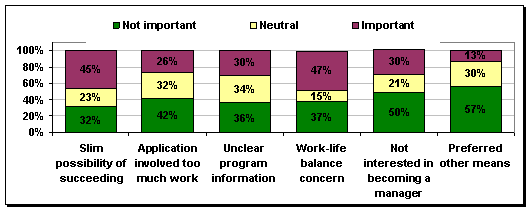
Note: Percentages may not add to 100% due to rounding.
[ Description ]
Forty-one percent (41%) of the respondents who did not apply to the Program in 2006 indicated that they would apply to the Program in the future. Twenty-seven percent (27%) of the respondents who applied in 2006 but were not selected indicated that they would apply again.
Of those respondents who planned to apply in the future, 44% identified themselves as being an Aboriginal person, 30% as a member of a visible minority group and 27% a person with a disability.
If the Program were offered again, 64 or 39% of the 165 LA respondents would apply, while 5 (29%) of the 19 respondents from other professions would. Of the 69 who would apply to the JLTP in the future, 36 or 53% were from regional offices, 21 or 30% at headquarters and 12 or 17% were in a Departmental Legal Services Unit.
Highlights:
- Most survey respondents were informed about the JLTP at the time of program announcements in 2006.
- Most respondents thought that the Program’s objectives and core elements were clear, but only 44% said the eligibility criteria were clear.
- Roughly 5% of the eligible population applied.
- Most of the applicants were from the LA category (95%).
- Only a small number (4) of Aboriginal employees applied.
- The two top reasons for not applying were “work-life balance consideration” and “slim possibility of succeeding”.
- If the Program were to be offered again, 41% of the respondents who did not apply before would apply and 29% of those who applied but did not succeed would apply again.
- If the Program were offered again, 44% of Aboriginal respondents, 30% of visible minority respondents and 27% of respondents with disabilities would apply. (The status information is based on self-identification.)
- If the Program were to be offered again, 39% of the LA respondents would apply while only 29% from other professional groups would.
- Among those who would apply in the future, 53% are from the regions.
4.3.2. The participants
Overall, candidates selected appear to be well suited for the Program. They were said to be a group of highly talented and motivated people who are quick to adapt and eager to contribute.
Sixty-eight (68) applicants—35 from the regions and 33 from the NCR—met the screening criteria. From the 68 candidates, 20 were selected to participate in the Pilot JLTP. Table 3 shows the breakdown of applicants and JLTP participants by professional group, EE group, location, gender and first official language.
An important JLTP objective is to increase the representation of EE designated groups in the Department of Justice management. The Program reached its target of filling 10 of the 20 seats with members of EE designated groups as shown in Table 3. It should be noted that there were only four Aboriginal applicants, two of whom were eliminated due to incomplete applications. HR managers raised some concern about this lack of Aboriginal participation. One HR manager suggested that the Program will need to find out why this was the case and speculated that more direct targeting and encouragement may be required to increase Aboriginal participation.
Table 3: Characteristics of JLTP Applicants and Participants
| Applications | Selected for Program | |||
|---|---|---|---|---|
| Number | Percentage | Number | Percentage | |
| LA | 94 | 94 | 19 | 95 |
| Other Professional Groups | 7 | 7 | 1 | 5 |
| Total | 101 | 100[4] | 20 | 100 |
| Applications | Selected for Program | |||
|---|---|---|---|---|
| Number | Percentage | Number | Percentage | |
| Member of Designated Groups | 37 | 36 | 10 | 50 |
| Visible Minorities | 26 | 26 | 8 | 35 |
| Persons with Disabilities | 7 | 7 | 1 | 5 |
| Aboriginal Peoples | 4 | 3 | 1 | 10 |
| Not member of Designated Groups | 64 | 64 | 10 | 50 |
| Total | 101 | 100[4] | 20 | 100 |
| Applications | Selected for Program | |||
|---|---|---|---|---|
| Number | Percentage | Number | Percentage | |
| NCR | 57 | 56 | 9 | 45 |
| Regional Office | 44 | 44 | 11 | 55 |
| Total | 101 | 100[4] | 20 | 100 |
| Applications | Selected for Program | |||
|---|---|---|---|---|
| Number | Percentage | Number | Percentage | |
| Female | 67 | 66 | 14 | 70 |
| Male | 34 | 34 | 6 | 30 |
| Total | 101 | 100[4] | 20 | 100 |
| Applications | Selected for Program | |||
|---|---|---|---|---|
| Number | Percentage | Number | Percentage | |
| French | 24 | 24 | 4 | 20 |
| English | 77 | 76 | 16 | 80 |
| Total | 101 | 100[4] | 20 | 100 |
It is important for the JLTP to know whether it has identified people for leadership development who might otherwise be missed. Some managers believed that the JLTP has helped people who face barriers. Other managers disagreed and were adamant that people with leadership potential are consistently being promoted in their area. Participants who are members of designated groups tend to believe that had it not been for the JLTP, they would not have been trained for management positions.
The survey was also used to explore this issue. People were asked to rate on a scale of 1 (Strongly agree) to 7 (Strongly disagree) their response to the statement: The JLTP has likely identified people with managerial potential who might not otherwise be identified. Close to 85% of the respondents answered to the question (i.e. 171 out of 202). One third of them disagreed with the statement; 18% agreed; another third neither agreed nor disagreed; and 16% said they don’t know. A respondent who disagreed with the statement offered the following comment: “…it seemed to me that the JLTP identified people with managerial potential who had already pre-identified themselves, rather than ‘who might not otherwise be identified’.”
4.3.3. The selection criteria
Criteria used to select participants were, overall, considered fair. It was important for most informants that the criteria be merit-based and that people not be excluded on the basis of language. However, several issues were brought up during the interviews.
There were questions and discussions about the Program’s intended beneficiaries. The fact that 19 out of the 20 participants are lawyers begs the following questions: is the JLTP geared mainly toward lawyers? If it is, why was this not communicated? If not, why did so few people in other professional categories apply? A senior HR manager conceded that this program was geared more toward lawyers. He/she explained that lawyers’ career path differs from that of any other professional group. LA-2s are already paid at the Executive level, which disqualifies them from most leadership development programs offered by the Public Service. Moreover, they need leadership programs that are tailored to a justice environment. Members of other professional groups can participate in programs designated for the Public Service in general.
A Senior Regional Director raised a question about the type of qualifications managers should focus on when recommending candidates, that is, leadership potential or (legal) technical knowledge. He/she was concerned that there was a tendency of seeking out and promoting people with superior technical competency, first and foremost. He/she suggested that the qualification rationale needs to be determined and then clearly communicated.
4.3.4. The selection process
The selection process was thought to be very thorough but onerous.
The Selection Committee was composed of representatives from the regions, designated groups, LA, HR, etc. Application requirements included a personal statement of the applicant, two endorsements from the manager, and four references, one from each of the applicant’s immediate supervisor, a colleague, a subordinate and a client.
Some managers complained about the amount of material they had to provide and admitted often not knowing how exactly to complete the forms, which they said were ambiguous and repetitive at times.
A more important concern among managers was that since the candidates were assessed solely on written materials, the process clearly favoured candidates whose managers/referees were more skilled in writing reference letters and had the time to do so. As a result, there could have been some biases in the final outcome of the selection. Some survey respondents raised the same concern.
Suggestions to streamline and simplify the process were offered, namely, reducing the requirements for certain written information but conducting short interviews and quick reference checks. However, there were differences in opinion about interviewing candidates. Some felt that it would be much too time consuming, while others believed that it is important to offer candidates an opportunity to elaborate on their application in front of the selection board. A senior manager suggested a radically different approach to selection: once a candidate is short listed through screening, he/she would be given an assignment; the performance appraisal would form the basis for admission or rejection.
Follow-up work after the selection of participant is very important and can be challenging. The JLTP team offered to have a one-on-one post-selection follow-up session with all unsuccessful applicants to give them feedback and offer them support by way of an on-line career development tool or a one-hour career counselling session, and to obtain their feedback on the selection process. According to the Program team, over 43 (53%) of the 81 unsuccessful applicants accepted the offer and the team was stretched to its limits to complete the task within a reasonable timeframe; 42 (52%) of them chose the on-line career development tool and 15 (19%) took the offer of a session with a career development advisor.
The survey shows that this effort was appreciated. Thirty-four unsuccessful applicants responded to our survey. Of those who attended the follow-up session, 39% found the session useful or very useful and 28% found it somewhat useful. The respondents who chose not to attend the session cited reasons such as scheduling conflicts and the perception that it would not be useful. Fourteen unsuccessful applicants followed up with a career development on-line tool or a one-hour session with a career development advisor; 20 did not. Among those who chose a tool, eight of them found it somewhat useful to very useful, but six did not find it useful. Reasons for not choosing any developmental tool included scheduling conflicts and a perceived lack of clarity regarding the purpose of such tools.
The follow-up measures after the selection need to be deliberate and planned in advance. Applicants who were unsuccessful this time around could succeed the next time. In other words, these very people who showed interest in developing their leadership skills will remain an important source of the Program’s future recruitment. It is very important that they be treated with respect and sensitivity.
4.3.5. Communications
The JLTP’s initial communication efforts were effective in reaching potential applicants, according to the survey. When the Program was announced, e-mails, feature articles in the Department’s internal Intranet newsletter, JustInfo, the JLTP Web site, and information sessions were used to inform potential applicants and their managers. Ninety-six percent (96%) of potential applicants who responded to our survey learned about the Program through one or more of these means when the Program was announced.
The survey indicates that 93% of respondents received information about the Program when it was first announced. About two thirds of them thought that the program objectives and the description of program core elements were clear, but less than half (44%) said that the eligibility criteria were clear.
According to most interviewees and survey respondents, more clarity in communications was needed. Less than half (41%) of people surveyed thought that the selection process was well explained, which is almost equal to the number of respondents who thought it was not. One respondent indicated that the justifications for accepting and rejecting an applicant were not clear and that this was a transparency issue. Apparently, quite a number of applicants had met the screening criteria but were ultimately unsuccessful. These applicants were not informed about the status of their application; instead, they were sent the same letter as those who did not meet the criteria. Applicants need to feel respected, encouraged and positive about their experience regardless of the outcome. The lack of precision and sensitivity has caused feelings of distrust and disappointment in some cases.
Frequent, comprehensive and clear communications are crucial but they can be resource-intensive. Potential applicants and their managers need to know exactly, from the very beginning of the process, what they are getting into. Fully aware of the importance of communication, the Program team agrees that more and better communications are needed, not only for the initial stages but the entire cycle of the Program. The team has learned much from its first experience; therefore, according to the JLTP team, great improvement can be made if more resources are available.
4.4. Program delivery
This section discusses issues of program activity planning, coordination and performance management. It also identifies and discusses some of the challenges that have been encountered. It should be noted that the JLTP is a two-year program. Since the time of data collection for this evaluation, more learning components have been implemented; therefore, some issues discussed in this section may already have been addressed by the JLTP team and/or management.
4.4.1. Planning and coordination
Virtually all informants were impressed by the way all the collective learning activities had been planned, coordinated and delivered. Informants acknowledged that the JLTP is a demanding undertaking for all involved, in the sense of labour intensity. First of all, as a pilot program it involves some exploration and learning by doing. Second, participants are scattered across the country, creating a heavy logistical task to deliver each collective learning event. The JLTP team has only three members: a Project Manager, a Human Resources Advisor and an Administrative Assistant. Their dedication and hard work were widely recognized and appreciated by the participants and managers at all levels.
The Program required that a learning road map be developed at the collective and individual levels. Ideally, collective learning and individual learning should proceed along parallel tracks. The collective learning road map was well developed and communicated to the participants, which gave them a sense of direction and facilitated planning. The development of the individual learning plan, however, was delayed. The Project Manager did not have time to discuss the individual learning plan with each and every participant. This left those participants and their managers wondering what was expected of them and what they were missing in terms of learning.
The work of the JLTP in supporting participants and requesting their on-going feedback is seen as being very effective and is highly appreciated. Continuous assessment for the purpose of improving program effectiveness is a distinctive feature of the JLTP management practice. Participant feedback was solicited for all learning sessions. Results were summarized and communicated back to participants without delay. Action plans were developed and followed through on all important issues identified. This builds morale among participants and creates a sense of a community, that is working together to achieve common goals.
4.4.2. Challenges
The bilingual set-up of the JLTP posed considerable challenges to content delivery for unilingual participants. Some participants whose first official language is French often struggled a great deal to follow what was being said. When the content was delivered in French, some participants who are more comfortable in English tuned out. Since 16 out of the 20 participants have English as their first official language, the sentiment was to use English as much as possible. Consequently, some participants felt alienated and at a disadvantage. As long as Francophone and Anglophone participants are placed in the same group, the Program should find a way to ensure that content is delivered in both official languages. The JLTP management is already considering the idea that a minimum level of second language competency should be imposed on future candidates.
The JLTP needs to have policy and/or guidelines for handling special needs of the participants. For example, there may be cases when several participants had to take extended leave due to personal circumstances. The JLTP management was perceived as being caught by surprise and unable to deal with those situations in a decisive manner. This created some uncertainty among participants. The Project Manager has acknowledged the problem and is seeking both immediate and long-term solutions to deal with such situations.
4.5. Management support and program visibility
This section discusses the issue of management support for the JLTP and the level of the Program’s visibility in the NCR and the regions.
4.5.1. Managers’ support
All middle and senior manager informants expressed their strong support for the JLTP. Most of them would want to stay involved and some of them saw themselves playing a bigger role in the Program in the future.
Many senior managers took part in delivering learning components themselves, e.g., giving speeches and presentations on various topics. Others acted as advisors or mentors to JLTP participants. All the middle manager informants were direct supervisors of program participants. They have all discussed learning plans with their JLTP participant(s), commented on their work, and had offered or were trying to find acting opportunities for their participants.
Support for Program participants required managers to go even further. When the participant was away, the manager often had to perform the participant’s job themselves or re-assign work to other employees. The consequences were sometimes a strain on their relationships with their employees or resentment in the work team.
Most of the participants interviewed felt supported by their managers and they could not stress enough the importance of that support. They thought the key to getting buy-in from managers is communication. Furthermore, the managers need to have a sense of ownership of the Program. They should be consulted at the program planning stage and be more directly involved in the delivery of the Program. Currently, the level of support a participant receives varies a great deal. On the whole, however, participant informants felt that support for the Program among managers has been increasing steadily since the Program began.
4.5.2. Program visibility
The Program has reasonably high visibility in national headquarters but not in most of the regions or among the Departmental Legal Services Unit. The Program achieved high visibility in the NCR due to conscientious efforts made by senior management to promote it. The JLTP has often been mentioned as a Department initiative in management meetings in the NCR, and presentations about the Program were made to other interested federal departments and agencies. As well, the Program was presented to a parliamentary committee as an example of best practices late in 2007.
The case is quite different in the regions, in that many people only vaguely knew that the Program existed. Two factors were thought to be mainly responsible for the Program’s low visibility in the regions. First, almost half of the Program participants (9 out of 20) are from the NCR. Second, all collective learning events, except the Business-Driven Action Learning Project, took place in Ottawa. The JLTP team indicated that considerations for cost and time efficiency are the main reasons for this situation.
4.6. Program effects
This section describes the key effects generated by the Program, both intended and unintended.
4.6.1. Intended Effects
All participants consider that the JLTP has been an extremely enlightening experience for them. Particularly valued facets are the Business-Driven Action Learning Project, exposure to senior management, and networking opportunities. The diversity of program participants is also considered to be an important strength of the Program. This diversity has enhanced participants’ learning and enriched their experience on a personal level. According to participants, the Program has given them a broader perspective, enabling them to think and act more strategically, e.g. seeing the connection between their work and higher level objectives.
For many participants, their experience with the Program has also caused them to reflect more deeply on themselves. Self-awareness has helped them discover new career options and manage their personal lives more effectively. Some participants felt that their participation in the Program has injected new energy in them and the people around them. Participants’ managers and colleagues are increasingly taking an interest in the JLTP and in what participants are learning from it.
Managers are satisfied with the progress they see participants making. Some managers even said that they are learning new things from the program participant(s). Both managers and participants showed a great deal of confidence in the Program. One manager went as far as to suggest that the JLTP curriculum content be made available on line for all departmental employees and a credentialing system be put in place to “certify” those who qualify to be a manager.
Support for the Program is strong across the Department of Justice. During this evaluation, all those encountered were not hesitant to express their genuine concerns and offer constructive criticisms—all for the purpose of perfecting and preserving the Program.
4.6.2. Unintended Effects
A few unintended program effects have been identified, all of which have been touched upon earlier in this report. Some of them, potentially, could be addressed through modifications to the Program; others should be dealt with at the departmental level. Those effects, if not handled carefully, could have implications for the sustainability of the Program.
The frequent and extended absence of participants from their jobs caused disruption and added burden for some managers. A small reduction to program activities may be possible but it will have only a minimal effect. Alternatively, participants could go on full-time training or be in a co-op arrangement, alternating between job and training every six months. These models would make planning a little easier but would have major financial implications.
Some participants experienced difficulties in the class because the course content was not always delivered in both official languages. It was perceived by some that participants with French as a first official language were at a disadvantage since when courses were delivered in one language only, it was more often in English than in French. It was suggested that this situation could be corrected by insisting that the learning content be delivered in both languages in class at all times. If this is not always practical, e.g. due to time constraints, a synopsis of the course content in French could be given before delving into detail in English. This would allow those Francophone participants with limited English to get the key points first which would make understanding the rest much easier. The same approach could be used if courses are presented only in French.
The Department’s recently appointed managers, who were excluded from the JLTP, feel left out, frustrated and worried. There is a sense of loss, i.e. they may have missed an opportunity to benefit from a leadership program tailored to their environment. Frustrated, they wonder where to go for such training. Most of them would not have access to other leadership training programs in the federal government because they are already managers but are not yet eligible for senior management training, such as the Accelerated Executive Development Program. On top of that, there is ultimately the worry that they could be easily passed in promotion by JLTP graduates, who have the advantage of having gone through formal leadership and management training.
- Date modified: