
Youth Justice Initiative Evaluation
Appendix A: Program Logic Model for Youth Justice Initiative Funding Components
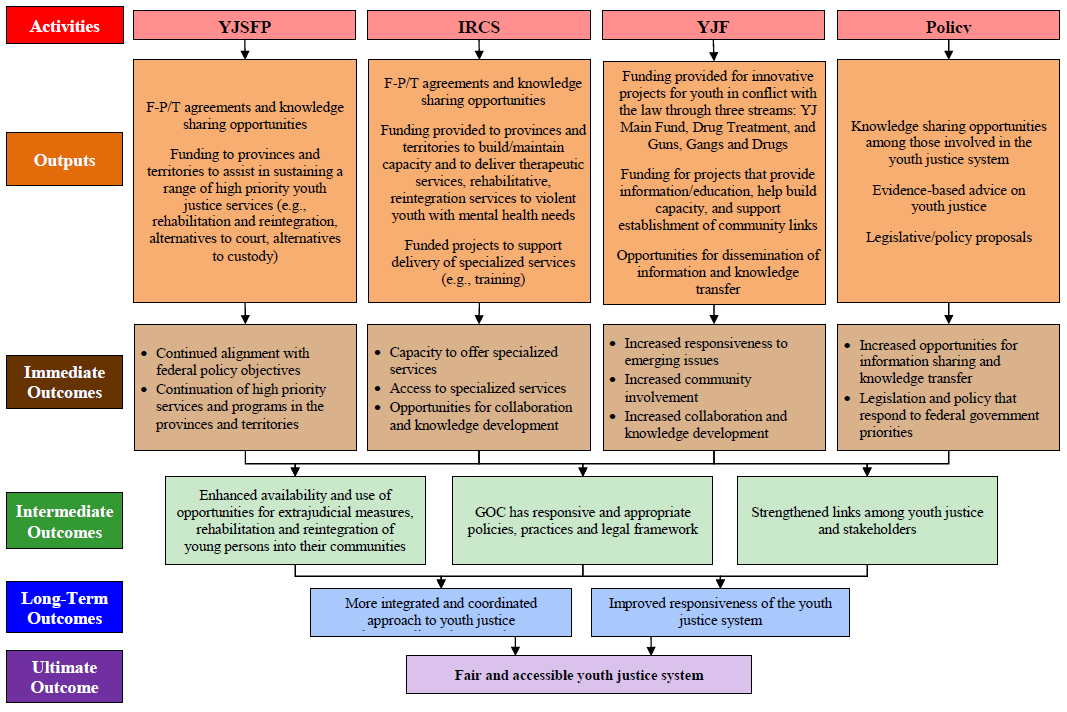
Logic Model - Text equivalent
The outputs of the Youth Justice Services Funding Program are:
- F-P/T agreements and knowledge sharing opportunities
- Funding to provinces and territories to assist in sustaining a range of high priority youth justice services (e.g., rehabilitation and reintegration, alternatives to court, alternatives to custody)
The outputs of the Youth Justice Services Funding Program contribute to the following immediate outcomes:
- Continued alignment with federal policy objectives
- Continuation of high priority services and programs in the provinces and territories
The immediate outcomes contribute to the following intermediate outcomes:
- Enhanced availability and use of opportunities for extrajudicial measures, rehabilitation and reintegration of young persons into their communities
- Government of Canada has responsive and appropriate polices, practices and legal framework
- Strengthened links among youth justice and stakeholders
The intermediate outcomes contribute to the following long-term outcomes:
- a more integrated and coordinated approach to youth justice
- improved responsiveness of the youth justice system
The long-term outcomes contribute to the following ultimate outcome:
A fair and accessible youth justice system
The outputs of the Intensive Rehabilitative Custody and Supervision Program are:
- F-P/T agreements and knowledge sharing opportunities
- Funding provided to provinces and territories to build/maintain capacity and to deliver therapeutic services, rehabilitative, reintegration services to violent youth with mental health needs
- Funded projects to support delivery of specialized services (e.g., training)
The outputs of the Intensive Rehabilitative Custody and Supervision Program contribute to the following immediate outcomes:
- Capacity to offer specialized services
- Access to specialized services
- Opportunities for collaboration and knowledge development
The immediate outcomes contribute to the following intermediate outcomes:
- Enhanced availability and use of opportunities for extrajudicial measures, rehabilitation and reintegration of young persons into their communities
- Government of Canada has responsive and appropriate polices, practices and legal framework
- Strengthened links among youth justice and stakeholders
The intermediate outcomes contribute to the following long-term outcomes:
- a more integrated and coordinated approach to youth justice
- improved responsiveness of the youth justice system
The long-term outcomes contribute to the following ultimate outcome:
A fair and accessible youth justice system
The outputs of the Youth Justice Fund are:
- Funding provided for innovative projects for youth in conflict with the law through three streams: YJ Main Fund, Drug Treatment, and Guns, Gangs and Drugs
- Funding for projects that provide information/education, help build capacity, and support establishment of community links
- Opportunities for dissemination of information and knowledge transfer
The outputs of the Youth Justice Fund contribute to the following immediate outcomes:
- Increased responsiveness to emerging issues
- Increased community involvement
- Increased collaboration and knowledge development
The immediate outcomes contribute to the following intermediate outcomes:
- Enhanced availability and use of opportunities for extrajudicial measures, rehabilitation and reintegration of young persons into their communities
- Government of Canada has responsive and appropriate polices, practices and legal framework
- Strengthened links among youth justice and stakeholders
The intermediate outcomes contribute to the following long-term outcomes:
- a more integrated and coordinated approach to youth justice
- improved responsiveness of the youth justice system
The long-term outcomes contribute to the following ultimate outcome:
A fair and accessible youth justice system
The outputs of policy activities are:
- Knowledge sharing opportunities among those involved in the youth justice system
- Evidence-based advice on youth justice
- Legislative/policy proposals
The outputs of policy activities are expected to result in the following immediate outcomes:
- Increased opportunities for information sharing and knowledge transfer
- Legislation and policy that respond to federal government priorities
The immediate outcomes contribute to the following intermediate outcomes:
- Enhanced availability and use of opportunities for extrajudicial measures, rehabilitation and reintegration of young persons into their communities
- Government of Canada has responsive and appropriate polices, practices and legal framework
- Strengthened links among youth justice and stakeholders
The intermediate outcomes contribute to the following long-term outcomes:
- a more integrated and coordinated approach to youth justice
- improved responsiveness of the youth justice system
The long-term outcomes contribute to the following ultimate outcome:
A fair and accessible youth justice system
- Date modified: