
Effectiveness - Funding to Support CJCs
The CJC Initiative has had early success. Its funding supported CJCs/IJCs that promoted the use of alternative measures and restorative justice and increased the capacity to offer integrated services in communities. In so doing, this has increased access to community supports that address the root causes of crime. Through the Ad Hoc Committee, the Initiative also undertook work toward a framework for a potential national CJC program.
Enabling the use of Alternative Measures and Restorative Justice
Available data indicates the CJCs’ potential to encourage the use of alternative measures and restorative justice.
Ability to enable use depends on the type of CJC model
The ability of the CJCs to enable the use of alternative measures and restorative justice varies by CJC model and its context.
- The ON CJCs include the Crown as a team member, which enables the CJC to have a more direct role in determining the use of alternative measures and restorative justice approaches.
- In BC, where the Crown is not part of the IJCs, the IJC counsel focus instead on providing the Crown with information to encourage the use of alternative measures and restorative justice. The IJC is credited with creating a justice response that is more attuned to the cultural needs of participants.
- For the MB CJCs, their role related to alternative measures and restorative justice is more limited. The CJC navigators assist community justice workers (non-CJC staff of MMF and MKO) who work in the court diversion programs by identifying relevant community resources that the participant could be referred to.
Early results
The ON CJCs track information on the use of alternative measures, including community-based dispositions, and restorative justice. Early results show that most cases involved the use of alternative measures. The Kenora CJC with its Indigenous target population uses restorative justice in all cases.
Figure 5: ON CJCs’ use of alternative measures (including community-based dispositions) or Indigenous -led restorative justice
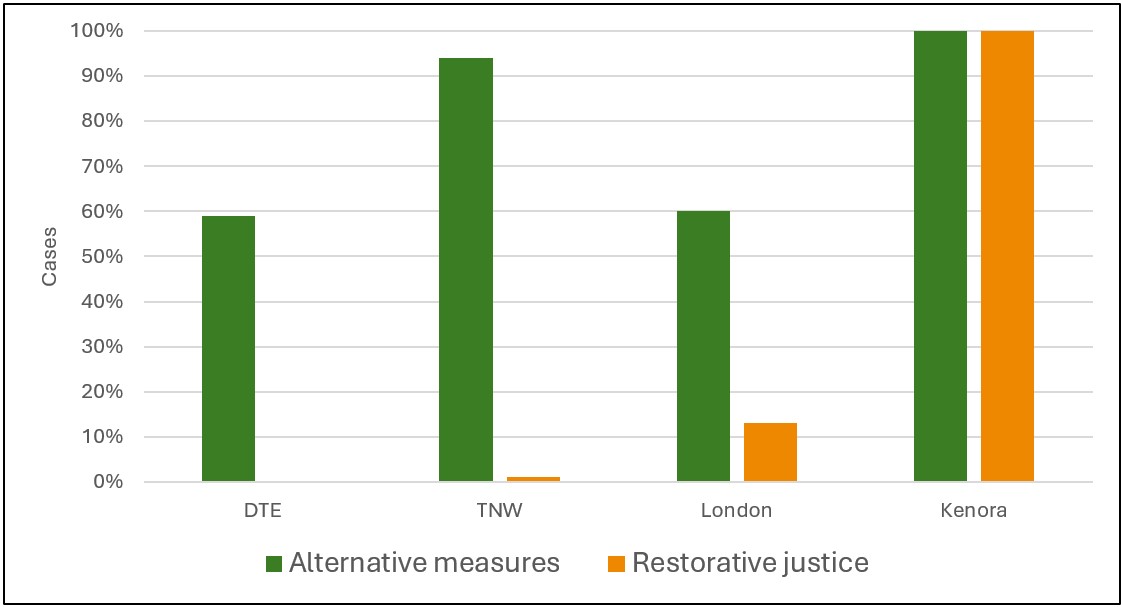
Figure 5: ON CJCs’ use of alternative measures (including community-based dispositions) or Indigenous -led restorative justice
| Community Justice Centre | Alternative measures | Restorative justice |
|---|---|---|
| Toronto Downtown East Justice Centre | 59% | 0% |
| Toronto Northwest Justice Centre | 94% | 1% |
| London | 60% | 13% |
| Kenora | 100% | 100% |
Increasing the Capacity to Offer Integrated Activities and Services
The Initiative increased funding recipient’s capacity to offer integrated activities and services to target population groups. Engagement sessions contributed to a better understanding of community needs and helped initiate the development of partnerships for potential CJCs.
Ad Hoc Committee
Through the IAID’s management and leadership, the Ad Hoc Committee, implemented as part of the CJC Initiative, emerged as a best practice. The Committee supported capacity development by serving as a forum to learn from other jurisdictions’ experiences, including challenges and promising practices. In addition to facilitating this peer learning, the Committee brought in experts, such as the US Center for Justice Innovation, to share insights on CJCs internationally. The Committee also fostered a vibrant a network, with members reaching out to each other outside of committee meetings for advice and in-person visits. Jurisdictions that were funded for the engagement process continued to attend even after their engagements were completed. These are all signs of the vibrancy of the community formed through the Initiative and the level of interest in CJCs.
Provincial and territorial community engagement sessions
The provincial and territorial community engagement sessions would not have occurred without the federal funding. These sessions allowed provinces and territories to introduce and discuss the concept of CJCs, learn more about community needs, and begin building relationships with various potential partnering organizations.
CJCs/IJCs
For the ON CJCs and BC IJCs, the federal CJC Initiative funding is a proportion of the total funding, with the provincial governments providing most of the funding. As a result, it is difficult to attribute increased capacity to provide integrated services specifically to the federal funding. However, key informants commented that the federal funding was critical to enabling them to expand the partnerships, enhance services, and include new sectors that might not typically see themselves as having a role in criminal justice interventions, such as housing. As one key informant put it, “We would not have been able to work as expansively, as dynamically, and as robustly as we ended up doing.”
The MB CJCs are entirely federally funded; therefore, without this funding, MKO and MMF would not have been able to create their navigation services. Efforts to build and expand partnerships are ongoing.
The networks of organizations are different for each CJC model. They range from complex networks where partnering organizations serve a variety of roles to less complex networks where partnering organizations are primary referral sources. Despite these differences, the evaluation found that all CJCs/IJCs offer integrated services, through connections to justice system actors and by either directly providing or referring to supports across social service sectors, such as health, education, employment, life skills, and housing.
Increasing Access to Community Social Supports to Address Root causes of Crime
By their design and as evidenced by available data, the CJCs increase access to community social supports by connecting participants with relevant supports to address root causes of crime.
Accessibility is reflected in both the number of participants served and the CJCs/IJCs ability to reach their target population.
Participants served or cases handled since receiving federal funding
The statistics below reflect that the CJCs/IJCs are at different stages in implementation (ranging from over three years since receiving federal funding to, in the case of the Red River Métis CJC, less than one year). Taken together, the CJCs/IJCs have provided supports to thousands of participants.
- Six of the 10 BC IJCs have assisted 1,007 participants with criminal and child protection matters.
- ON CJCs have handled approximately 6,000 cases.
- The MKO Justice Navigation Hub has assisted 666 participants (given some challenges in data tracking, this may slightly undercount the number of participants).
- The Red River Métis CJC has assisted 114 participants.
Note: Data is not available for four of the BC IJCs. ON CJCs collect information based on cases rather than participants.
CJCs/IJCs are reaching target populations
The BC IJCs and MB CJCs are reaching their target populations, as 100% of participants who are willing to self-identify indicate that they are Indigenous.
ON CJCs are also reaching their target populations.
- DTE – 98% identified housing, mental health, and/or substance use needs; 94% are older adults (over 24 years of age), 29% are women, and 16% are people with disabilities.
- TNW – 100% are youth (12 to 17 years of age), 60% are Black, and 21% are racialized people.
- London – 100% of participants are emerging adults (18 to 24 years of age).
- Kenora – 90% are Indigenous people, 70% are emerging adults, and 20% are youth.
Note: Since multiple responses were permitted, the statistics for ON CJCs may exceed 100%.
Evidence of increased access
The evaluation evidence shows that CJCs/IJCs are increasing access to community social supports that address root causes of crime. This is reflected in the wide-ranging supports that participants are offered directly or by referral. These supports address issues related to poverty, trauma, and racism (the key factors identified in the literature that are related to high risks for criminality).
While not all CJCs/IJCs are tracking the extent to which participants are being connected to specific types of services, available information shows that many participants receive relevant referrals.
Reflecting that these population groups are often underserved, the DTE found that 88% of its active participants came without existing connections to programming, supports, or services. The DTE staff made connections to relevant services for most participants who had needs in the following areas (percentages represent participants with that need who were connected to supports):
- Mental health services – 84% of participants
- Family and basic need supports – 81% of participants
- Housing services – 75% of participants
- Addictions/substance use supports – 69% of participants
- Primary care supports – 61% of participants
Other CJCs also made connections to services for many of their clients.
- TNW: 100% of youth participants were connected to mental health supports
- Kenora CJC: in 95% of cases, the participant received referrals to supports
- London CJC: 100% of participants received services/supports related to mental health, addictions, housing, employment, and/or education
- Red River Métis CJC: 82% of participants received referrals to supports
- MKO Justice Navigation Hub: 27% of participants received referrals to supports
The BCFNJC reported that between January 2024 and March 2025, the IJCs provided referrals to over 1,000 individuals.
Possible impact on recidivism and level of criminal involvement
Although data is limited, there is evidence that by connecting participants to wrap-around community social supports to address root causes of crime, the level of criminal involvement and recidivism rates are lowered among participants.
Early indications for the DTE shows that participants are less likely to re-offend than before, using a pre/post analysis (e.g., 77% of active clients demonstrated desistance from crime). Similarly, TNW results for high-risk 17-year-old participants show a lower recidivism rate (25%) than the provincial average for high-risk youth (61%).
Developing a Framework for a Potential National CJC Program
The Initiative – through the Ad Hoc Committee – has supported progress toward developing a framework for a potential national program.
Role of Ad Hoc Committee and support for current approach
Starting in 2024, the Ad Hoc Committee devoted several meetings to discussions on the development of a framework for a potential national CJC program. Key informants thought the discussions about a potential framework for a national program were very collaborative, providing space for thoughtful exploration of a shared philosophy for CJCs that could inform a potential national framework.
Challenges
Developing a national framework is challenging when the pilot CJCs are at different stages of development and using different approaches. Outcomes and results of the pilot CJCs are not necessarily available yet, and it is difficult to attribute results to the different approaches in ways to support future planning. While the flexibility of the program has major benefits as discussed earlier, that same flexibility complicates strategic planning and analyzing outcomes.
- Date modified: