
Expanding Horizons: Rethinking Access to Justice in Canada
Appendix B (continued)
From the Rule of Law to Philia (continued)
Preventive Law
As we can well imagine, the border line between self-regulation and preventive law is somewhat blurred. Montreal's centre for preventive law was created as a result of our symposium entitled Le droit en question, under the auspices of the "Chambre des notaires du Québec". The centre is responsible, inter alia, for providing a free legal information service. This is a step in the right direction. We should note in passing that the notary, member of a profession unknown in British North America, is a preventive law officer. We invited Marc Galantier, an American specialist in preventive law, to attend our symposium. He left having been convinced that the profession of notary would be very useful in the United States. A proper contract in the presence of a notary who has done his job properly considerably reduces the risk of litigation. But rather than strengthening this venerable profession in the only region of North America where it still exists, we appear to be trying to replace it by the profession of lawyer, which is gradually ceasing to be a liberal arts profession. The typical lawyer is now either a businessman or a legal technician.
Unfortunately, the centre for preventive law has refused to apply, even on an experimental basis, an idea that I borrowed from an obscure member of Parliament from the late 19th century. He had achieved passage of a "conciliation" law, allowing leading citizens in remote regions to act as judges. You may recall that, at the time, two farmers from the Gaspé region who were involved in a dispute over a fence had to go to Kamouraska to have their case heard.
The Chicoyne Act resolved the problem of access to justice caused by geographic remoteness. Today the remoteness is financial or cultural. To reduce this remoteness, perhaps we should consider simpler, less professional, and more efficient measures than, for example, mediation in separation cases. For this purpose, I proposed that the centre for preventive law provide basic legal training to a few volunteers among the leading citizens of the village or community, who would then be authorized to provide basic legal services within their community. In the past, I was interested in alternative medicines. In my opinion, there was also a place for alternative forms of justice, which had already spontaneously begun to appear. I was told at the time that, in Ontario in particular, a number of retired policemen were practising alternative forms of justice.
Preventive law could also play a role in the administrative sector. A few years ago, I was invited to speak at a conference of the Appeal Board of the CSST (workplace health and safety commission [TR]). I knew that an alarming number of files were pending and I could not recommend increasing the number of board members to resolve the problem, before examining the situation carefully. I was given no explanation of any of the various documents made available to me. Everything became clear, however, when a senior staff member, more forthright than most, explained that the initial interview with workers injured on the job was conducted by staff who had received no special training but were asked to help the applicant complete an anonymous form. In other words, the workers came up against a brick wall when they arrived at the CSST. This was the source of the workers' sense of unfairness. The best-trained employees within the organization, for the most part doctors and lawyers, were clustered at the top of the hierarchy. From this, a cynical observer would have concluded that the institution had been organized so that the maximum possible number of disputes rose to the top to occupy the greatest possible number of senior staff. My informant was convinced that a little more hospitality, flexibility and judgment at the reception level would have eliminated most of the complaints, even before they materialized.
Before attempting to prevent disputes, as in the case of the CSST, we must consider whether it is possible to create or re-create alternative solutions.
Alternatives
As you may have noted, I distinguish between preventive law and what are referred to as alternatives. I include in the latter mediation, arbitration and what is generally referred to in the United States as informal justice. On this point, I will simply cite the conclusions of an American expert in the matter.
After pointing out all its contradictions, Richard Abel praises informal justice: "[...] it expresses values that arouse deserved support: harmony rather than conflict; mechanisms accessible to the many, rather than privileges offered to the few. It operates swiftly and inexpensively; it allows all citizens to participate in decision-making, rather than restricting authority to professionals; it is convivial rather than esoteric; its purpose is to restore all the authenticity of justice to those who would otherwise have to make do with purely formal justice."
[TR]
The Court
The court and its judges sit at the top of the pyramid of justice. Concerning the judges, we are merely the latest of many to recommend the greatest possible reduction of the importance of political criteria in the appointment process.
Perhaps we should also ask that judges, as they become increasingly competent, be given increasing time to devote to exemplary cases. Then their judgments could form the base of the system and become a source of inspiration for preventive law specialists.
Only in this way can we hope to reverse the current trend, in which the court is perceived as the base of the pyramid, when it should be the apex.
In order to make our courts more accessible, both psychologically and morally, we might draw a few lessons from the Athenian example. Access to justice was not a problem for citizens when they themselves were at the heart of the legal establishment, since they acted as their own lawyers and occasionally had to serve as judges. I recommend that all you distinguished legal scholars, who have listened to me so patiently, read Aristophanes' play Wasps very carefully. If a genuine effort were made to make things easier for citizens who wished to conduct their own defence, the problem of education might be solved at the same time. Indeed, Athenians learned to read, write and speak in public, in part because they needed all those skills to enjoy all the advantages of citizenship.
Locke or Aristotle?
My proposed changes could only be achieved in an appropriate philosophical climate. Can this climate be the liberalism referred to by Mr. Kingwell at the start of his discussion paper? When I wrote Le Procès du Droit [the law on trial - TR] , I was not sure. After reading English-speaking Justice by George Grant, I am now convinced not only that the remedy is not to be found in liberalism, but also that the ideas of Hobbes and Locke, made worse by John Rawls, are the distant but omnipresent cause of the social evils behind the inflation in demand for legal services.
A good society is based on order, justice and a friendship peculiar to communities, referred to by Aristotle as philia.
When justice, in the form of the legal establishment, takes up too much space and philia too little, the situation becomes unhealthy and conducive to litigation. What can we do to restore to philia its lost importance?
In order to answer the question, we must begin by making a perilous detour through philosophy.
First, we must be prepared to trust in human nature, which, according to Aristotle, is fundamentally good. For most of us, this implies asking difficult questions about the modern ideas by which we have been shaped. According to Aristotle, man is a zoon politikon, literally, an animal who dwells in the city, a sociable animal, which leads to the following interpretation: if no impediment is placed to the expression of his nature, he will spontaneously show philia toward his fellow men.
This concept of man served as a basis for a concept of justice that was central to western tradition for over a thousand years. With this concept, which led directly to Roman law, the idea of justice was subordinate to the idea of good, and human nature was subordinate to God.
But, just as there was a Copernican revolution in cosmology and philosophy, so too was there one in law, introduced by two British philosophers: Hobbes and Locke. Doubtless, too many crimes had been committed in the name of divine justice. A more down-to-earth approach appeared more prudent. As a result, since Hobbes' time, we have believed that brother will turn on brother and, from Locke through to John Rawls, that justice revolves no longer around God, but around the interests of the individual, who is primarily concerned with his survival, i.e., his security. In English-speaking Justice, George Grant clearly demonstrates that, for both Rawls and Locke, justice is "fairness in the self-interest"
.
How should we translate the word fairness into French? Since it relates to respect for the terms of a social contract, which are comparable to the rules of a game, we can use the French word honnêteté. The good player is one who does not cheat, who is fair. But his fairness is in defence of his self-interest! This is John Rawls' definition and, although he appears as a successor to Locke and Kant, he stands, first and foremost, within the ranks of the British analytical philosophers. Any reference to human nature, or to a transcendental concept of justice, has been removed. We are left only with the observation, made earlier by John Locke, the founder of liberalism, that the first thing that a reasonable living being seeks to ensure is his own survival. For the author of The Theory of Justice, the fundamental issue is to define the conditions under which each person can best ensure his survival in a social context in which everyone has the same motives.
More fundamental than fairness, this concept of justice stresses the individual and his security. This is one paradox of liberalism, since it is based on the opposite of freedom. Extending our analysis of society's tendency to go to court a little further, we discover that the need for security is almost always an issue, either directly or indirectly, and that it becomes exaggerated as man, moving further away from God, becomes the absolute. Since he no longer finds security in God, man has deified security. In the meantime, the fear of the other, i.e., the other sex, the other generation, or the other ethnic group, becomes stronger. Sartre's aphorism borrowed from Hobbes, "Hell is other people"
, was prophetic. If society's tendency to go to the doctor is caused by fear of germs, its tendency to go to court is caused by fear of others …(and, often, of their germs). The ultimate cause of both phenomena is an excessive need for security. Individually and collectively, we cannot escape the domination of medicine unless we accept our mortality and bow before the evidence: the value of each human life is not unlimited. We can only escape the domination of the legal establishment in the same way.
In order for philia to be restored in those places from which it has disappeared, first and foremost, a philosophical climate must reign in which security ceases to be the absolute that it now is. Such a climate exists within the family of my neighbours, who have 12 children. A short time after the bus accident in Nicolet, the father was pulled over by a policeman, because only three of the five children in the back of his Chrysler were wearing seat belts. You can imagine the father's reply: "What do you expect, officer, there are only three belts".
The police officer warned him that, next time, he would impose a severe fine rather than letting him off with a warning. At this rate, my neighbours will soon only be able to travel by train or bus!
Commenting on the panic aroused by the accident, my neighbours expressed wisdom worthy of Aristotle. "It is as though, they told me, people have forgotten that they are mortal and so, when they are reminded of this fact by an uncommon accident, they try to banish the spectre of death by calling for utopian security measures"
. Just as they were telling me this at their sugar shack, I saw a small patch of colour racing down the hill on the other side of the stream. It was their youngest boy, Robert, just three years old, who had come to find his parents on his own, over half a kilometre from the house. "He will have wonderful memories of this"
, said his parents, rather than worrying about the accident that might have befallen him.
Once this philosophical climate has been re-established, a range of simple measures to ease the legal burden will become possible. The simple solution is to practise social Hippocratism. Nature cures itself, taught Hippocrates. We must only strive not to harm it. Primum non nocere. The same holds true for man's social nature. Remove the obstacles and philia will reappear.
We have a civil liberties union and innumerable agencies to watch over the security of our citizens. The time has come to watch over philia, by encouraging the creation of citizens' groups responsible for reducing our fear of others and its corrosive effects on the community, for example. How? Perhaps by identifying acts and regulations that are harmful to community life and recommending their repeal or amendment.
With this in mind, we, along with some friends from Vancouver who work with the disabled, and with the support of the McConnel Foundation, have launched the "Philia" project to recreate the social conditions for philia.
Justice Pyramid
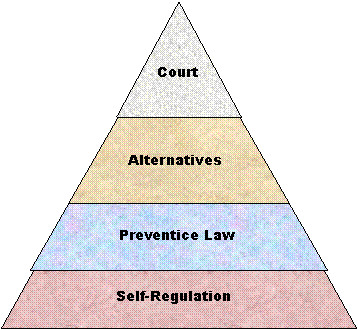
This table, as we said, suggests the following general principle: given the inability of individual citizens to prevent a dispute from occurring, that, insofar as possible, it be resolved spontaneously by society; that in situations where, despite all attempts to avoid it, the risk of a dispute is high, the services of a preventive law specialist be used, i.e., either a notary who, as a public official, is in reality a judge before the fact, or a lawyer who assumes a role similar to that of a notary.
If the dispute occurs despite all these precautions, the first step must be to try and resolve it through procedures that are less formal and severe than court proceedings, yet still guarantee that justice will be fully done. These proceedings are, in order of application, conciliation, mediation and arbitration. Private settlements are the procedure of last resort because, of all the procedures, it has the greatest potential for the use of coercion.
Under these conditions, only disputes that absolutely could not be settled by other means, and that would, insofar as possible, have an exemplary value, would go to court.
Preventing disputes through more ethical behaviour and improving the quality of the social fabric may appear to be a nebulous and remote solution. However, we would simply repeat that, without such change, all the solutions that appear, at first glance, to be more detailed and concrete will quickly lose their promise.
This does not mean that we should not even try to find solutions. What it does mean is that the effort we must expend will be even more productive if it is accompanied by a more radical ethical renewal.
- Date modified: