
Review of Provincial and Territorial Domestic Violence Legislation and Implementation Strategies
Figure 1: Processes and Teamwork Requirements in Emergency Applications
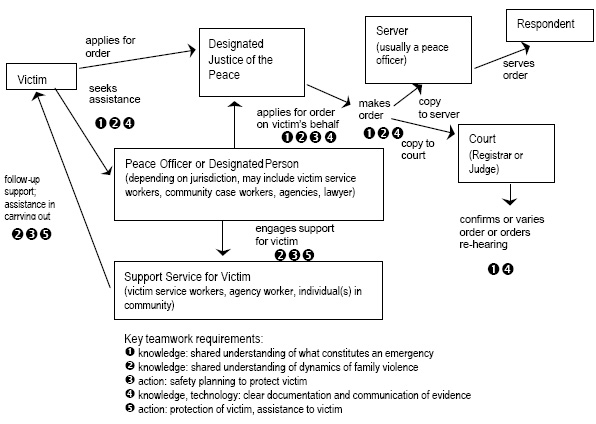
The following organizational chart shows the operation that could lead to an order application in an emergency response. Each of the players involved are represented in a rectangle and interrelated by arrows. In addition, each process is assigned one or more numbers (from 1 to 5) representing key teamwork requirements. Such requirements involve the following:
- Knowledge surrounding shared understanding of what constitutes an emergency;
- Knowledge surrounding shared understanding of dynamics of family violence;
- Safety planning to protect victim;
- Knowledge and technology surrounding the documentation and communication of evidence
- Action to be taken for the protection of the victim and assistance to the victim.
First, the victim is given a choice between
- Applying for an order directly with the designated justice of the peace;
- Seeking assistance from a peace officer (involving key requirements1, 2 and 4).
The peace officer may then respond to the request for assistance in two ways:
- Apply to the justice of the peace for an order on the victim's behalf (involving key requirements 1, 2, 3 and 4).
- Provide assistance (stakeholders, social workers or individuals within the community) directly to the victim (involving key requirements 2, 3 and 5). Such stakeholders will provide follow-up support and the necessary assistance to the victim (which involves key requirements 2, 3 and 5).
The designated justice of the peace will then receive the application and make an order (involving key requirements 1, 2 and 4) in two copies:
- One for the respondent (through the explanations of a peace officer)
- The other for the court (registrar or judge)
Finally, the court may decide to confirm/vary the order or order a re-hearing (involving key requirements 1 and 4).
- Date modified: