
Luckiest Man Alive: Hong Nguyen, ambassador for authenticity

Hong Nguyen was born during a war and grew up in poverty, yet he considers himself extremely lucky.
Hong is a tax law team leader in British Columbia, having worked many positions at the Department of Justice. His journey to and through the department has helped him discover many things, including how fortunate he is to live in a country of strong laws, how helping Canadians understand tax law can strengthen the bedrock of our democracy, and how the one thing as important to him as his family was being true to himself.
A new home
Despite only being five years old at the time, Hong still remembers his all-time favourite meal: the one he received from Air Canada when he first arrived in Montreal, following an arduous journey across the ocean on the back of an oil tanker to escape the war in Vietnam. The last leg on a plane felt like crossing a finish line with the meal being a welcome from his new home. “I am still trying to replicate that meal – it is a little like my Rosebud”, Hong explained, referencing the MacGuffin in the movie Citizen Kane.
In the fog of war, as people were escaping Vietnam, parents who were unable to get away would ask others to take their children and raise them in safety. This was the case with Hong’s family as three of his four brothers were adopted by his parents during their migration to Canada. Growing up as part of a large family in Montreal, Hong experienced poverty. His father, once a judge and senator in Vietnam, worked long hours as a busboy in Canada to make ends meet. His mother worked as well, leaving the younger children in the care of their brothers. There wasn’t a lot of room in the house and Hong sometimes found himself sleeping in the hall.
But he was happy.
Hong considered how lucky he was to have made it to Canada and thankful to have escaped war. Mostly though, as he was surrounded by a supportive family, he and his brothers found the joy in the everyday in Montreal with Hong having the freedom to discover himself – high-energy, exuberant, and a little bit geeky.
Hong loved movies, particularly horror movies, and so he explored a career in film production, travelling to study in New York City. It was there however, that a real-life horror made him reassess his path: the terrorist attack of September 11, 2001. Realizing that the world was getting more dangerous, Hong appreciated how Canada was built on a basis of equality and law.
“When September 11th happened, I, like a lot of people, felt helpless.” explained Hong. “But I had an epiphany that our laws were going to be fundamental to our future and what we were going to become.”
After the terrorist attacks and the global panic that followed, Hong knew that, to protect that future, it was important for his fellow citizens to understand and appreciate how fortunate they were. He wanted them to see justice in action.
He realized then it was through a career in law that he would be able to do this.
Death and taxes
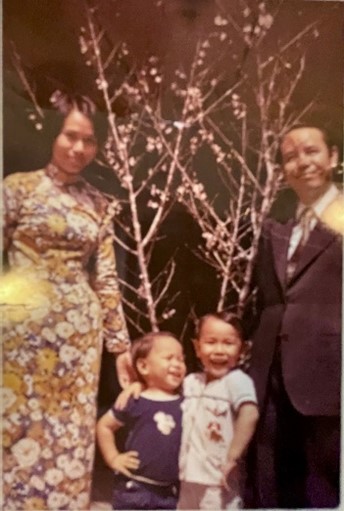
A family photo taken in Vietnam before Hong and his family immigrated to Canada to escape the war.

Hong’s Father, once a senator, judge, and counsel in Vietnam, worked long hours as a busboy in Canada to make ends meet.
Hong was having trouble reconciling his energetic personality with what he felt would be expected of him as a legal professional. He had a career goal, but he was also worried that he was going to have to give up part of himself to achieve it. When he looked at the legal system in Canada, he saw precious few immigrant film geeks looking back at him.
He recalled being interviewed by a judge for a clerk position where he tried to put his best foot forward. In the interview, as they discussed a hypothetical case surrounding medical assistance in dying, the judge asked Hong if he had seen Clint Eastwood’s film “Million Dollar Baby”, which touched on the topic. Hong had not. He decided to be honest about it but had to note his love for other Clint Eastwood films, especially spaghetti westerns. Leaving the interview, he felt he had blown it, that he should have been quieter, more professional. He wore his enthusiasm on his sleeve and worried that it wouldn’t work out.
“Turns out the judge was a huge fan of spaghetti westerns! I was in my own head and learned that you must be honest with yourself and others,” said Hong. “I had to be me.”
He got the job and two years into his work as a clerk, Hong had an epiphany. While he had originally been driven to be a human rights lawyer, as he studied and was exposed to cases, he began to gravitate towards, of all things, tax law.
“About 50% of all litigation against the government is in taxes and the volume is absurd, thousands of cases a year, many of which are self-represented,” he said. “I feel there is an opportunity to demonstrate justice in action in front of the very people who are regularly going before the court, many who are there for the first time.”
Hong worked for two years as a court clerk, before benefiting from a program that can transition clerks into positions in the federal government. He and his partner had a young child and they decided to stay in Ottawa to be closer to her work and family.
Joining Justice
As a father, Hong desperately wanted to be there for his kid in a way that his parents, concentrated on surviving war and poverty, just couldn’t be for him. When Hong Nguyen walked through the office of the Department of Justice in 2007, shaking hands with his new colleagues, he couldn’t help but be struck by the smiling family photos looking back at him on seemingly every desk.
“As a tax lawyer, I meet a lot of people and partners to law firms and when I ask them about their careers, the first thing they note is the sacrifices that they made,” said Hong. “You must decide what's deeply important to you because our profession is so complicated and, looking at the photos on the desks, I saw people who valued family life like I did.”
Hong’s journey through the department was one of trying new things, of finding opportunities to lend his creativity, his energy, and his expertise. He began working in the Legal Services Unit for the Canada Revenue Agency, providing legal advice on all matters related to that agency – much of which concerned sales tax.
When a General Counsel retired, Hong started getting even higher-profile files. At first, he wasn’t sure he could handle it. “I got kind of lucky and into this area of tax that's a little bit niche,” explained Hong. “I landed like all these big files, like GST, but I felt like I had support from my team and manager.”
Hong’s tips:
- Be true to yourself: “I think it is important just to feel settled in yourself, to feel like you are who and where you are meant to be. Don’t worry too much about external factors and conditions that can hinder your ability to act.”
- Make time for what’s important: “Innovation, efficiency and productivity are also words to describe how to make time for what can truly inspire us: family, relationships, and our energy for creating.”
- Take on new challenges: “Don’t be afraid of changes and challenges. As someone who has experienced some fundamental changes in their life, from war to moving across Canada, change often opens us up to unknown parts of ourselves.”
Hong enjoyed it so much, he worked there for twelve years. As much as he liked it, the work itself wasn’t his favourite thing. “My favourite thing was starting early in the morning so that by the time my daughter came home from school, I could run and pick her up at the bus and we would go to the park – “I always thought “this is a dream,” said Hong.
But as his daughter got older, Hong’s priorities began to shift, and he started to look for new opportunities.
He found them in spades.
Truth in advertising
First, he joined the training group to help new law professionals joining the department. Then he worked in an Assistant Deputy Minister's Office specializing in taxation, lending his growing knowledge and expertise to the decision-makers of the department. He eventually even joined the Deputy Minister’s Office, the most senior group in the department, to help manage the organization’s highest profile issues.
In the middle, he took a step outside of the department into the larger government world, joining the National Judicial Institute where, as the Strategic Advisor to the Chief Judicial Officer and Chief Executive Officer, he helped judges during the pandemic navigate the new digital tools they needed for their jobs. “We were the first to teach a room of judges how to use Zoom,” he said with a laugh. He loved working with the judges, but also noticed that there weren’t many that looked like him. Passionate about representation, Hong aspires to one day be a judge, and offer a role model in the judiciary for people like him.
But, until then, Hong is a fixture at the Department of Justice, seemingly knowing almost everyone. He shares his energy and enthusiasm constantly, coaching staff, leading charitable campaigns, and contributing wherever he can. He works in B.C. but comes to Ottawa regularly. Hong even goes to schools and colleges to recruit new staff. He says, above all, it’s his message of feeling authentic and comfortable at work that really resonates with the next generation.
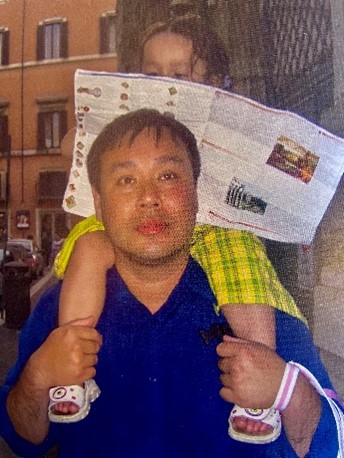
Hong and his child in Rome, Italy. Still today they continue to help him navigate the world and value the importance of family.
“I don't think I would have survived in, let's say, a firm where I had to take people out and play golf with them,” said Hong. “I only play golf with people I want to.” Hong sees people work very hard every day around him and feels that, if they couldn’t bring their authentic self to work, they would struggle.
It is that message of being true to yourself that has defined Hong’s career, along with an appreciation of all he has been given by Canada: “I'm a child of war, which fundamentally changes a little bit the way you see the world - I wanted the world to be better and I think I got very lucky.”
- Date modified: