
3. Victim Statements in Conditional Release – Prevalence and Predictors
The Canadian Victims Bill of Rights (CVBR 2015) enshrines in law victims’ statutory rights to information, protection, participation, and restitution. Two key mechanisms enable victims to participate in decisions that affect them:
- victim impact statements,Footnote 33 submitted for consideration at sentencing; and
- victim statements, submitted to the Correctional Service of Canada (CSC) and/or the Parole Board of Canada (PBC or the Board) for consideration during conditional release decision-making after sentencing.
Victim impact statements used during sentencing are shared with the CSC and placed on an offender’s file, which is then shared with the PBC. Once a victim impact statement is on file, it will be considered for all subsequent decisions during an offender’s sentence. Victims may choose to write a statement to do any or all the following: describe the impact that the crime continues to have on their life, express safety concerns, and request that special conditions be imposed for their protection should the offender be released.
Victim statements in conditional release serve dual functions: they are expressive (communicating ongoing harm and safety concerns) and instrumental (provide information that can inform the decision). Under the Corrections and Conditional Release Act (CCRA, s. 101(a)), information from victims, including victim impact statements and victim statements provided directly to the Board, is among the materials Board members consider in their decision-making. As outlined in PBC policy, Board members use these statements to assess the following (PBC 2025):
- the nature and extent of the harm and its continuing impact;
- the risk of re-offending and any threatening behaviour toward the victim;
- the offender’s understanding of the offence’s impact;
- whether special conditions are reasonable and necessary to protect the victim; and
- whether the offender’s release plan could place them near the victim.
Results from surveys of victims registered with the PBC have suggested that victims consider both the expressive and instrumental functions of victim statements important. Victims who responded in a recent survey of federal victim services in corrections and conditional release reported that having their victim statement referred to at a PBC hearing or in a written PBC decision was an important aspect of their satisfaction. Alternatively, not feeling their statement was given sufficient weight or considered by the Board resulted in reduced satisfaction (Clark 2023). This is consistent with other studies that report that victims find it important that the harm they experienced be acknowledged by decision-makers (Roberts and Erez 2004).
How often do victims submit statements for sentencing or conditional release decision-making?
Despite the long-standing use of victim statements in conditional release (PBC began accepting victim statements over 40 years ago; PBC 2017), little is known about their use because little research has been done. Foundational questions, such as how often victim statements are used and what impacts their use, have not been well studied. These gaps are not unique to Canada or to conditional release. Research on victim impact statements used in courts in Canada and internationally has also been limited. Because of different legislative and policy frameworks across jurisdictions, direct comparisons of prevalence rates should be avoided. However, the following consistent patterns emerge from the available research on victim impact statements:
- Low overall prevalence. Victim impact statements are generally uncommon, with only a minority of victims submitting statements (Leverick et al. 2007; Roberts and Manikis 2013). In Canada, available data suggests that about 5 to 9 percent of cases include a victim impact statement (Canadian Centre for Justice Statistics n.d.; Dufour, Ternes, and Stinson 2023).
- Higher prevalence in serious offences. Victim impact statements are common among more serious crimes, such as offences involving death (Dufour et al. 2023; Leverick et al. 2007), contact sexual offences (Dufour et al. 2023), and violent offences (Erez et al. 1997; Erez and Tontodonato 1990). While this pattern appears across most studies, some research has found no differences by crime type (Mastrocinque 2014).
- Relationships with victim demographics are unclear. Findings are mixed regarding whether submission rates vary by victim demographics, such as gender, age, racial group, or ethnicity (Erez and Tontodonato 1990; Lens et al. 2013; 2015; Leverick et al. 2007; Mastrocinque 2014).
Only two studies examined the prevalence of victim statements in parole decisions. Both reported similar prevalence rates, with victim statements present in about 12 to 17 percent of parole decisions across two US states (Caplan 2010; Richardson 2012). However, the study that examined variation by crime type found no significant differences in the prevalence of victim statements across offence categories (Caplan 2010). This contrasts with the pattern of results found with victim impact statements.
The current study
Considering these gaps in knowledge, PBC examined:
- the prevalence of victim statements in conditional release decision-making in Canada; along with
- trends over time; and
- how the relationship between crime severity and offender demographics affected the likelihood that a victim statement was submitted.
While previous research has investigated the impact of victim demographics, offender characteristics have not been studied. The prevalence of victim impact statements among conditional release decisions was also examined.
A sample of 30,197 PBC reviews for unique individuals serving a federal sentence who had a completed PBC review between the 2017–2018 to 2022–2023 fiscal years was included. The study considered the proportion of reviews with at least one victim impact statement or one victim statement. The prevalence of victim impact statements might be an underestimate due to missing victim impact statements in the files sent to the Board. If a victim submitted their victim impact statement as a victim statement it was counted as both a victim impact statement and a victim statement.
Crime severity was assessed using crime type and sentence type. Crime type was divided into the following categories:
- caused death (includes attempts to cause death and motor vehicle charges such as impaired driving causing death);
- sexual;
- other violent (includes other violent offences other than those that cause death); and
- non-violent.
Sentence type was divided into determinate sentences (fixed end date) and indeterminate sentences (no fixed end date).
Results
Prevalence
The prevalence of completed reviews between 2018–2019 and 2022–2023 with a victim statement on file was 8.6 percent. The low proportion of victims who submit statements is consistent with the low participation of victims in other areas of the criminal justice system. For example, data from the 2019 General Social Survey on Victimization (Canadians’ Safety) found that a little over a third of physical assaults and only 6 percent of sexual assaults were reported to police (Cotter 2021).
Because PBC reviews involve individuals serving federal sentences, which generally reflect more serious offences, higher prevalence rates were expected. Consistent with this, 29.8 percent of reviews included a victim impact statement, substantially higher than the 5 to 9 percent typically reported for sentencing decisions in courts. Among the reviews with a victim impact statement on file from sentencing, only about one-fifth (19.2 percent) also had a victim statement on file. This suggests that many victims who submitted a victim impact statement for consideration at sentencing did not submit a new victim statement for conditional release decision-making. These results do not provide information about why victims did not submit a victim statement. Results from a survey of victims registered with the PBC showed that a little more than a quarter of registered victims who did not submit a statement were not aware they could (28.6 percent). Others were aware they could submit a statement but chose not to (71.5 percent).
Reasons for not submitting a statement included a belief that it would not impact the decision, not wanting the statement to be shared with the offender, and the emotional difficulty of writing a statement (Clark 2023). The survey results were only of victims who were registered with the PBC and might underestimate the number of victims who are aware that they can submit victim statements.
When examining trends over time (see Figure 1 below), there is a clear trend towards a higher proportion of reviews with victim statements and victim impact statements. The increase is more pronounced in victim statements, which increased 94.6 percent from 2018–2019 to 2022–2023, than victim impact statements, which increased by 35.3 percent over the same period.
Figure 1. Prevalence of victim statements and victim impact statements over time (2018/2019 to 2022/2023)
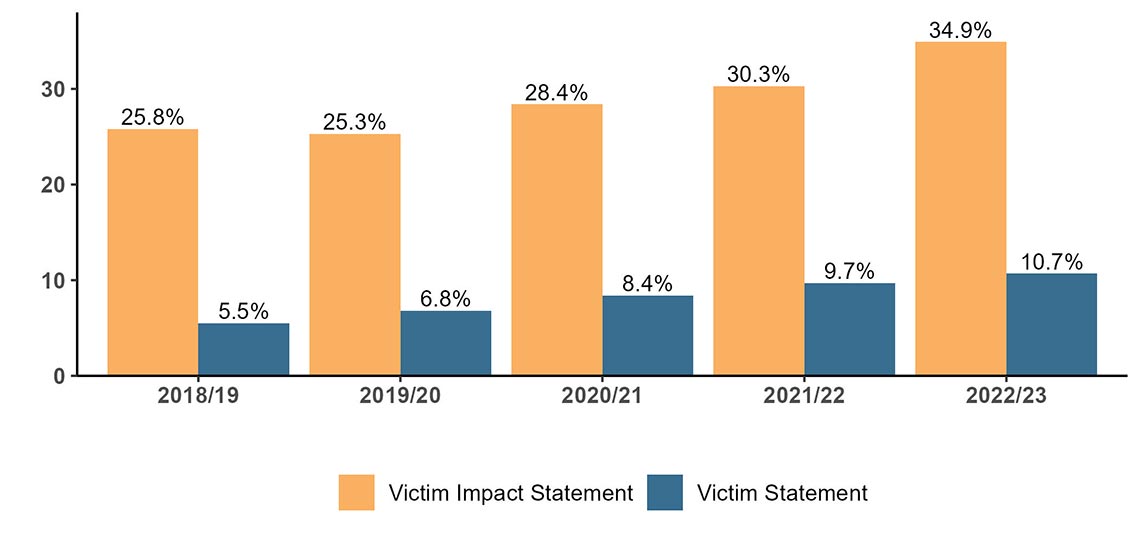
Figure 1. Prevalence of victim statements and victim impact statements over time (2018/2019 to 2022/2023) – Text version
This graph presents the prevalence of "Victim Impact Statement" and "Victim Statement" across multiple years (2018/2019–2022/2023).
The image is a bar chart that compares two types of victim statements over five years, from 2018/2019 to 2022/2023.
The values are shown as percentages.
The two types of statements are:
- Victim Impact Statements
- Victim Statements
Each year has two bars, one for each type of statement.
What the data shows, year by year
- 2018/2019
- 25.8% involved a Victim Impact Statement
- 5.5% involved a Victim Statement
- 2019/2020
- 25.3% involved a Victim Impact Statement
- 6.8% involved a Victim Statement
- 2020/2021
- 28.4% involved a Victim Impact Statement
- 8.4% involved a Victim Statement
- 2021/2022
- 30.3% involved a Victim Impact Statement
- 9.7% involved a Victim Statement
- 2022/2023
- 34.9% involved a Victim Impact Statement
- 10.7% involved a Victim Statement
The prevalence of statements across age and gender showed a similar pattern for victim impact statements and victim statements (see Figure 2). Where the offender was older, reviews contained a higher proportion of both victim statements and victim impact statements, though the difference is more pronounced with victim statements. For gender, a slightly higher proportion of victim statements was found among male offenders compared with female offenders. Differences by racial group were also evident, though the pattern depended on the type of statement. Victim statements were more commonly found in reviews involving White offenders, whereas victim impact statements were slightly more prevalent when the offender was Indigenous. Reviews involving Black offenders and other racialized groups had somewhat lower proportions of both statement types.
Figure 2. Prevalence of victim statements and victim impact statements by offender demographics
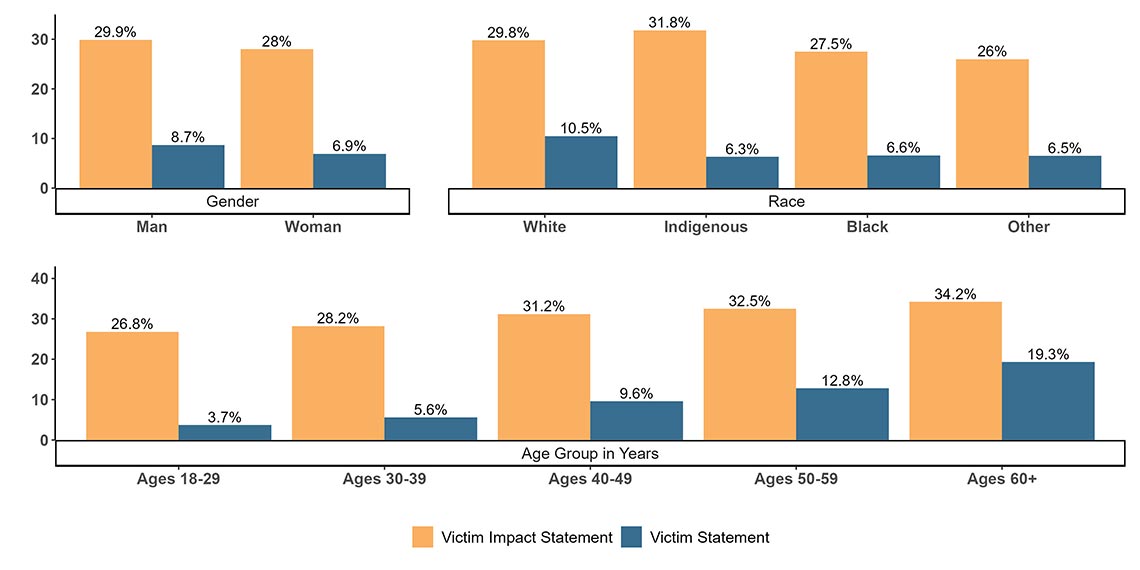
Figure 2. Prevalence of victim statements and victim impact statements by offender demographics – Text version
The image contains three grouped bar charts showing the percentage of cases involving victim statements. Two types of statements are compared:
- Victim Impact Statements
- Victim Statements
Percentages are shown for different gender groups, racial groups, and age groups. Victim Impact Statements are consistently more common than Victim Statements in every group shown.
Breakdown by gender
- Men
- 29.9% had a Victim Impact Statement
- 8.7% had a Victim Statement
- Women
- 28.0% had a Victim Impact Statement
- 6.9% had a Victim Statement
Breakdown by race
- White
- 29.8% had a Victim Impact Statement
- 10.5% had a Victim Statement
- Indigenous
- 31.8% had a Victim Impact Statement
- 6.3% had a Victim Statement
- Black
- 27.5% had a Victim Impact Statement
- 6.6% had a Victim Statement
- Other racial groups
- 26.0% had a Victim Impact Statement
- 6.5% had a Victim Statement
Breakdown by age group
- Ages 18–29
- 26.8% had a Victim Impact Statement
- 3.7% had a Victim Statement
- Ages 30–39
- 28.2% had a Victim Impact Statement
- 5.6% had a Victim Statement
- Ages 40–49
- 31.2% had a Victim Impact Statement
- 9.6% had a Victim Statement
- Ages 50–59
- 32.5% had a Victim Impact Statement
- 12.8% had a Victim Statement
- Ages 60 and older
- 34.2% had a Victim Impact Statement
- 19.3% had a Victim Statement
Both victim statements and victim impact statements varied substantially by crime type and sentence type. For crime type, reviews of offences involving death had the highest proportion of victim statements on file (about 25 percent), followed by sexual offences, other violent offences, and non-violent offences. For victim impact statements, the prevalence for offences involving death and sexual offences was similar, exceeding 45 percent. It then decreased for other violent and non-violent offences.
In differences observed by sentence type, victim impact statements were roughly 10 percent more prevalent in reviews involving indeterminate or life sentences than determinate sentences. The corresponding difference for victim statements was about 20 percent.
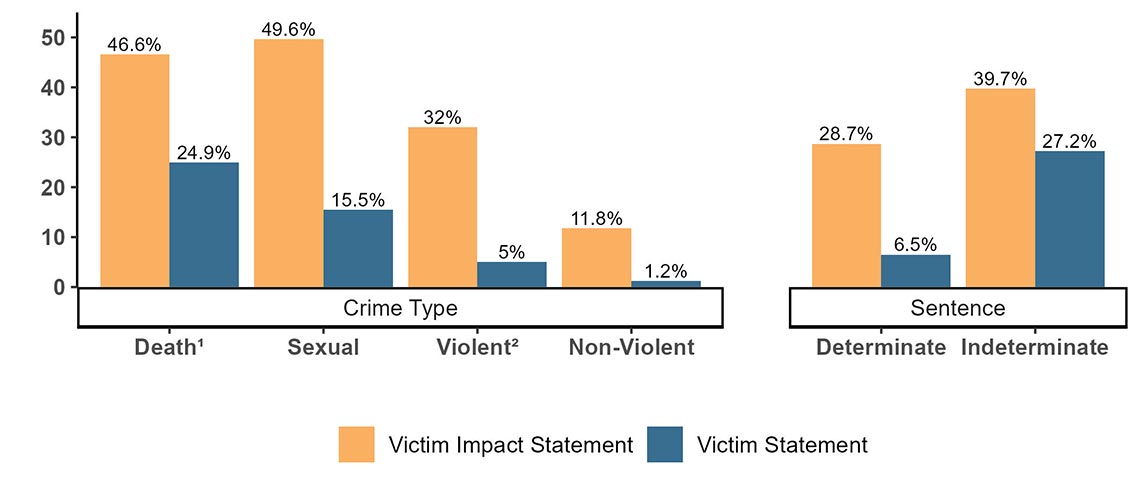
Figure 3. Prevalence of victim statements and victim impact statements by crime severity – Text version
The image is a bar chart that shows the percentage of cases in which two types of statements were used:
- Victim Impact Statements
- Victim Statements
The data is grouped in two ways:
- By type of crime
- By type of sentence
For each category, there are two bars showing how common each type of statement is. Percentages are written above each bar.
Breakdown by type of crime
Four crime categories are shown.
Death
- 46.6% included a Victim Impact Statement
- 24.9% included a Victim Statement
Sexual
- 49.6% included a Victim Impact Statement
- 15.5% included a Victim Statement
Violent
- 32.0% included a Victim Impact Statement
- 5.0% included a Victim Statement
Non-violent
- 11.8% included a Victim Impact Statement
- 1.2% included a Victim Statement
Breakdown by type of sentence
Two sentencing types are shown.
Determinate
- 28.7% included a Victim Impact Statement
- 6.5% included a Victim Statement
Indeterminate
- 39.7% included a Victim Impact Statement
- 27.2% included a Victim Statement
Relative impact of factors on the likelihood of a victim statement
While the preceding results describe how victim statement prevalence varies across groups and offence types, many of these factors were interrelated. For example, offender age was related to crime type, which means differences in prevalence by age may be partly explained by crime type. Therefore, to better understand which factors are most strongly associated with victim statement submission, a regression model was conducted that accounted for their combined effects. A mixed effects model was used to account for variation across year and region. Across regions, the prevalence of victim statements ranged from 5 percent in the Prairie region (Manitoba, Saskatchewan, Alberta, and Northwest Territories) to 12.8 percent in the Pacific region (British Columbia and Yukon).
Results showed that offence severity, in particular crime type, had the strongest association with the likelihood of a victim statement being on file while accounting for all other variables in the model. Compared with non-violent offences, the odds of a victim statement were nearly twelve times higher for offences involving death, almost seven times higher for sexual offences, and about three times higher for other violent offences.
Sentence type was also associated with victim statement submission. The odds of a victim statement were 40 percent higher among indeterminate sentences compared with determinate ones. Reviews with a victim impact statement on file had roughly four times higher odds of also having a victim statement on file after accounting for the other variables in the model. The relationships between offender characteristics and victim statements were more modest. White offenders and older offenders had higher odds of having a victim statement on file, while gender was not significantly related to having a victim statement on file (see Table 1).
Table 1. Mixed effects logistic regression predicting victim statement submission
| Variables | AOR | AOR 95% CI | |
|---|---|---|---|
| Lower | Upper | ||
| Intercept | 0.01 | 0.01 | 0.01 |
| AgeFootnote 1 of Table 1 | 1.27 | 1.11 | 1.33 |
| Gender (reference: Man) | 1.12 | 0.93 | 1.36 |
| Racial Group (reference: White) | |||
| Indigenous | 0.60 | 0.54 | 0.68 |
| Black | 0.67 | 0.56 | 0.81 |
| OtherFootnote 2 of Table 1 | 0.71 | 0.59 | 0.84 |
| Crime Type (reference: Non-Violent) | |||
| Other ViolentFootnote 3 of Table 1 | 3.15 | 2.59 | 3.84 |
| Sexual | 6.93 | 5.73 | 8.38 |
| Related to DeathFootnote 4 of Table 1 | 11.88 | 9.76 | 14.45 |
| Victim Impact Statement | 4.01 | 3.63 | 4.42 |
| Sentence Type (reference: Determinate) | 1.40 | 1.23 | 1.60 |
| Random Variables | Variance |
|---|---|
| Region | 0.06 |
| Year | 0.02 |
The relationship between crime severity and victim statements is consistent with previous research on victim impact statements in sentencing (Dufour et al. 2023; Erez et al. 1997; Erez and Tontodonato 1990; Lens et al. 2013; Leverick et al. 2007; Roberts and Manikis 2013) and contrasts with previous research on New Jersey parole cases (Caplan 2010). It is important to acknowledge that while crime type and sentence type (determinate versus indeterminate) capture key aspects of offence severity, they do not fully reflect its complexity. Substantial variation in harm and violence can exist within the same offence category. Given that crime severity is one of the few factors shown to have a relatively consistent relationship with victim statement submission across victim impact statements in sentencing and victim statements in conditional release, future research would benefit from exploring additional or more nuanced measures of offence severity to better capture this relationship.
Conclusion
This study addressed an important gap on the prevalence of victim statements and related factors in conditional release decisions. Three key findings from the study were:
- Victim statements in conditional release decisions are only present in a minority of PBC reviews.
- Crime severity was the strongest predictor of having a victim statement on file.
- Victims who submit a victim impact statement at sentencing are more likely to submit a victim statement in conditional release decisions.
Further research is needed to continue to advance knowledge in this area:
- Enhancing data collection and the availability of victim data can support future research efforts to continue to advance knowledge in this under-researched area. Increasing the coverage of demographic information is one area to enhance. Although the current study examined offender demographics, victim demographics could not be included because few registered victims provide this information.
- Other enhancements could include distinguishing between updated victim statements from submissions by new victims. This would allow the number of statements by unique victims and patterns of submissions across the conditional release process to be examined.
- Finally, differentiating victim impact statements used as victim statements from victim statements would allow research to examine factors that impact whether victims choose to write a new statement rather than use their victim impact statement. By improving data quality and coverage, future studies will be better positioned to evaluate trends, identify disparities, and assess how victim statements are used over time.
References
- Canadian Centre for Justice Statistics. n.d. Integrated Criminal Court Survey (ICCS), 2016–2022: Prince Edward Island, Nova Scotia, Alberta, and Northwest Territories [Unpublished data].
- “Canadian Victims Bill of Rights (CVBR).” Government of Canada overview. https://www.canada.ca/en/office-federal-ombudsperson-victims-crime/cvbr-ccdv.html
- Caplan, J. M. 2010. “Parole release decisions: Impact of victim input on a representative sample of inmates.” Journal of Criminal Justice, 38:3, 291-300.
- Clark, H. J. 2023. Victim Experiences with Victim Services and the Conditional Release Process: Results from the 2022 Victim Survey. Unpublished Report. Parole Board of Canada: Ottawa.
- Cotter, A. 2021. “Criminal victimization in Canada.” Juristat. Statistics Canada. https://www150.statcan.gc.ca/n1/pub/85-002-x/2021001/article/00014-eng.htm [Accessed 23 November 2023]
- Corrections and Conditional Release Act, S.C. 1992, c. 20. Government of Canada. Available at: https://laws-lois.justice.gc.ca/eng/acts/C-44.6/
- Dufour, G. K., Ternes, M., and V. Stinson. 2023. “The relationship between victim impact statements and judicial decision making: An archival analysis of sentencing outcomes.” Law and Human Behavior. 47:4, 484-498.
- Erez, E., Roeger, L., and F. Morgan. 1997. “Victim harm, impact statements and victim satisfaction with justice: An Australian experience.” International review of Victimology,5:1, 37-60.
- Erez, E. and P. Tontodonato. 1990. “The effect of victim participation in sentencing on sentence outcome.” Criminology, 28:3, 451-474.
- Lens, K. M., Pemberton, A., Brans, K., Braeken, J., Bogaerts, S. and E. Lahlah. 2015. “Delivering a Victim Impact Statement: Emotionally effective or counter-productive?” European Journal of Criminology, 12:1, 17-34.
- Lens, K. M., Pemberton, A. and S. Bogaerts. 2013. “Heterogeneity in victim participation: A new perspective on delivering a victim impact statement.” European Journal of Criminology, 10:4, 479-495.
- Leverick, F., Chalmers, J. P., and P.R. Duff. 2007. An evaluation of the pilot victim statement schemes in Scotland. Scottish Executive.
- Mastrocinque, J. M. 2014. “Victim Personal Statements: An analysis of notification and utilization.” Criminology & Criminal Justice, 14:2, 216-234.
- Parole Board of Canada. 2017. “History of Victim Services at the Parole Board of Canada.” Internal document, Parole Board of Canada intranet.
- Parole Board of Canada. 2025. Decision-Making Policy Manual for Board Members: Third Edition. https://publications.gc.ca/collections/collection_2025/clcc-pbc/PS91-12-3-4-2025.pdf
- Roberts, J. V. and E. Erez. 2004. “Communication in sentencing: Exploring the expressive function of victim impact statements.” International Review of Victimology, 10:3, 223–244. https://doi.org/10.1177/026975800401000302
- Roberts, J. V. and M. Manikis. 2013. “Victim personal statements in England and Wales: Latest (and last) trends from the Witness and Victim Experience Survey.” Criminology & Criminal Justice, 13:3, 245-261.
- Date modified: