
Background for YCJA
Part B: Use of Custody
Figure B1 shows the rate (per 1,000 youths age 12 to 17 in the jurisdiction) of sentencing youths to custody in 1998-9. There is considerable variation across provinces in the use of custody. For example, Saskatchewan sentences youths to custody at a rate of 24.1 per 1,000 youths while Quebec sentences youths at a rate of 4.8 per 1,000 youths.
Figure B1: Rate of youths sentenced to custody

Provinces vary in the rate at which they bring cases into youth court, and they also vary in the proportion of cases they find guilty and sentence to a period of custody. Table B1 shows the rate (per 1,000 youths age 12 to 17 in the population) of bringing cases into youth court, the percent of those cases that are found guilty and the percent of guilty cases that are sentenced to custody. Finally, custody is also expressed as a rate (per 1,000 youths age 12 to 17 in the population) in the second last column and as the number of youths for every one case sentenced to custody (last column). What this shows is that provinces bringing cases in a higher/lower rates may end up with similar incarceration rates due to the percentage they find guilty and then sentence to custody. For example, Manitoba and Saskatchewan bring in cases at similar rates (87.1 and 84.1 respectively). However, they have different incarceration rates (16.1 and 24.1 respectively). Put another way, Manitoba sends one youth to custody for every 62 youths while Saskatchewan sends one youth to custody for every 41 youths. This happens because Manitoba finds 58% of the cases it brings in guilty while Saskatchewan finds 82% of its cases guilty. Another example is PEI and Nova Scotia. While they bring cases in at different rates (26.8 and 41.9 respectively) they have a similar incarceration rate (10 per 1,000 youths - or one youth sent to custody for every 100 youths). This happens because while PEI beings in fewer cases than Nova Scotia, it finds a larger proportion guilty and of the guilty sends a larger proportion to custody.
| Rate (1,000 youths) of bringing cases into court | Percent found guilty | Percent (of guilty) sent to custody | Rate (per 1,000 youths) sent to custody | 1 case to custody per  youths in the population youths in the population |
|
|---|---|---|---|---|---|
| Canada | 43.5 | 67% | 35% | 10.3 | 97 |
| NFLD | 43.2 | 82% | 43% | 15.1 | 66 |
| PEI | 26.8 | 84% | 45% | 10.0 | 100 |
| Nova Scotia | 41.9 | 68% | 35% | 10.1 | 99 |
| New Brunswick | 32.3 | 87% | 32% | 8.9 | 112 |
| Quebec | 20.1 | 81% | 30% | 4.8 | 206 |
| Ontario | 45.0 | 60% | 42% | 11.2 | 89 |
| Manitoba | 87.1 | 58% | 32% | 16.1 | 62 |
| Saskatchewan | 84.1 | 82% | 35% | 24.1 | 41 |
| Alberta | 67.1 | 68% | 26% | 12.0 | 83 |
| British Columbia | 36.9 | 70% | 33% | 8.7 | 115 |
Source: Source: Statistics Canada (2000). Youth Court Statistics 1998-9. Ottawa: Canadian Centre for Justice Statistics. (Table 8).
Table A4 showed that the cases that accounted for 74% of the cases in youth court in Canada were relatively minor offences. Interestingly, those same offences also account for 74% of the cases sentenced to custody in Canada. Table B2 shows that theft à under $5,000, possession of stolen property, failure to appear and failure to comply with a disposition account for 46% of the cases sentenced to custody. Adding in other theft, mischief/damage, break and enter and minor assault accounts for 75% (18,674) of the cases (25,169) sentenced to custody in Canada in 1998-9.
| Total number of cases | Percent | |
|---|---|---|
| Theft under $5,000 | 2,289 | 9% |
| Possession stolen of property | 1 522 | 6 % |
| Failure to appear | 2,822 | 11% |
| Failure to comply with a disposition | 4,979 | 20% |
| Subtotal | 11,612 | 46% |
| Other thefts | 1,168 | 5% |
| Mischief/damage | 788 | 3% |
| Break and enter | 3,415 | 14% |
| Minor assault | 1,691 | 7% |
| Total: Sum of eight offences | 18,674 | 74% |
| All cases | 25,169 | 100% |
Source: Statistics Canada (2000). Youth Court Statistics 1998-9. Ottawa: Canadian Centre for Justice Statistics. (Tables 3 and 3a).
Failure to appear and failure to comply with a disposition are very likely to be sentenced to custody. Table B3 shows that close to half of the YOA offences are sentenced to custody. Specifically, 47% of failure to comply with a disposition offences receive custody, 58% of failure to comply with undertaking and 41% of failure to appear cases receive custody.
| Total found guilty | Total sent to custody | Percent (of guilty) that are sentenced to custody | |
|---|---|---|---|
| Failure to comply with disposition (e.g. breach of probation) | 10,547 | 4,979 | 47% |
| Failure to appear | 6,946 | 2,822 | 41% |
Source: Statistics Canada (2000). Youth Court Statistics 1998-9. Ottawa: Canadian Centre for Justice Statistics. (Table 8).
Youths with previous convictions are also very likely to receive a custodial disposition, even if the current offence is relatively minor. Table B4 and B5 shows the effect of criminal record for a minor theft and a minor assault across eight provinces[6]. Looking first at Table B4, in Quebec 7.2% youths with no previous record, who are currently found guilty of a minor theft, are sentenced to custody while only 3.5% are sentenced to custody in Alberta. With one previous conviction, the proportion sentenced to custody increased from 7.2% to 16.0% in Quebec and from 8.1% to 26.2% in Ontario. By the time a youth with a current conviction of a minor theft and three or more previous convictions, half are sent to custody in Quebec, 64.1% are sent to custody in Ontario, 38.7% in Alberta and 47.5% are sent to custody in BC.
| Number of times previously sentenced: | ||||
|---|---|---|---|---|
| None | One | Two | Three + | |
| NFLD | 3.6% | 12.5% | 42.9% | 65.2% |
| New Brunswick | 3.8% | 13.5% | 48.1% | 63.6% |
| Quebec | 7.2% | 16.0% | 26.5% | 50.0% |
| Ontario | 8.1% | 26.2% | 51.6% | 64.1% |
| Manitoba | 6.8% | 7.8% | 23.1% | 52.6% |
| Saskatchewan | 8.9% | 13.8% | 9.8% | 50.0% |
| Alberta | 3.5% | 9.0% | 19.8% | 38.7% |
| British Columbia | 3.6% | 13.4% | 24.7% | 47.5% |
Table B5 shows the effect of criminal record on the likelihood a minor assault case will receive custody. While there is variation across the eight provinces, the more previous convictions the more likely a youth convicted of a minor assault will receive custody. When a youth has three or more convictions, there is a range from a high of 78.6% sentenced to custody in Quebec to a low of 38.6% sentenced to custody in>Alberta.
| Number of times previously sentenced: | ||||
|---|---|---|---|---|
| None | One | Two | Three + | |
| NFLD | 5.7% | 26.5% | 86.7% | 53.8% |
| New Brunswick | 3.1% | 23.7% | 77.8% | 42.9% |
| Quebec | 7.9% | 20.7% | 52.8% | 78.6% |
| Ontario | 11.8% | 38.7% | 62.0% | 70.6% |
| Manitoba | 5.5% | 18.0% | 26.3% | 53.6% |
| Saskatchewan | 1.8% | 17.7% | 30.0% | 57.7% |
| Alberta | 3.3% | 13.7% | 26.5% | 38.6% |
| British Columbia | 6.3% | 23.1% | 44.6% | 75.0% |
Overall, it appears that Canada has an overall higher incarceration rate than the United States. Examining the incarceration rate (per 100,000 youths age 12 to 17) in Canada and the United states reveals that Canada has an incarceration rate of roughly 1,046 while the US has an incarceration rate of roughly 775 per 100,000 youths age 12 to 17. Figure B2 illustrates this finding.
Figure B2: Overall rate of youth incarceration between Canada and US
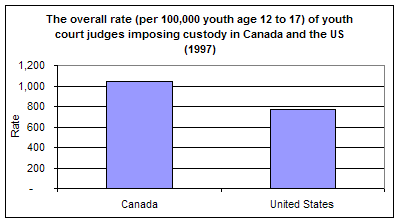
*Note: this inflates the US rate slightly because they bring 10 and 11 year olds into court, but youths age 10-11 are not included in the denominator. Having 10 and 11 year olds in the denominator produces an overall incarceration rate for the US of: 568.33
**Note: this custody rate does not include those youth transferred to adult court and sent to custody. There are no national data available on the total number of youths transferred in the US each year (for more details see: Sprott & Snyder. 1999. Une comparaison de la délinquance des jeunes au Canada et aux États-Unis. Criminologie Vol. 32(2): 55-82). However, including transferred cases may not change the results considerably because transferred youths do not invariably receive custody in the US (see: Snyder, Sickmund and Poe-Yamagata. 2000. Juvenile Transfers to Criminal Court in the 1990's: Lessons Learned from Four Studies. Washington DC: Office of Juvenile Justice and Delinquency Prevention.).
Source: Source: Statistics Canada (2000). Youth Court Statistics 1997-8. Ottawa: Canadian Centre for Justice Statistics. (Table 8).
Snyder, H., Finnegan, T., Stahl, A., and Poole, R. (1999). Easy Access to Juvenile Court Statistics: 1988-1997 [data presentation and analysis package]. Pittsburgh, PA: National Center for Juvenile Justice [producer]. Washington, DC: Office of Juvenile Delinquency and Prevention [distributor].
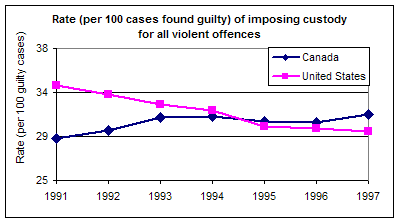
Breaking down the offence categories - violence or property - again reveals that Canada has similar or slightly higher incarceration rates than the US. Figure B3 examines the rate of imposing custody (per 100 cases found guilty) on violence cases in Canada and the US from 1991 to 1997 (most recent year of data available from the US). While the US appears to be decreasing the use of incarceration, Canada has remained relatively stable or increasing slightly so that in 1997 Canada's incarceration roughly 31.4% of its guilty violence cases while the US incarcerated roughly 29.9% of its guilty violence cases.
Figure B3: Incarceration rate for violence offences in Canada and US (1991-1997)
Source: Statistics Canada (2000). Youth Court Statistics 1997-8. Ottawa: Canadian Centre for Justice Statistics. (Table 8).
Snyder, H., Finnegan, T., Stahl, A., and Poole, R. (1999). Easy Access to Juvenile Court Statistics: 1988-1997 [data presentation and analysis package]. Pittsburgh, PA: National Center for Juvenile Justice [producer]. Washington, DC: Office of Juvenile Delinquency and Prevention [distributor].
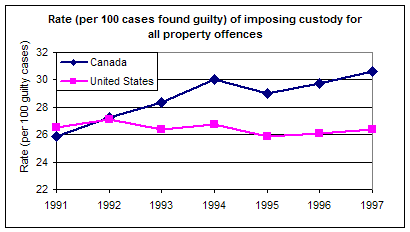
Figure B4 shows the rate (per 100 cases found guilty) of incarcerating property offences in Canada and the US from 1991 to 1997. While the US has remained relatively stable in its rate of incarceration from 1991 to 1997, Canada has increased slightly. By 1997 Canada was incarcerating roughly 30.6% of its guilty property cases while the US was incarcerating roughly 26.4% of its guilty property cases. (See methodological notes on Canada-US comparisons in Sprott, J.B. and Snyder, H. N. (2000). Une comparaison de la délinquance des jeunes au Canada et aux États-Unis Criminologie, 32(2), 56-82.
Figure B4: Incarceration rate for property offences in Canada and US (1991-1997)
Source: Statistics Canada (2000). Youth Court Statistics 1997-8. Ottawa: Canadian Centre for Justice Statistics. (Table 8).
Snyder, H., Finnegan, T., Stahl, A., and Poole, R. (1999). Easy Access to Juvenile Court Statistics: 1988-1997 [data presentation and analysis package]. Pittsburgh, PA: National Center for Juvenile Justice [producer]. Washington, DC: Office of Juvenile Delinquency and Prevention [distributor].
Table B6 shows total number of cases sentenced to custody, the rate (per 1,000 youths) and the percent of cases that are found guilty that are sentenced to custody. Looking at the rate (per 1,000 youths) it appears that custody is being used slightly less over the years. This is because there has been a growth in the youth population over the years while the total number of cases sentenced to custody has remained relatively stable since 1992-3. When looking at the percent of guilty cases sentenced to custody, however, there is an increase in the use of custody. This appears to be due more to a change in the denominator (fewer cases found guilty) as opposed to a change in the numerator (number of cases sentenced to custody).
| Cases found guilty | Total cases sentenced to custody |
Rate sentencing cases to custody per 1,000 youths |
Percent of guilty cases sentenced to custody |
|
|---|---|---|---|---|
| 1991-2 | 75,143 | 22,298 | 10.17 | 30% |
| 1992-3 | 77,256 | 24,043 | 10.40 | 31% |
| 1993-4 | 78,010 | 25,602 | 11.07 | 33% |
| 1994-5 | 73,969 | 25,212 | 10.68 | 34% |
| 1995-6 | 72,945 | 24,312 | 10.20 | 33% |
| 1996-7 | 74,797 | 25,278 | 10.46 | 34% |
| 1997-8 | 74,528 | 25,670 | 10.50 | 34% |
| 1998-9 | 71,961 | 25,169 | 10.26 | 35% |
[6] PEI, Yukon and NWT were not included due to too few cases. Due to complications with linking data, Nova Scotia could not provide any information.
- Date modified: