
Youth Justice Initiative Evaluation
4. Evaluation Findings
This section of the report presents the findings of the YJI evaluation. The findings are organized by the evaluation questions identified in the evaluation matrix in Appendix B.
4.1. Relevance
4.1.1. Continued need for the YJI
Need for the YJI can be demonstrated in two ways: by the continued existence of youth crime and the requirement for the kinds of remedies that the Initiative was designed to address, and by evidence that federal youth justice policies and the YJI funding programs are required in order to achieve the objectives of the YCJA. The evaluation has found that by both of these measures, the YJI continues to be relevant.
4.1.1.1 Recent youth justice experience
Youth crime data shows improvements in important areas associated with the objectives of the YCJA and the YJI, and continued challenges in some areas.
Rates of Police-reported Youth Crime
Rates of police-reported youth crime declined during the evaluation period. In 2010, the rate per 100,000 was 6,186 and in 2014 it was 4,016, a decrease of 35 percent (Statistics Canada, 2012; Statistics Canada, 2015). The most significant decrease occurred with respect to property crime, although violent crime and other types of crime rates are also lower.
Clearance Status
According to Statistics Canada, of the 94,100 youth accused of a criminal incident in 2014, 55% were dealt with by other means (including diversion from the formal criminal justice system through the use of extrajudicial measures, such as warnings, cautions or referrals to community programs), while the remaining 45% were formally charged by police.Footnote 4 The difference in clearance types has been the case since the YCJA was introduced; however, the difference between the rates has decreased slightly since about 2009, as indicated in the figure below. This trend could suggest a continuing need for the YJI.
Figure 1: Youth accused of crime, by clearance status, Canada, 2004 to 2014
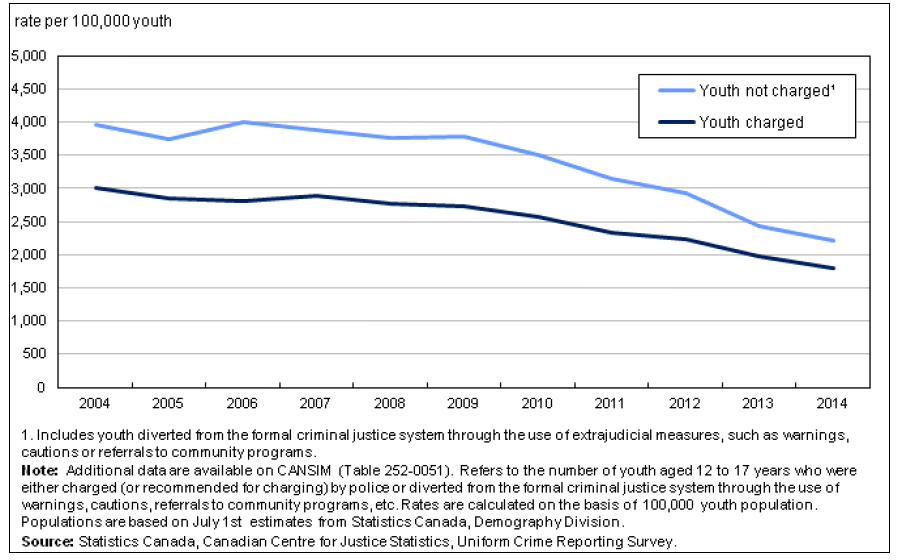
Figure 1 - Text equivalent
Line graph showing the number of youth charged and youth not charged (rate per 100,000 youth) from 2004 to 2014.
| Year | Youth not chargedFootnote a | Youth charged |
|---|---|---|
| 2004 | 3,955 | 3,004 |
| 2005 | 3,736 | 2,860 |
| 2006 | 3,996 | 2,812 |
| 2007 | 3,884 | 2,886 |
| 2008 | 3,768 | 2,769 |
| 2009 | 3,787 | 2,728 |
| 2010 | 3,514 | 2,564 |
| 2011 | 3,138 | 2,344 |
| 2012 | 2,923 | 2,232 |
| 2013 | 2,425 | 1,970 |
| 2014 | 2,216 | 1,800 |
Note: Additional data are available on CANSIM (Table 252-0051). Refers to the number of youth aged 12 to 17 years who were either charged (or recommended for charging) by police or diverted from the formal criminal justice system through the use of warnings, cautions, referrals to community programs, etc. Rates are calculated on the basis of 100,000 youth population. Populations are based on July 1st estimates from Statistics Canada, Demography Division.
Source: Statistics Canada, Canadian Centre for Justice Statistics, Uniform Crime Reporting Survey.
Numbers of Youth Court Cases
Consistent with the changes in clearance status discussed above, Table 3 shows substantial decreases in youth court cases for all offence categories between 2008-09 and 2013-14. In total, the percentage of cases proceeding to Youth Court decreased by 31.6%.
| Offence Category | Number of Cases 2008-09 |
Number of Cases 2013-14 |
Category Percentage 2013-14 |
% Change from 2008-09 |
|---|---|---|---|---|
| Property Offences | 22,001 | 13,370 | 33.5 | -39.2 |
| Violent Offences | 15,457 | 11,720 | 29.3 | -24.1 |
| Administration of Justice | 6,284 | 4,290 | 10.7 | -31.7 |
| Other Criminal Code | 3,021 | 2,160 | 5.4 | -28.5 |
| YCJA Offences | 5,880 | 3,841 | 9.6 | -34.6 |
| Other Federal Statute Offences | 4,609 | 3,874 | 9.7 | -15.9 |
| Criminal Code Traffic | 1,127 | 646 | 1.6 | -42.6 |
| Total | 58,379 | 39,901 | 100.0 | -31.6 |
Source: Adapted from Statistics Canada, Juristat, 85-002-XI Summer, 2010; and Juristat, 85-002-X, released September 2015.
Custody Rates
By 2013-14, youth sentence custody rates had declined for the sixth consecutive year. The majority of youth in the correctional system (approximately 90 percent) are being supervised in community corrections, primarily while serving a sentence of probation, rather than in custody (Correctional Services Program, Statistics Canada, 2015). Figure 2 indicates the rates of youth in custody for the period 2003-04 to 2013-14 for eleven jurisdictions, based on average daily counts.
Figure 2: Youth in Custody, 11 Jurisdictions, 2003-04 to 2013-14 Footnote b
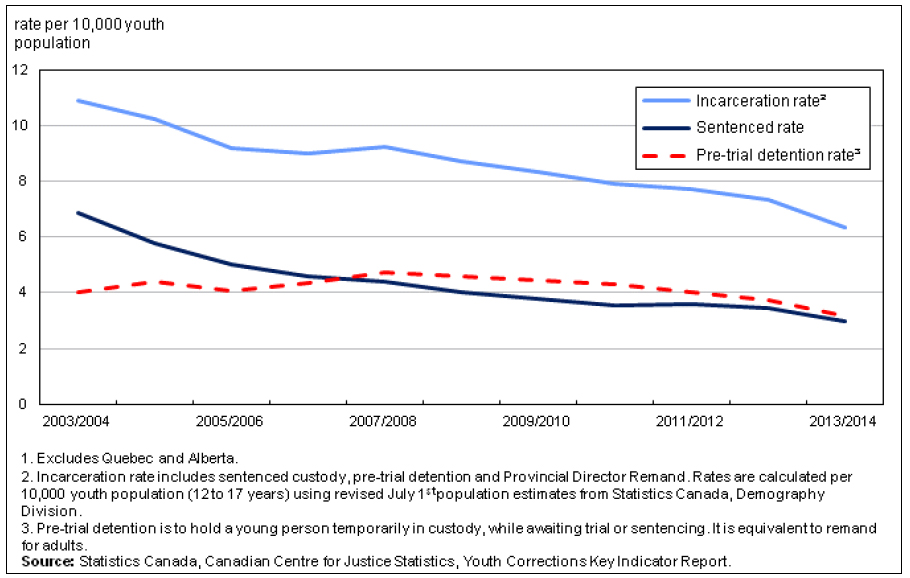
Figure 2 - Text equivalent
Line graph showing youth in custody (rate per 10,000 youth population) for 11 jurisdictions.
| Years | Incarceration rateFootnote c | Sentenced rate | Pre-trial detention rateFootnote d |
|---|---|---|---|
| 2003/2004 | 10.9 | 6.9 | 4.0 |
| 2004/2005 | 10.2 | 5.8 | 4.4 |
| 2005/2006 | 9.2 | 5.0 | 4.1 |
| 2006/2007 | 9.0 | 4.6 | 4.3 |
| 2007/2008 | 9.3 | 4.4 | 4.7 |
| 2008/2009 | 8.7 | 4.0 | 4.6 |
| 2009/2010 | 8.4 | 3.8 | 4.5 |
| 2010/2011 | 7.9 | 3.5 | 4.3 |
| 2011/2012 | 7.7 | 3.6 | 4.0 |
| 2012/2013 | 7.3 | 3.4 | 3.7 |
| 2013/2014 | 6.3 | 3.0 | 3.2 |
Source: Statistics Canada, Canadian Centre for Justice Statistics, Youth Corrections Key Indicator Report.
Challenges in Youth Justice
While sentenced custody rates have steadily decreased under the YCJA, pre-trial detention rates have remained relatively stable. The pre-trial detention rate (per 10,000 youth population) has decreased over time: from 4.4 in 1999-2000 (a few years pre-YCJA, 4.6 in 2002-03 (the year before the YCJA), 3.8 in 2009-10, to 3.2 in 2013-14.Footnote 5 (See section 4.1.1.2 below, for further discussion on the question of pre-trial detention rates).
Aboriginal youth continue to be overrepresented in both sentenced custody (46% of youth in sentenced custody in 2013-14) and pre-trial detention (48% of youth in pre-trial detention in 2013-14) while representing only 7% of Canada’s youth population.Footnote 6 Aboriginal female youth accounted for 53% of all female youth admitted to sentenced custody, while Aboriginal male youth accounted for 45% of all male youth admitted to sentenced custody in 2013-14. Aboriginal female youth accounted for 62% of all female youth admitted to pre-trial detention, while Aboriginal male youth accounted for 43% of all male youth admitted to pre-trial detention. Some authors suggest the rates of Aboriginal youth overrepresentation will continue to rise (Calverley, Cotter & Halla, 2010).
Youth with mental health issues and/or cognitive disabilities are at higher risk of offending and often are not effectively diagnosed or treated (Cesaroni, 2013; Bell, 2012; MacRae, Bertrand, Paetsch and Hornick, 2011; Mishna and Muskat, 2001). As well, effective alternative programming for any justice-engaged youth, according to some studies, may not be adequate in certain regions, particularly for youth living in rural and remote communities (Clark, 2015b; Clark and Landau, 2012; Nuffield, 2003).
4.1.1.2 The role of the YJI
The ongoing challenges noted above provide, in themselves, a rationale for the continuation of the YJI and its support in addressing the challenges. It is important to acknowledge that alternatives to formal court processes and to custody require financial investment and program expertise if they are to be both available and successful. It is in this connection that the YJI and its concomitant funding support have played a positive role. Barnhorst (2012: 131) concluded the following:
Funding of programs is essential to the implementation of youth justice legislation. For example, the recognition in law of new sentencing options or extrajudicial measures is of little value if the funds are not available to implement them…. The increase in federal funding, although not as much as many provinces wanted, helped to enable the system of changes, including shifting it away from the high use of custody and courts.
The YCJA recognizes the negative impacts of youth crime on society in general, on victims of crime and on the young persons involved with the youth criminal justice system. Custody, physical injury, emotional or psychological distress, and the breakdown of cohesion and sustainability in communities are a few of the harms which can result.Footnote 7 Considering these effects and the continuing reality of youth crime, there is a continued need to conduct research to develop an understanding of the factors which contribute to youth violence and other crime, and to develop justice system approaches to respond effectively. The research, policy development and program activities under the YJI can continue to provide opportunities to meet those needs.
Key informant interviews and case studies indicate that youth justice practitioners and agencies see the YJI and its various components (specific program funding and non-monetary support) as contributing to positive changes with regard to youth crime. Further, there was agreement among provincial and territorial officials and NGO personnel interviewed for the evaluation that YJI funding is essential in developing and implementing YCJA-related programs and projects. Respondents pointed to the declining overall rate of youth crime in Canada as evidence that the YJI is helping them achieve positive results but that youth crime rates must decline further yet. As noted by community-based service providers and provincial, territorial and Justice Canada officials, if it were not for the support provided through the YJI, the risk of reversing the progress to date would be a serious possibility. They therefore maintain that a need for the YJI continues.
4.1.2. Alignment with government priorities
A review of documents and YJI files, and key informant interviews, indicate that YJI is consistent with federal government priorities.
Federal government policy statements have reflected recognition of the need to apply appropriate sanctions and emphasize the importance of rehabilitating young people in conflict with the law.Footnote 8 The YCJA embodies these principles. The YJI, designed to assist provinces and territories in implementing the Act, has objectives that are explicitly aligned with the YCJA:
- appropriate use of courts;
- appropriate use of custody;
- justice system responses that are proportionate to the severity of the offence and the degree of responsibility of the offender; and,
- enhanced rehabilitative and reintegration opportunities.
The YJI is also in alignment with the 2010 Speech from the Throne: “Our Government will also ensure the youth criminal justice system responds strongly to those few who commit serious and violent crimes, while focusing on the rehabilitation of all young offenders.”Footnote 9
The 2012-13 Justice Canada Departmental Performance Report (DPR) describes the YJF as making funding available for innovative pilot projects and related activities, such as training and evaluation. It notes that funding priorities are set annually based on identified needs and emerging federal youth justice priorities.Footnote 10 The 2013-14 DPR cites the importance of being sufficiently flexible to respond to emerging youth justice issues.Footnote 11
The document review found evidence of YJI operating in keeping with the above-described government priorities. Terms and conditions of the three funding components are clearly aligned with those priorities.Footnote 12 The YJF terms and conditions, and the fund’s targeted selection of projects, have maintained the key YJI principles while adapting to emerging issues such as FASD and cyberbullying. Key informant interviews and Justice Canada working documents also indicate that YJI officials review and revise funding criteria for the YJF annually to ensure that they continue to reflect current priorities and emerging issues.
Finally, involvement in the federal government’s National Anti-Drug Strategy and youth crime prevention initiative focusing on guns, gangs and drugs provides evidence that the YJI is aligned with federal government priorities.
4.1.3. Alignment with the strategic outcomes of the Department of Justice
The YJI is aligned with the Justice Canada strategic outcome of “a fair, relevant and accessible justice system that reflects Canadian values” (Department of Justice, 2009, July). It is also well aligned with the Department’s outcomes related to youth justice.Footnote 13
Under its broad program of stewardship of the Canadian legal framework, Justice Canada has a sub-program of Justice System Support. The Department, through grant and contribution funding, supports access to the justice system by enabling Canadians to obtain assistance and legal information in order to resolve their legal issues, whether in the formal justice system or through alternative resolution mechanisms. The Department provides ongoing funding to provinces and territories and NGOs, Aboriginal groups, and communities. This program provides justice system support to advance federal justice policy in the following core domains: criminal justice (including youth justice and victims of crime), family justice, access to justice, official languages, contraventions, and Aboriginal justice.
Under that sub-program’s youth justice component the Department, through contribution and grant funding, supports programming for youth aged 12 to 17 involved in the criminal justice system. The Department directs resources towards the federal youth justice priorities of holding youth accountable through measures that are proportionate to the seriousness of the offence and degree of responsibility of the young person, promoting the rehabilitation and reintegration of young persons who have committed offences, and supporting the prevention of crime by referring young persons to programs or agencies in the community, while also assisting the provinces and territories in their responsibility of administering the YCJA. A portion of discretionary funding also exists which allows the Department to encourage innovation.
Key informants supported the findings that the YJI aligns with the strategic outcomes of the Department of Justice. In particular, respondents mentioned the rights of access to justice for Canadians, criminal law and safer communities under the Program Alignment Architecture, and the common goal of promoting alternatives for engaging people on youth justice issues as well as reintegration and rehabilitation and working with marginalized populations (e.g. Aboriginal groups and people with mental health issues).
4.1.4. Alignment with Federal roles and responsibilities
The YJI and the Department’s activities under the Initiative in the evaluation period are in keeping with federal government roles and responsibilities in youth justice.
The document review found evidence that the roles and responsibilities of Justice Canada in delivering the YJI are appropriate to the federal government. The YJI funding components reflect the shared authority between federal, provincial and territorial governments over the youth justice system, and provide funding to the provinces and territories and other organizations to support the objectives of the YCJA. This arrangement respects the fact that the provinces and territories are responsible for the administration of the youth justice system while the federal role is to enact criminal legislation and provide the public and justice system officials with information about youth justice laws, play a lead role in federal, provincial and territorial committee work to align approaches to youth justice across jurisdictions, and support provincial and territorial efforts to implement the YCJA effectively.
Key informants internal to the Department of Justice as well as representatives from provinces and territories indicated that the roles and responsibilities associated with the YJI are appropriate to the federal government. They described the role of the provinces and territories as leading service delivery, whereas the YJI supports the implementation of legislation through the provision of information (about the law, funding programs, etc.), funding for priority programs, and taking the lead in national coordination to ensure knowledge sharing across Canada. Informants also pointed out that the role and responsibilities are appropriate for the federal government because the YJI can help foster a coordinated Canadian approach to emerging criminal justice issues that affect multiple provinces and territories, such as cyberbullying, and then use a funding stream such as the YJF to support new project initiatives.
4.2 Performance
4.2.1. Effectiveness
This section of the findings is organized according to the YJI logic model (see Appendix A). First, evidence is provided about the Initiative’s activities, its outputs and the achievement of immediate outcomes. In this part, the evidence is organized by activity area, corresponding to the three funding streams and the Policy Development, Monitoring and Support Unit. It is organized this way because many of the outputs and anticipated immediate outcomes are specific to the activity areas. This is in contrast to the intermediate and longer-term outcomes, which are examined later in this section and are largely designed to result from the combined activities under all or most of the four activity areas.
4.2.1.1 Outputs and Immediate Outcomes
This section describes the activities of the YJI component programs and what is being produced by those activities. It also presents findings on the achievement of the immediate outcomes of the Initiative. Each component is described separately.
Youth Justice Services Funding Program
In the evaluation period under study, the YJSFP was expected to produce funding agreements and knowledge sharing opportunities, and to provide funding to provinces and territories to assist in sustaining a range of high priority youth justice services including rehabilitation and reintegration, alternatives to court and alternatives to custody. YJSFP activities were expected to be aligned with federal policy priorities, and result in a continuation of high priority programs and services by the provinces and territories. An examination of YJI documents, including minutes of federal, provincial and territorial meetings and funding agreements, a review of financial data on YJSFP expenditures by Justice Canada and the provinces and territories, and key informant interviews, provides evidence that the YJSFP has produced the expected outputs and achieved its anticipated immediate outcomes.
The YJSFP funding agreements identify high, medium and lower priority types of programs and services, and set expectations on the allocation of federal funds to emphasize high, and to a lesser extent medium priority activities. The priorities are recognized in the agreements as being consistent with YCJA and YJI objectives. These priorities are derived through extensive consultation and information sharing at federal, provincial and territorial senior and working level committee meetings. Information shared at these meetings includes: research reports on the effectiveness of alternative programming approaches; reviews of available data on youth criminal justice arrests, charges, findings of guilt, sentencing and the application of alternatives to the courts and custody, and recidivism; and other documents to contribute to the discussion of priorities. The priorities that are decided upon are common across all jurisdictions. In the evaluation period, the high priority programs and services included extrajudicial measures and sanctions, rehabilitative services, treatment programs, psychiatric and psychological services, social skills programs, and a range of other counselling and educational services.
YJSFP expenditures for the five years covered by this evaluation were examined to assess the extent to which the funds contributed to the continuation of priority programs and services in keeping with YJI objectives. Table 4 below presents total federal, provincial and territorial expenditures on youth justice programs and services, and the federal contribution to those expenditures.
Table 4 demonstrates that the federal contribution ranged from a high of 11% to a low of 9% of total expenditures in Saskatchewan to between 44% and 36% in PEI, and averaged about 24% nationally over the evaluation period. The federal contribution was reduced by 20% to an average of 20% in 2013-14 due to federal budget restraints. This decrease will remain in effect during the current five-year agreements. The terms of the YJSFP funding and a well-established process of reporting and assessment of claims ensure that this funding has been used for programs and services and other related allowable expenses in keeping with YJI objectives.
Table 5 shows how YJSFP-related expenditures were allocated among high, medium and low priority programs and services. The figures represent total expenditures, including federal funds provided under the agreements and provincial and territorial expenditures. The Department encourages an emphasis on high priority expenditures in the funding agreements by agreeing to pay 75%Footnote 14 of eligible expenditures up to the maximum, whereas for medium priority items, the payment is 35% and for low priority items, 20%. The table demonstrates that where breakdowns are available (about 80% of total expenditures), high priority programs and services represent about half of all expenditures, and medium priority programs and services represent another 26% or 27%.
| P/T | 2009-10 F-P/T | 2009-10 Fed | % Fed | 2010-11 F-P/T | 2010-11 Fed | % Fed | 2011-12 F-P/T | 2011-12 Fed | % Fed | 2012-13 F-P/T | 2012-13 Fed | % Fed | 2013-14 F-P/T | 2013-14 Fed | % Fed |
|---|---|---|---|---|---|---|---|---|---|---|---|---|---|---|---|
| NFLD | 21,312,026 | 5,119,000 | 24 | 18,421,899 | 5,119,000 | 28 | 15,828,884 | 5,119,000 | 32 | 14,092,694 | 5,119,000 | 36 | 12,530,011 | 4,090,883 | 33 |
| PEI | 4,957,004 | 2,020,974 | 41 | 4,827,257 | 2,020,974 | 42 | 4,700,757 | 2,020,974 | 43 | 4,583,238 | 2,020,974 | 44 | 4,465,719 | 1,615,075 | 36 |
| NS | 17,764,568 | 6,169,876 | 35 | 18,069,798 | 6,169,876 | 34 | 17,778,320 | 6,169,876 | 35 | 19,645,093 | 6,169,876 | 31 | 20,890,063 | 4,930,698 | 24 |
| NB | 16,283,922 | 4,822,454 | 30 | 16,331,009 | 4,822,454 | 29 | 15,640,540 | 4,822,454 | 31 | 15,262,192 | 4,822,454 | 32 | 14,627,675 | 3,853,896 | 26 |
| QC | 92,220,727 | 36,682,899 | 40 | 94,365,624 | 36,682,899 | 39 | 101,796,505 | 36,682,899 | 36 | 100,942,799 | 36,682,899 | 36 | 100,096,252 | 29,315,385 | 29 |
| ON | 315,353,546 | 63,808,755 | 20 | 324,624,542 | 63,808,755 | 20 | 332,690,136 | 63,808,755 | 19 | 309,226,407 | 63,808,755 | 21 | 287,580,558 | 50,993,195 | 18 |
| MB | 36,882,126 | 6,432,530 | 17 | 49,755,034 | 6,432,530 | 13 | 51,092,045 | 6,432,530 | 13 | 54,273,002 | 6,432,530 | 12 | 57,652,003 | 5,140,600 | 9 |
| SK | 65,886,173 | 7,416,026 | 11 | 67,499,045 | 7,416,026 | 11 | 70,393,403 | 7,416,026 | 10 | 68,689,030 | 7,416,026 | 11 | 67,315,249 | 5,926,567 | 9 |
| AB | 45,371,354 | 16,956,560 | 37 | 43,989,383 | 16,956,560 | 38 | 46,922,665 | 16,956,560 | 36 | 49,391,064 | 16,956,560 | 34 | 48,873,412 | 13,550,949 | 28 |
| BC | 68,749,769 | 22,133,992 | 32 | 68,405,262 | 22,133,992 | 32 | 65,563,868 | 22,133,992 | 34 | 63,323,001 | 22,133,992 | 35 | 61,592,409 | 17,688,528 | 29 |
| YK | 4,582,536 | 1,102,688 | 24 | 4,632,185 | 1,102,688 | 24 | 4,647,837 | 1,102,688 | 24 | 4,687,794 | 1,102,688 | 23 | 5,163,306 | 881,221 | 17 |
| NWT | 8,824,848 | 3,059,652 | 35 | 8,229,343 | 3,059,652 | 37 | 6,795,305 | 3,059,652 | 45 | 7,076,364 | 3,059,652 | 43 | 7,369,048 | 2,445,141 | 33 |
| NU | 4,054,319 | 1,577,009 | 39 | 4,512,896 | 1,577,009 | 35 | 4,934,497 | 1,577,009 | 32 | 4,360,159 | 1,577,009 | 36 | 5,231,419 | 1,260,277 | 24 |
| Total | 702,242,918 | 177,302,415 | 25 | 723,663,277 | 177,302,415 | 24 | 738,784,762 | 177,302,415 | 24 | 715,552,837 | 177,302,415 | 25 | 693,387,124 | 141,692,415 | 20 |
| Priority Level | 2009-10 | 2010-11 | 2011-12 | 2012-13 | 2013-14 | |||||
|---|---|---|---|---|---|---|---|---|---|---|
| Expenditures | % | Expenditures | % | Expenditures | % | Expenditures | % | ExpendituresTable note * | % | |
| High | $267,396,419 | 47 | $279,533,160 | 48 | $311,229,430 | 49 | $302,626,492 | 50 | $279,960,252 | 51 |
| Medium | $154,892,282 | 27 | $158,976,113 | 27 | $171,720,830 | 27 | $158,461,395 | 26 | $141,862,324 | 26 |
| Low | $142,362,136 | 26 | $146,798,996 | 25 | $154,037,997 | 24 | $148,938,913 | 24 | $144,829,084 | 27 |
| Total | $564,650,837 | 100 | $585,308,269 | 100 | $636,988,257 | 100 | $610,026,800 | 100 | $543,651,846 | 100 |
| Non-prioritizedTable note ** | $137,592,081 | $138,355,008 | $101,796,505 | $105,526,037 | N/A | |||||
| Full Total | 702,242,918 | 723,663,277 | 738,784,762 | 715,552,837 | N/A | |||||
Source: Justice Canada YJSFP financial statements
All key informants at Justice Canada and with provincial and territorial youth justice services indicated that the YJFSP funds were supporting sustainable programs and services that provide rehabilitation and reintegration, as well as alternatives to court and custody. Several Justice Canada officials pointed out that, while the funds have made a significant overall difference in enabling provinces and territories to implement the YCJA, there are still some variations, with some jurisdictions having limited programs in place. Even within a given jurisdiction, there can be variation, such as between large urban centres and smaller, more rural centres. The funds were reported to be effective because they provided funding for provinces and territories to put in place the services in the YJI priority areas. Without the YJSFP funding, the provinces and territories would reportedly continue to offer basic services (with greater emphasis on custody, as these services are mandatory) and fewer YJI priority services. Key informants indicated that the funding was sustainable in that the YJSFP funds were in place for a five-year period with the expectation that they will be renewed over the long term.
Provincial and territorial representatives reported that the YJSFP (in combination with funds from their own governments) had allowed the building of capacity in the justice system to provide effective youth justice services and programs, to build sustainable programs and services in their jurisdiction (but only with continued federal support), and to provide effective alternatives to court and custody. Some respondents indicated that the fact that federal government placed certain restrictions on funding encouraged more innovative approaches than custody and provided an incentive for the provinces and territories to create and fund those programs.
The Province of Alberta offers a good example of what is in place and being achieved with the contributions from the YJSFP. The province’s two Youth Attendance Centres (in Edmonton and Calgary) provide a wide array of rehabilitation and reintegration services for young persons who come into conflict with the law (i.e., Curfew Compliance Program, Attendance Order Supervision, Extrajudicial Sanctions Program, and Community Service Work Program). The Province’s use of Attendance Orders allows for more educational programming for youth who are on the lower end of the spectrum of offences, which the courts reportedly see as being more beneficial to a young person’s reintegration into the community. The goal of the Extrajudicial Sanctions Program is to reduce the degree of formal criminal justice intervention into the lives of young persons and it is in accordance with section 10(2) of the YCJA. Youth justice committees deliver the Extrajudicial Sanctions Program in most locations; however, probation officers administer the Program where there is no youth justice committee. Through the Extrajudicial Sanctions Program, the two Youth Attendance Centres have observed a significant decrease in the number of youth going through the Program a second time, according to officials interviewed for the evaluation. The Centres work closely with police and probation in the Centres’ Curfew Compliance Program to monitor curfew in real time so that any issues can be managed quickly to avoid further non-compliance issues and the commission of new offences. Many of the youth going through the Program receive hands-on training in the trades and are reportedly successfully acquiring employment.
In summary, the YJSFP appears to be meeting its immediate outcomes by contributing substantially to efforts to continue to offer programs and services in keeping with YJCA objectives.
Intensive Rehabilitative Custody and Supervision Program
Funding under the IRCS Program is available to ensure that there is a basic capacity to deliver services to support case specific requirements for therapeutic programs and services and special projects in areas such as specialized staff training, research and evaluation. As a result of these funding activities, we would expect to see an increased provincial and territorial capacity to provide specialized services, youth gaining access to those services, and opportunities for collaboration and knowledge development. Evidence from IRCS Program administrative files, key informant interviews and targeted interviews with officials delivering IRCS Program-related programs and services in three provinces indicates that the immediate outcomes of the Program are being achieved.
IRCS Program - Part A Funding Component Activity
Data from Justice Canada financial systems, as reported by the provinces and territories and reviewed for compliance by Justice Canada officials, indicates significant uptake of the Part A IRCS Program funding available under the YJI in all jurisdictions for capacity development. The data also shows that in at least several provinces and one territory, expenditures on capacity building exceeded the amount that could be claimed under the IRCS Program funding agreements.Footnote 15 This indicates that these provinces and territories are committing their own resources in support of the IRCS Program objectives.
Justice Canada and provincial and territorial officials agree that the Part A funds are used to put in place therapeutic and educational programs and procedures that would not otherwise be offered. Most jurisdictions have basic programs in place to address the needs of youth who have been found guilty of violent offences, but the federal funding, they say, enables them to improve and expand services and extend programming beyond the main urban centres.
IRCS Program - Parts B and C Funding Component Activity
The IRCS Program began on April 1, 2003, in support of a new sentencing option under the YCJA. Youth found guilty of murder, attempted murder, manslaughter or aggravated sexual assault, as well as youth found guilty of a third offence in which they caused/attempted to cause serious bodily harm and who are suffering from mental health issues, may be subject to an IRCS order. The intent of this sentencing option is to ensure that these youth have access to intensive, therapeutic programs and services required to reduce the likelihood of future violent offending. Part B funding under the IRCS agreements pays for expenses incurred in providing assessment and therapeutic services for youth sentenced under the “IRCS” provision. Expenses for individual cases are claimed individually.
In 2008-09, the scope of the IRCS Program was expanded to include federal funding under Part C of the IRCS funding agreements to cover other youth who have similar mental health issues and who have committed a violent offence involving serious bodily harm for which an adult could receive a sentence of 14 years or more.
IRCS Program Parts B and C Cases
Table 6 shows that there were 94 and 62 approved IRCS Program cases for Parts B and C respectively during the evaluation period. Sixty-five Part B and 55 Part C cases started during the evaluation period, and 29 Part B and 7 Part C cases started before the evaluation period. Eighty-one Part B and 46 Part C cases were completed or terminated earlyFootnote 16 during the evaluation period, and 13 Part B and 16 Part C cases are still active with the latest expiry date being January 28, 2021.
| IRCS Cases | Number of cases - Part B | Number of cases - Part C |
|---|---|---|
| Completed | 52 | 46 |
| Active | 42 | 16 |
| Total | 94 | 62 |
Source: Justice Canada IRCS case files
The majority of the IRCS participants were male. Fifty percent of the male participants and most of the females were Aboriginal.
Thirty-two percent of the qualifying offences for Part B were associated with manslaughter, 27% with second degree murder, 9% with first degree murder, and 6% with aggravated sexual assault. Sixty percent of the young persons’ qualifying offences for Part C were aggravated assault, 15% were robbery, 10% were aggravated sexual assault, 8% were manslaughter, 3% were second degree murder, 2% were robbery with violence or arson, and 1% were assault with weapon. Most of the young persons had committed more than one offence. The most common diagnoses among the young persons were conduct disorder (62%), poly-substance and substance abuse (65%), and attention deficit hyperactivity disorder (26%). Most young persons were diagnosed with more than one disorder.
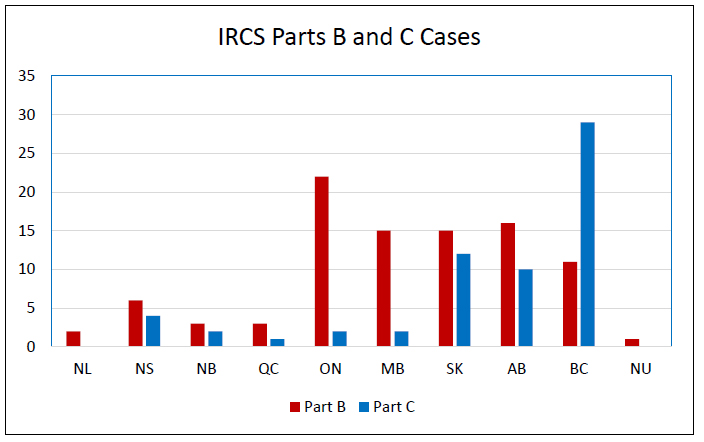
The breakdown of cases by province and territory is presented in the chart below. It shows that five of the larger jurisdictions, and especially B.C. and Ontario, had the preponderance of IRCS cases in the period.
Figure 3: Intensive Rehabilitative Custody and Supervision Program Parts B and C Cases by Jurisdiction during the Evaluation Period, 2009-10 to 2013-14
Source: Justice Canada IRCS case files
Figure 3 - Text equivalent
Bar graph showing the number of cases by province and territory.
| Province | Part B | Part C |
|---|---|---|
| NL | 2 | 0 |
| NS | 6 | 4 |
| NB | 3 | 2 |
| QC | 3 | 1 |
| ON | 22 | 2 |
| MB | 15 | 2 |
| SK | 15 | 12 |
| AB | 16 | 10 |
| BC | 11 | 29 |
| NU | 1 | 0 |
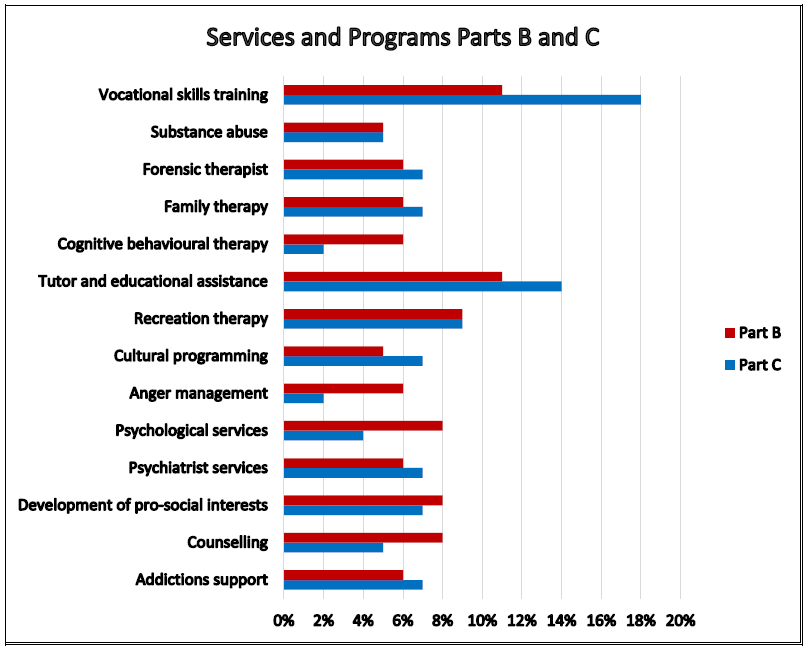
During their eligibility period for Parts B and C cases, youth in conflict with the law receive various programs and services according to their individual treatment plan after being assessed and diagnosed, and they can receive more than one service at a time. The following charts show the programs and services the young person received during the evaluation period. This information is based on 30% of the IRCS Program cases identified above – cases for which data was available in the Justice Canada program files. The reporting requirements have changed in the last few years and therefore more information is available now compared to the previous years.
Figure 4: Intensive Rehabilitative Custody and Supervision Program Parts B and C Services and Programs Provided between 2009-10 and 2013-14
Source: Justice Canada IRCS case files
Note: Percentages reflect participation in multiple programs, and do not add up to100%.
Figure 4 - Text equivalent
Bar graph showing the programs and services young persons received during the evaluation period.
| Services and Programs | Part B | Part C |
|---|---|---|
| Addictions support | 6% | 7% |
| Counselling | 8% | 5% |
| Development of pro-social interests | 8% | 7% |
| Psychiatrist services | 6% | 7% |
| Psychological services | 8% | 4% |
| Anger management | 6% | 2% |
| Cultural programming | 5% | 7% |
| Recreation therapy | 9% | 9% |
| Tutor and educational assistance | 11% | 14% |
| Cognitive behavioural therapy | 6% | 2% |
| Family therapy | 6% | 7% |
| Forensic therapist | 6% | 7% |
| Substance abuse | 5% | 5% |
| Vocational skills training | 11% | 18% |
Provincial and territorial key informants all expressed the view that the IRCS Program funding is critical. They said that there is still work to do to raise awareness in the justice community about the availability of funding for case-specific services tailored to the individual youth, and that the courts, especially outside major urban centres, are still not using the IRCS sentencing option as much as they would like to see. About half of the respondents reported emphasizing training, often using train the trainer models, given that there is not a lot of experience institutionally or among community-based service providers in serving the needs of the IRCS population. Several respondents from smaller jurisdictions indicated that they often send eligible youth under Part B to programs in other provinces because they do not have sufficient resources to provide the services. This is complicated by the fact that services tend not to be resourced where very few youth qualify for the services.
IRCS Program - Part D Funding Component Activities
Where available, if overall IRCS Program funding limits are not reached under Parts A, B and C, funding under Part D is provided for special projects related to the needs of youth meeting IRCS-related criteria. During the period of the evaluation, 195 projects were funded under Part D. The majority of the projects were for training, fora, workshops and professional development, and a few were for developing/updating assessment tools and for evaluation and research.
Tables 7 shows the number of Part D projects approved for funding in the evaluation period. While all jurisdictions had projects that were approved for funding, four provinces (Nova Scotia, Manitoba, Alberta and B.C.) each had more than 20 during this period. Nearly 60% of the projects approved for funding ranged in value from $10,000 to $50,000; 18% were approved for more than $100,000.
| Jurisdiction | 2009-10 | 2010-11 | 2011-12 | 2012-13 | 2013-14 | Total |
|---|---|---|---|---|---|---|
| NL | 3 | 3 | 2 | 0 | 0 | 8 |
| PE | 3 | 2 | 3 | 2 | 3 | 13 |
| NS | 10 | 7 | 2 | 2 | 3 | 24 |
| NB | 2 | 2 | 3 | 2 | 3 | 12 |
| QC | 1 | 2 | 1 | 3 | 9 | 16 |
| ON | 3 | 1 | 1 | 1 | 1 | 7 |
| MB | 8 | 6 | 3 | 3 | 1 | 21 |
| SK | 0 | 1 | 1 | 1 | 2 | 5 |
| AB | 4 | 2 | 6 | 4 | 5 | 21 |
| BC | 9 | 14 | 4 | 7 | 10 | 44 |
| YT | 1 | 1 | 1 | 1 | 0 | 4 |
| NT | 2 | 1 | 1 | 1 | 1 | 6 |
| NU | 5 | 4 | 3 | 0 | 2 | 14 |
| Total | 51 | 46 | 31 | 27 | 40 | 195 |
Source: Justice Canada IRCS Program files
While Part D projects represented a relatively small proportion of IRCS Program spending during the evaluation period, provincial and territorial officials were unanimous in supporting the availability of this funding component, especially for training and information exchange. This is viewed as particularly important, because IRCS sentencing by the courts and the provision of specialized assessment and therapeutic services for youth found guilty of violent offences, often with mental health and addictions issues, are still relatively new. Outside major urban centres such services are often not available, partly because there are few if any trained service providers or programs in those areas. Almost all of the respondents pointed to the high value of the IRCS programming and the importance of making it available as widely as possible.
In summary, the IRCS Program appears to be meeting its immediate outcomes by contributing substantially to an increased provincial and territorial capacity to provide specialized services, youth gaining access to those services, and opportunities for collaboration and knowledge development.
Youth Justice Fund
The YJF makes funds available for innovative projects for youth in conflict with the law through three streams: YJ Main Fund, Drug Treatment, and Guns, Gangs and Drugs. In addition to the development and implementation of pilot projects, some of the funding is for projects that provide information/education, help build capacity, and support the establishment of community links to youth justice. As well, the YJF seeks opportunities for dissemination of information and knowledge transfer about youth justice. Through the YJF, the Department expects to: increase responsiveness to emerging youth justice issues; increase community involvement in youth justice; and increase collaboration and knowledge development. Based on data on the nature of funded projects and an analysis of evaluation reports and case studies for a sample of projects, there is evidence that the YJF has contributed to these outcomes. Further research will be required to assess the longer-term effectiveness of the projects and their sustainability (where applicable) beyond the YJF funding period.
During the evaluation period, the YJF has provided funding to a total of 325 projects, divided among the three funding streams, as presented in Table 8 below.
| Fiscal Year | Main | Guns, Gangs and Drugs | Drug Treatment | Total |
|---|---|---|---|---|
| 2009-10 | 17 | 30 | 37 | 84 |
| 2010-11 | 13 | 31 | 15 | 59 |
| 2011-12 | 9 | 12 | 12 | 33 |
| 2012-13 | 14 | 39 | 27 | 80 |
| 2013-14 | 20 | 26 | 23 | 69 |
| Total | 73 | 138 | 114 | 325 |
Source: Justice Canada files
Ninety one percent of the projects were intended to improve the system's ability to rehabilitate and reintegrate young people in conflict with the law, in keeping with YJI objectives. Of those projects, 45% were funded under the Guns, Gangs and Drugs stream, 31% under Drug Treatment, and 24% under the Main fund. To further the objective of improving the justice response to youth, the YJF has recently produced two reports outlining some key lessons learned from Guns, Gangs and Drugs and Drug Treatment projects. These lessons learned reports identify findings from YJF projects that offer guidance for programs and servicesFootnote 17 and exemplify, through their dissemination in the youth justice community, the knowledge development and information sharing value of YJF projects.
Project evaluation reports
An analysis of a sample of 30 YJF project evaluation reports provides further detail as to the nature of the funded projects, and their linkages to the Fund’s anticipated outcomes. Thirteen of the 30 projects whose evaluation reports were reviewed emphasized the provision of information/education and the dissemination of information and knowledge on youth justice issues. Some of these produced written and /or video materials aimed at youth themselves (for example a comic book intended to dissuade youth from joining or staying in gangs) or guides and other written materials aimed at youth service providers, disseminated either at conferences/ workshops or through inter-agency connections. All of these were assessed by the project evaluators as having successfully produced and disseminated materials that were received as being of good quality and as valuable by users (youth and youth service providers) surveyed or interviewed.
Twenty-three of the projects for which evaluations were reviewed were pilot projects introducing an innovative service delivery approach, sometimes combined with research or information dissemination. Six of those were targeting youth either in gangs or at risk of falling into gang activity. Four targeted Aboriginal youth. Another five targeted youth with FASD. Evaluators of the projects were uniform in finding that the programs and services were considered as valuable by users and partners, and that they had resulted, at least in the short term, in improvements in the lives of the youth being served. The evaluations in about half the cases pointed to areas for improvement, typically in areas such as communications between the service providers and their partners in the justice system and other community agencies, and the need for more resources to expand capacity and improve post-program follow-up.
A sample of 30 evaluations of pilot projects was examined as part of this evaluation.Footnote 18 The findings demonstrate that a substantial number of these projects contributed to the achievement of the YJF immediate outcomes, at least to some degree. The longer-term impacts of the projects are unknown at this point, as is the extent to which the pilot projects have been sustained beyond the YJF funding period.
Case studies and Thematic Studies
The evaluation also conducted case studies and other thematic studies to collect more detailed information on a sample of six YJF projects and three other special YJI initiatives. Evaluators inquired through interviews, a review of available documents and on-site observation, about the extent to which the projects and initiatives contributed to the achievement of YJI objectives. Brief descriptions of the case study projects are provided in Appendix C.
The case studies and thematic studies demonstrated that YJF projects are indeed contributing to the achievement of YJI objectives by designing and testing new service delivery approaches in keeping with the intentions of the YCJA, producing research to further support improved service delivery, training service providers according to demonstrably effective methods, responding to emerging issues such as cyberbullying, and sharing and disseminating information to better inform youth justice stakeholders about promising approaches and useful programs and services. Long-term outcomes of the projects are not known, but the project evaluations and the examinations for this evaluation indicate a high degree of short-term success.
According to key informants working in youth justice, the YJF provides funds to “seed” innovative program ideas. They indicated that new youth justice issues were always emerging from YJF funding, and that funding and other forms of federal support would always be necessary in order to adapt to and address the issues.
In summary, YJF funding and other YJI activities were found to have made a positive contribution by engaging community-based programs and services, fostering innovation, and encouraging sharing of information and promising practices.
Policy Development, Research and Liaison and Outreach
The policy development, research and liaison and outreach component of the YJI does not have a grants and contribution funding element. It is responsible for providing analysis and development of youth justice law and policy, responding to emerging youth justice issues, promoting knowledge-sharing, and enabling greater community participation in the youth justice system. Through this work, it is anticipated that there will be legislation and policy that responds to federal government priorities and increased opportunities for information sharing and knowledge transfer. Evidence from a review of available documents and key informant interviews indicates that the Policy Unit has been providing valued policy and legislative advice on youth justice issues, and is actively engaged in research and knowledge-sharing activities. Provincial and territorial youth justice officials have valued the policy and legislative work that has been accomplished, but report a recent reduction in face to face meetings and genuine consultation on policies and legislative initiatives, in particular the recent YCJA amendments. This has diminished the quality of the working relationship, despite continued high quality communication at the officer level.
The YJI Policy Unit, which is part of the YJSIS, is the federal government’s centre of expertise on youth justice. The YJSIS provides legal and policy advice on both domestic and international youth justice matters based on the YCJA, supports the Minister in Cabinet and Parliament with respect to legislative and other initiatives, and works in collaboration with other sections within the Department of Justice and other federal departments, provincial and territorial government officials, and NGOs on matters relating to the youth justice system.
The major legislative activity during the evaluation period was a significant set of amendments to the YCJA. First introduced as a YCJA-specific bill, Bill C-4 was introduced in the House of Commons in March 2010 and was before the House of Commons Justice Committee when the 2011 federal election was called. After the election, the YCJA amendments were reintroduced as part of a broader criminal justice reform package known as the Safe Streets and Communities Act. This bill, Bill C-10, was introduced in September 2011 and received Royal Assent in March 2012. The YCJA amendments came into force on October 23, 2012.
The evaluation document review found that the development and implementation of the amendments to the YCJA made through Bill C-10 involved significant work by the youth justice policy group. Among other things, the policy development/legislative process/implementation processes involved:
- briefings for senior departmental officials, political staff and the Minister;
- consultations with provincial and territorial colleagues, along with the development of materials to support them in understanding the proposed changes to the YCJA;
- meetings with officials from other federal government departments (e.g. Correctional Services Canada);
- development of several Memoranda to Cabinet, along with additional materials to support the Minister at Cabinet;
- drafting of legislation;
- preparation of materials to support the government throughout the parliamentary process;
- appearances before parliamentary committees;
- support for the Minister in meetings with federal, provincial and territorial counterparts, the Canadian Bar Association and other key stakeholders;
- development of communications products to inform stakeholders and the public about the changes resulting from the legislation;
- in-person training for provincial and territorial officials and other criminal justice system stakeholders on the amendments; and,
- support for and review of public legal education materials on the amended YCJA prepared by Public Legal Education and Information (PLEI) organizations.
As previously noted, during the evaluation period, the Policy Unit also worked collaboratively with the Policy Sector at the Department of Justice and other federal government departments on a wide range of policy and legislative files, and provided advisory services on matters related to youth justice across government.
Another important aspect of the Policy Unit’s work is the special initiatives it undertook during the evaluation period to encourage more effective youth justice policy responses to emerging issues. Among other things, these initiatives included research, knowledge sharing, outreach and liaison. Some examples of these kinds of activities include:
- hosting of fora, workshops and expert roundtables on youth justice issues, such as youth with mental health issues in the criminal justice system; adolescent brain development; youth gangs; drug treatment for youth involved in the justice system; and bail and pre-trial detention;
- commissioning of research reports on emerging issues such as youth gangs; trauma and desensitization to violence; developmental science and youth justice; resilience and mental health; youth mental health courts; and transition from youth to adult justice systems;
- delivery of a series of webcasts for youth justice stakeholders and the public on various youth justice issues/initiatives, including justice system responses to youth with mental health problems or cognitive disabilities and youth resiliency; and,
- development, in partnership with the Royal Canadian Mounted Police (RCMP), of an on-line course for police and other front-line professionals on the YCJA.
A survey of 152 participants of ten YJI-sponsored events was commissioned by Justice Canada in 2011. The events included fora focused on drug treatment for youth involved in the justice system, youth corrections and mental health, programming for gang-involved youth, Section 6 referrals, and Youth Net events. About 350 stakeholders working in the youth justice field attended the events, with some attending more than one. The survey found that they were viewed as valuable in raising awareness and in informing youth justice professionals about effective practices, and that this learning had led, in some cases, to positive changes in strategies and programming.
Provincial and territorial youth justice officials interviewed for the evaluation were unanimous in their view that the development and implementation of the YCJA have been highly beneficial. These measures enabled them to reduce rates of custody and implement programs and services that present real alternatives to the courts and custody, and to better serve the needs of youth in serious trouble. The IRCS-related provisions and funding were especially cited as critical and positive, and the need for continued federal support in this area was highlighted by most informants.
The majority of provincial and territorial officials also said that communications with the Policy Unit at Justice Canada have been very helpful in addressing issues that have arisen, for example in developing approaches to encourage Crown, judges and law enforcement to make use of various options such as IRCS sentencing and extrajudicial measures, and in improving linkages with community-based services for youth. They pointed in particular to officer level phone and e-mail communications. Several of them cited the value of the CCSO meetings and working level meetings on policy and on the YJI funding agreements. In this area, however, there were some concerns raised by about half of the informants that the frequency of meetings has been reduced in the last five years, and that there has been insufficient opportunity recently to address policy issues such as the continued high rates of pre-trial detention and certain technical amendments to the YCJA that some provinces would like to see. Almost all provincial and territorial government respondents also said that they are no longer consulted in a meaningful way on federal policies and legislation affecting youth justice before they are set in stone. During this evaluation period, the key legislative activity was the package of YCJA amendments included in Bill C-10. With respect to this Bill, the provinces and territories said that these policies and legislation were brought to the federal, provincial and territorial table after the fact, with Justice Canada describing the upcoming changes rather than seeking feedback. They said that this represented an unwelcome departure from the previous consultation process.
In summary, the Policy Unit has produced legislation and policy that responds to federal government priorities, and has undertaken a range of successful activities to foster information sharing and knowledge transfer. A recent decline in policy consultation with provincial and territorial government counterparts was widely characterized as detrimental to what has been a positive working relationship in past years.
4.2.1.2 Intermediate and Long-term Outcomes
The activities undertaken under the YJI, including the work of the Policy Unit and the three funding streams, have brought a number of immediate outcomes including legislative initiatives, high priority programs and services at the provincial and territorial level and their heightened capacity to deliver specialized services for youth with severe problems, opportunities for collaboration and knowledge sharing, responses to emerging youth justice issues, and increased community involvement. With the continuation of YJI activities and the achievement of immediate outcomes, it is expected that in the intermediate and longer-term we should see:
- enhanced availability and use of opportunities for extrajudicial measures, rehabilitation and reintegration of young persons into their communities;
- responsive and appropriate policies, practices and legal framework;
- strengthened links among youth justice personnel and stakeholders;
- more integrated and coordinated approach to youth justice; and,
- improved responsiveness of the youth justice system.
Findings on progress in each of these areas are presented below.
Enhanced availability and use of opportunities for extrajudicial measures, rehabilitation and reintegration of young persons into their communities
Justice Canada has a direct role in enhancing the availability of extrajudicial measures and programs designed to rehabilitate and reintegrate youth into their communities, through its YJI funding programs. The evaluation has documented the fact that the YJI has contributed substantially to the ability of the provinces and territories to provide these measures and programs through its funding. In particular, it was found that these high priority areas represented close to 50% of all YJI program expenditures across the country (see Table 5, p. 31). Interviews with provincial and territorial youth justice officials confirmed that YJI funds were being used for those purposes, that in most jurisdictions a range of these programs are currently available, and that without YJI funding fewer of these types of services would be available.
Data on the extent of use of these services by young persons in the last five years by provinces and territories was not available to evaluators. However, the evaluation has demonstrated (see section 4.1.1) that there has been progress in the use of extrajudicial measures and community-based sentencing options and sanctions as against charges and custodial sentences, which indicates that the use of these alternatives has increased along with their availability. The literature points to some success in the use of these types of services, but identifies the fact that outside larger urban centres, such services are sometimes not available. Key informant interviews supported both these findings, pointing to the high value placed on the programs, but noting that the courts do not always take advantage of them in their sentencing, and that the programs are vulnerable to tight budget restrictions and not always available because of the high cost.
GOC has responsive and appropriate policies, practices and legal framework
By its nature, this expected outcome is subjective. In the academic literature (previously cited) and among youth justice practitioners interviewed for this evaluation, there appears to be wide agreement that programs in support of the YCJA have responded successfully to recognized emerging needs including alternatives to formal court proceedings and custody, increased and more diverse rehabilitative opportunities, and initiatives responding to issues such as FASD and cyberbullying. The Act and the supporting programs under the YJI have enabled provinces and territories to reduce the number and proportion of young persons receiving custodial sentences, and have helped develop a capacity to provide alternatives that are widely viewed as being better suited to addressing youth justice requirements than was the case under the YOA.
That does not mean that the job is done, of course. This evaluation has already reported on some remaining challenges, including persistently high pre-trial detention rates, disproportionately high charging and custodial rates for Aboriginal youth, and emerging issues such as cybercrime and the need for resources and infrastructure to provide for more programs and services outside large urban centres.
Justice Canada practices at the working level are viewed positively by their provincial and territorial partners and by those community-based program managers interviewed for the evaluation. These include practices associated with planning and administering the funding streams, and communications and collaborative practices associated with implementing the YCJA effectively. On the other hand, provincial and territorial officials noted a recent trend that they had not been given the opportunity to take an active role in the youth justice policy development process. In their view, recent policy and legislation, including the amendments to the Act, did not reflect the perspectives of partners.
A more integrated and coordinated approach to youth justice with strengthened links among youth justice personnel and stakeholders
Earlier in this section, evidence was provided of coordination and collaboration in the implementation of the YCJA. This included joint implementation planning at the CCSO and officer levels, tailored PLEI and other communications and training initiatives, and regular communication and reported responsiveness by Justice Canada officials to provincial and territorial government issues as they arose. It was also noted that the Department has participated in a number of international efforts to share information and practices on youth justice and to foster coordinated approaches.
Further examples of action leading to increased coordination included the:
- development, in partnership with the RCMP, of a new online course on the YCJA for police officers and other frontline criminal justice system personnel; and,
- sharing of resources and opening of training opportunities across jurisdictions (e.g. British Columbia preparing a presentation on lessons learned through IRCS for corrections professionals and inviting other provinces to attend).
The case studies and reviews of thematic initiatives on FASD, cyberbullying and PLEI conducted for this evaluation also demonstrated the contributions of YJF projects and Justice Canada-initiated projects to increased integration and coordination.
The YJI, through webcasts and workshops, has enabled information-sharing about different innovative approaches to effectively serving youth with FASD. In addition, the various meetings, webcasts and research studies regarding FASD that were funded by the Department have facilitated knowledge-sharing among youth justice professionals in Canada.
Almost all Justice Canada key informants and provincial and territorial representatives agreed that YJI had contributed to a more integrated and coordinated approach to youth justice in Canada, through formal and informal federal, provincial and territorial collaboration and especially through funding that has brought improved and more coordinated programs and services. The exception, as previously noted, was the perceived shortcomings in the consultation process with the provinces and territories on policy development.
Improved responsiveness of the youth justice system
In the long term, the YJI seeks to enhance the ability of the youth justice system to respond effectively to youth crime in ways in keeping with the objectives of the YCJA. It is expected, then, that the justice system will be able to offer accessible and effective alternatives to the formal court process and to custody where this is warranted.
The evaluation has focused on what is achievable within the (at least) partial control of the federal government, which is to help ensure that alternatives are available and accessible. The evidence to date, presented in previous sections of this report, has shown that the YJI has contributed substantially to the availability of a range of new programs and services that are widely viewed as progressive and effective in improving the youth justice response. The evaluation has also presented data that indicates that these programs and services are being accessed by virtue of the significant reduction in youth criminal court cases, and custodial sentences in the last ten years. The police, Crown offices and the courts are all reported to be taking advantage of the greater flexibility that the YCJA encourages, and extrajudicial measures in particular are being widely used. In general and especially in IRCS-related cases, the availability and use of alternative programs and services in larger urban centres is greater than in smaller centres, and interviews for the evaluation indicated that this variance needs to be reduced.
A remaining area of concern is the number of youth in pre-trial detention.
Before the YCJA came into effect, there was evidence that pre-trial detention was being used excessively. In particular, youth who had been charged with relatively minor offences, were being detained – even for charges for which adults would not be detained. Pre-trial detention was used as a way of responding to a youth's social-welfare needs rather than for legitimate criminal law reasons.
Most of the provisions related to pre-trial detention under the YOA were not changed with the coming into force of the YCJA, including the application of the Criminal Code. However, in response to concerns about the over-use of pre-trial detention, the YCJAincluded the following changes:
- Pre-trial detention could not be used as a substitute for child protection, mental health or other social measures;
- If a young person would otherwise be detained, the judge was required to inquire as to whether a responsible adult was available to take care of the young person as an alternative to pre-trial detention; and,
- If the young person could not be sentenced to custody if found guilty, the judge was required to presume that pre-trial detention of the young person was not necessary for the protection or safety of the public.
Despite the changes to the pre-trial detention provisions and the YCJA’s overall objective of reducing over-reliance on custody, pre-trial detention rates have remained relatively stable under the YCJA. As noted above, the pre-trial detention rate (per 10,000 youth population) has decreased over time: from 4.4 in 1999-2000 (a few years pre-YCJA to 4.6 in 2002-03 (the year before the YCJA) to 3.8 in 2009-10 to 3.2 in 2013-14. This is in contrast to the significant decreases in sentenced custody rates that have been realized since the YCJA came into force.
However, there are some statistical trends relating to pre-trial detention that are more positive. Fewer youth (27%) began their involvement with the youth correctional system in pre-trial detention in 2013-14 compared to 2009-10 (41%) and 2002-03 (33%)Footnote 19. In 2013-14, there were slightly more than 7,000 youth admitted to pre-trial detention, representing approximately four out of five (79%) of youth custody admissions that year. In comparison, youth admissions to pre-trial detention made up 64% of admissions to custody in 2002-03 and 80% in 2009-10. There were just over 1,500 youth admitted to sentenced custody (secure and open), representing 17% of all youth admissions to custody in 2013-14. Although more frequent, pre-trial detention is generally of shorter length: 54% of youth released from pre-trial detention in 2013-14 served one month or less compared to 42% of those youth released from sentenced custody.Footnote 20
In 2012, the pre-trial detention provisions in the YCJA were amended by Parliament. The objective of the amendments was to reduce complexity in order to facilitate effective decision-making at the pre-trial stage. This means that where possible, youth are managed in the community, while those who should be detained are detained.
Rather than applying the grounds for detention in the Criminal Code to youth, the amendments created a new stand-alone test for pre-trial detention of youth in the YCJA. Now a court may detain a youth if the following criteria are met:
- The youth has been charged with a serious offence (an offence for which an adult would be liable to imprisonment for five years or more) or has a history of either outstanding charges or findings of guilt;
- One of the following grounds exists:
- There is a substantial likelihood that, if released, the youth will not appear in court when required;
- Detention is necessary for public protection, having regard to the circumstances, including whether there is a substantial likelihood that the young person will, if released, commit a serious offence; or
- If the youth has been charged with a serious offence and neither (i) nor (ii) applies (i.e., detention is not necessary to ensure that the youth appears in court or to protect the public), but there are exceptional circumstances that justify detention as necessary to maintain confidence in the administration of justice; and
- Release of the youth with conditions would not be sufficient to address the court's concern about releasing the youth.
It is still too early to assess the impact of the 2012 amendments on the numbers of youth held in pre-trial detention. This will be examined as part of the next five-year evaluation of the YJI.
The pre-trial detention of youth has been the subject of significant study over the years. Numerous academics have written on the topicFootnote 21 including recently Bell (2015)Footnote 22 and Sprott (2012)Footnote 23. Some of the factors identified as contributing to the pre-trial detention of youth include the following:
- YCJA provisions regarding pre-trial detention apply only to the courts, not to police who are continuing to use detention of youth at a relatively high rate (Bell);
- Administrative offences, including failure to appear in court and failure to comply with bail or probation, result in pre-trial detention at relatively high rates (Sprott, 2012). Sprott maintains the YCJA is ambiguous with regard to how courts should manage young persons in such cases and, as a result, it appears some judges may be deciding to impose pre-trial detention for youth charged with administrative offences. The reasoning may be that with these types of charges, the youth is likely to fail to appear for his/her next hearing, or that he/she may continue to breach bail or probation conditions if released. On that basis, pre-trial detention would be imposed; and,
- The denial of bail may be more frequent than necessary, in spite of the 2012 amendments to the YCJA intended to clarify the use of pre-trial detention. The decision to grant bail remains discretionary on the part of a Judge or Justice of the Peace, as noted above. If the presiding court official concludes, for example, that a youth is unlikely to attend his/her next court date, he/she is likely to be denied bail and detained. This can be particularly problematic for certain social groups, including poor and Aboriginal individuals, who are not as likely to provide positive responses to the court official’s questions regarding, for example, employment, education, place of residence, and family/community connections. Confounding this problem is the fact that there is a tendency among many judges in Canada to impose a custodial sentence at final sentencing when pre-trial detention has previously been imposed. These issues were noted as long ago as 1991 in the final report of the Aboriginal Justice Inquiry of Manitoba and have been subsequently confirmed by other commissions of inquiry, as well as by Justice Brent Knazan of the Ontario Court of Justice.Footnote 24
The literature suggests one approach to the problem should involve ensuring the existence of alternative programming (instead of pre-trial custody). However, according to Clark and Landau (2012)Footnote 25 among others, the lack of alternative programming for cases proceeding through the courts is a widespread problem in Canada, especially in rural and isolated areas and even more so for Aboriginal youth. Another proposed strategy would involve more effective education of police and courts about the dangers of over-using pre-trial detention and about available options (Sprott, 2012). It may also be appropriate for bail support programs, such as that offered by the Aboriginal Bail Program in Toronto, to be established in support of young individuals who might otherwise have no recourse to a surety or other supports.
Some YJI projects have undertaken interesting work to address these issues. Several of the case studies undertaken for this evaluation have shown that even relatively small organizations are able to provide alternatives and to educate courts and police through direct educational efforts or through other forms of communication and collaboration. For example, the Summerville Project of the John Howard Society of Ottawa (safe housing and counselling for disadvantaged young women) is a good example of what can be achieved in this regard. With the Summerville Project in place, key informants at John Howard Ottawa say they are having a positive impact on rates of pre-trial detention for young women in the Ottawa area. The courts are becoming increasingly aware of the program as an alternative and police increasingly collaborate with the program as they learn about it. Developments such as Summerville point to the continuing need for the YJI in its support of regional and community-based organizations, as well as continuing collaboration with provinces and territories.
The apparent over-use of pre-trial detention is a serious issue that requires further research regarding causes and the provision of meaningful responses. The YJI has the potential to make significant contributions in this regard.
In summary, there is evidence that the youth justice system is better equipped as a result of the YJI to respond effectively to youth crimes in keeping with the YCJA, and there is evidence that the response has improved as a result. It appears that there remain challenges in making alternative programs available and accessible, especially in remote and isolated parts of the country. It is also evident that the apparent over-use of pre-trial detention must be addressed.
4.2.2. Efficiency and economy
4.2.2.1 Unfulfilled need
The evaluation was unable to determine conclusively whether or not YJI resources were sufficient to meet its objectives, in large part because YJI objectives are comprehensive and long-term and rely heavily on programs and services that are the responsibility of provincial and territorial governments.
All budgeted YJSFP funds and most funds under the IRCS Program and YJF streams were used by the provinces and territories and other stakeholders. The YJF funding stream is reliant on applications from external agencies that do not always meet program criteria. In the case of the IRCS Program funding, much of that is dependent on court orders for the provision of services, and on the nature of individual youth justice cases and the decision of judges to issue IRCS court orders. YJI program files provide breakdowns of spending by the provinces and territories (see section 4.2.1). They indicate that provincial and territorial government spending on youth justice has increased over the five-year period of the evaluation, that IRCS spending was consistent throughout the evaluation period, that YJI funding decreased in 2012-13 and 2013-14, and that funding under the YJSFP was reduced in the new agreements starting in 2013-14. The reductions in both cases were due to broad federal government budget restraints. Spending data and evidence from key informant interviews suggest that recent reductions have meant that there is a greater onus on the provinces and territories to pay for needed programs and services. To the extent that these services are needed and would benefit from greater resources, and to the extent that other effective programs and services might be available with greater resources, federal spending reductions may be diminishing the ability to meet objectives at present.
In discussing the recent reductions in federal spending, several key informants at Justice Canada noted that the cutbacks in operations budgets may have increased efficiency in the short term, but that there may be resulting reductions in programs and services and associated benefits to the justice system as a result.
In assessing the sufficiency of federal contributions through the YJI, provincial and territorial representatives were in agreement that all the programs and resources were needed to implement the YJI in their jurisdictions. Respondents mentioned that there was a national trend towards decreased numbers of young persons involved in the youth criminal justice system and numbers of youth in custody (although there were a few jurisdictional exceptions to this trend). This trend had allowed many of the provinces and territories to absorb the recent funding cuts to the YJSFP. However, they said that it was too early to tell if these trends were going to be maintained and what the impact of the funding cuts would be if they were not. Those who could not absorb the cuts reported partial closures of some programs. Smaller jurisdictions were also more likely to report that they did not have the same economies of scale as the other jurisdictions, and so were more likely to suffer from the budget cuts.
Another trend provincial and territorial respondents mentioned was that they were seeing more youth with serious, compounded issues (especially mental health issues such as FASD and addictions) coming through the youth justice system. For some, it was in part because the system was better at identifying them. These youth require high levels of care which has been costly and not always available locally, especially in smaller urban regions and rural areas. Some of these high needs youth were also not eligible for IRCS but some respondents felt that they would have greatly benefited from the program (there was regional variation in whether this issue was reported or not). Respondents also worried about the impact of the funding cuts to YJSFP on the effectiveness of the IRCS Program. The IRCS Program was seen as most effective when layered on top of an overall youth justice system with a flexible range of programs and services, and that it would work less well when cuts to the overall system were made, in spite of IRCS Program funding remaining the same.
4.2.2.2 Cost of producing program outputs
On the whole, the YJI appears to be operated very efficiently, with low administrative costs and with actual spending corresponding reasonably to budgeted costs. Generally speaking, YJI spending reductions in the period related to overall federal government fiscal restraint.
For the YJSFP and IRCS Program funding streams, administrative costs were below 1% of total expenditures in the evaluation period, reflecting efficient program delivery and a simplified funding structure based on standard agreements and reporting protocols. Once agreements were in place, most administrative activities centered on the monitoring of expenditure claims. For the YJF, figures ranged between 5.2% and 7.8% in the five-year period. The higher figures for the YJF are explained by the relatively small size of the Fund and the requirement for more active involvement in project development and evaluation. There has been a considerable range and diversity of projects eligible for funding through the Program and many different organizations applied for and received funding. YJF staff members were actively involved in the development of some projects including those relating to emerging issues such as cyberbullying, and the YJF team helped to host some information-sharing events. The figures for YJF administration costs relative to overall expenditures are within the acceptable range.Footnote 26
It is worth noting that in 2014 there was a reduction of YJF staff from three program analysts and an administrator to one program analyst, with a PM-2 and a Director position vacant. This could have an impact on the effectiveness of the Fund going forward.
Tables 9, 10 and 11 show the administrative costs associated with the three funding program streams.
| Year | Total Admin | G&Cs | Total Costs | Admin as % of total |
|---|---|---|---|---|
| 2009-10 | 208,192 | 177,302,415 | 177,510,607 | 0.12% |
| 2010-11 | 111,467 | 177,302,415 | 177,413,882 | 0.06% |
| 2011-12 | 146,764 | 177,302,415 | 177,449,179 | 0.08% |
| 2012-13 | 157,888 | 177,302,415 | 177,460,303 | 0.09% |
| 2013-14 | 194,343 | 141,692,415 | 141,886,758 | 0.14% |
Source: Youth Justice Initiative, YJSFP administrative data
| Year | Total Admin | G&Cs | Total Costs | Admin as % of total |
|---|---|---|---|---|
| 2009-10 | 84,223 | 11,048,000 | 11,132,223 | 0.75% |
| 2010-11 | 72,109 | 11,048,000 | 11,120,109 | 0.65% |
| 2011-12 | 82,774 | 11,048,000 | 11,130,774 | 0.74% |
| 2012-13 | 144,251 | 11,048,000 | 11,192,251 | 1.28% |
| 2013-14 | 164,024* | 11,048,000 | 11,212,024 | 1.46% |
Source: Youth Justice Initiative, IRCS administrative data
*The increase in administrative costs in 2013-14 was due to the return of a staff member from maternity leave and the retention of the replacement staff member in order to support the YJI renewal process and to strengthen capacity to support the transition to a new team lead.
| Year | Total Admin | G&Cs | Total Costs | Admin as % of total |
|---|---|---|---|---|
| 2009-10 | 333,856 | 5,005,000 | 5,429,761 | 6.14% |
| 2010-11 | 308,853 | 5,005,000 | 5,904,259 | 5.23% |
| 2011-12 | 384,518 | 5,005,000 | 5,996,907 | 6.41% |
| 2012-13 | 392,689 | 4,505,000 | 5,335,520 | 7.36% |
| 2013-14 | 384,848 | 4,505,000 | 4,920,334 | 7.82% |
Source: Youth Justice Initiative, YJF administrative data
NOTE: Given that the YJF did not have a separately coded budget for most of the evaluation period, administrative costs were determined by salary dollars of Fund staff.
The evaluation also examined planned and actual spending under the three YJI funding streams, as a measure of the appropriateness of YJI budgeting and effective resource management. Tables 12, 13 and 14 provide figures for each funding stream for the five fiscal years under observation. The tables show that expenditures for the YJSFP and IRCS programs were closely aligned with planned expenses. For the YJF, expenses in 2011-12 and 2012-13 were below budgeted amounts. This situation has arisen largely as a result of increased requirements for senior-level approval of projects and subsequent delays in funding decisions.
| Year | Planned Spending | Actual Spending |
|---|---|---|
| 2009-10 | 177,302,415 | 177,302,415 |
| 2010-11 | 177,302,415 | 177,302,415 |
| 2011-12 | 177,302,415 | 177,302,415 |
| 2012-13 | 177,302,415 | 177,302,415 |
| 2013-14 | 141,692,415 | 141,692,415 |
Source: Youth Justice Initiative, YJSFP administrative data
| Year | Planned Spending | Actual Spending |
|---|---|---|
| 2009-10 | 11,048,000 (*) | 10,561,587 |
| 2010-11 | 11,048,000 | 10,929,773 |
| 2011-12 | 11,048,000 | 10,701,290 |
| 2012-13 | 11,048,000 | 10,872,387 |
| 2013-14 | 11,048,000 | 10,770,273 |
Source: Youth Justice Initiative, IRCS administrative data
$300,000 in contributions was transferred from Youth Justice IRCS to an Access to Justice Services to address the needs of the three territories for legal aid, Aboriginal Courtworker, and Public Legal Education and Information services.
| Year | Planned Spending | Actual Spending |
|---|---|---|
| 2009-10 | 5,005,000 | 4,429,439 |
| 2010-11 | 5,005,000 | 4,445,028 |
| 2011-12 | 5,005,000 | 2,932,291 |
| 2012-13 | 4,505,000 | 3,263,515 |
| 2013-14 | 4,505,000 | 3,748,904 |
Source: Youth Justice Initiative, YJF administrative data
A third measure of the economy of the YJI is how the costs compare to the costs of the youth justice system, and what savings there might be in administering youth justice with support from the YJI. The overall cost of youth justice in 2010 is estimated at $1.34 billion including police, court, prosecution and legal aid costs, and youth justice programs and services account for the majority ($738.4 million).Footnote 27 For example, to the extent that the YJI has supported and encouraged the provinces and territories to put in place programs and services that are used as alternatives to formal court processes and custody, an analysis could be undertaken to compare the costs of the programs and services against savings in court and custodial costs. Complicating factors in such an analysis include:
- the extent to which the programs and services help to prevent reoffending by participants;
- the extent to which the 2012 amendments to the YCJA that emphasize public safety may have led to the use of custody in some cases;
- changes over time in the overall costs of youth justice and factors other than the YCJA and the YJI that have influenced those changes; and,
- variations among provinces and territories, and in regions within provinces and territories, in youth justice costs and in the availability and uptake of programs and services supported by the YJI.
With available data, the evaluation was not able to assess the economy of the YJI from this perspective. However, it is plausible, given the high cost of custody, that alternative community-based programs and services offer an economical alternative, other factors being equal.
4.2.2.3 Lessons learned
The evaluation found a lesson learned relating to provincial and territorial reporting on the nature of YJI expenditures, and drew on two recent YJF lessons learned reports to identify some key findings to guide future youth justice programs and services.
In response to the recommendations in the 2010 YJI Evaluation report, Justice Canada developed an YJSFP reporting template and enhanced the IRCS Program Facesheet/Chronology report. The YJSFP reporting template captures consistent information reported by all provinces and territories, which helps the Department by having up to date information about programming and services available in each jurisdiction. The IRCS Program Facesheet/Chronology report also captures consistent information on youth utilizing the Parts B or C funding components of the IRCS Program.
In Section 4.1, it was noted that YJF staff recently compiled two reports of lessons learned from Guns, Gangs and Drugs and Drugs Treatment projects. Examples of the findings in these reports, presented below, offer insight into potential guidance for youth justice programs and services.
- Youth who have been found guilty of an offence face unique personal barriers to community reintegration and/or to accessing appropriate rehabilitative services. In addition to challenges pertaining to youths’ gang affiliation, many youth came to projects with several other issues and challenges, such as: criminal charges; a pro-crime attitude or orientation; addictions; mental health issues; learning disabilities; negative past experiences with school; limited pro-social attachments or few positive peer connections; dysfunctional or traumatic home environments; and/or a lack of family support. These complex individual issues ultimately shaped and affected youths’ participation in the various projects. As a result, while the reasons for joining a youth gang are varied, youth who are involved in gangs or at risk of gang involvement need significant help in developing positive social support systems outside of their gang, in making positive personal change, and in reintegrating into their communities.
- Youth involved in gangs or at risk of gang involvement also face multiple, complex systemic issues. Beyond personal or individual factors that contribute to risk for gang involvement, challenging structural conditions at the community level such as poverty, racism, and under-resourced communities also affect youths’ likelihood of joining a gang.
- Youth engagement is critical. Initiatives reported that youth did not always come to the program/project with an open mind, even if they later became enthusiastic about it. Engaging youth at the outset was a challenge. Building youth engagement and connection takes time and should be factored into careful planning at the outset.
- Establishing buy-in and strong partnerships from the outset are key. In all projects, collaboration and networking were deemed to be extremely important in realizing the goals and objectives of the Initiative. A project is, ultimately, only as strong as the partnerships upon which it is built; these partnerships are key to securing referrals, gaining access to needed community supports for youth, spreading the word about an initiative, building trust in and support for the project, creating a greater sense of ownership in the community for the project, and a range of other spin-off benefits.
- A key issue when working with gang-involved youth is building trust. The issue of trust permeates work undertaken with youth involved in gangs and gang behaviours. Trust is a core issue that has to be addressed to make any progress with a gang-involved youth.
- Including culturally relevant programming. Many Aboriginal youth have been disconnected from their heritage and have not experienced traditional cultural activities. Offering culturally appropriate programming was observed to help provide Aboriginal youth with an opportunity to forge links with their history, their community and their traditions, to encounter and interact with positive Aboriginal role models, and to build identity and a sense of belonging.
- Youths’ schedules should be taken into consideration. Youths’ schedules differ from those of adults, with the result that services cannot only be provided from 9 am to 5 pm. As well, youth often experience crises in the evenings and on weekends, and having supports in place to address these is considered a best practice.
- Offering services to youth where they live is desirable. Some projects emphasized the need – in cases where it is safe to do so – for youth to participate in project sites closer to, or within, the communities in which they live. This was seen as an important strategy to help reduce inefficiencies, as well as to ensure that youth have ready access to supports closer to home. It was thought that local resources would help promote a greater sense of community attachment and involvement among youth, and help youth overcome historic trauma and fear of their communities.
- Programs should offer a non-threatening, comfortable environment for youth. The physical spaces in which youth initiatives operate as well as their overall “vibe” can have a significant impact – with projects providing a safe, comfortable, relaxed environment more likely to help put youth at ease and fully engaged. In contrast, initiatives that did not have an appropriate space for youth participants – either initially or throughout the entire life of the program – identified this lack as a problem.
- It is important to provide youth with a role model or mentor. Mentorship was identified as a key success element by many programs, as well as a promising strategy for preventing and reducing gang involvement.
4.2.2.4 Alternatives
The evaluation examined the question of whether there are other options to the current management approach for the YJI that could realize the same/similar outputs in different ways or at a lower cost.
Information sources for this evaluation indicated that the YJI is a well-run and effective initiative. Because of the predominance of grant and contribution funding and the very low administrative costs associated with the operation of the funds, options to realize the same/similar outputs in different ways or at a lower cost are not apparent. Key informants did not provide concrete suggestions for more efficient and effective approaches.
- Date modified: