
Evaluation of Federal Support for Family Justice
Appendices
Appendix A: Evaluation Matrix
Issues and Questions |
Performance Indicators |
Lines of Evidence (Described in Appendix C) |
|||||
|---|---|---|---|---|---|---|---|
Surveys |
Justice Canada Studies |
Documents and File Review |
Focus Group |
Process Mapping Costing |
Key Informants |
||
Relevance |
|||||||
1. Is there evidence of an ongoing need for the Department to work in the area of family justice? |
1.1 Legal trends/policy gaps/emerging issues and policy needs related to family justice and children’s law |
● Yes |
● Yes |
|
● Yes |
|
● Yes |
1.2 Perceptions of continued need for family justice, and children’s law legal and policy work |
|
|
● Yes |
● Yes |
|
● Yes |
|
2. Is there a continued need to support the delivery of family justice services? |
2.1 Number/nature of applications for SFI and CFJF project funding/number of projects funded |
|
|
● Yes |
|
|
|
2.2 Perceptions of the continued need for support |
|
|
● Yes |
● Yes |
|
● Yes |
|
3. To what extent do the core family justice activities remain relevant? |
3.1 Constitutional and statutory authority for core activities |
|
|
● Yes |
|
|
|
3.2 Perceptions of relevance of core activities |
|
|
● Yes |
● Yes |
|
● Yes |
|
4. To what extent are the family justice activities consistent with government priorities, federal roles and responsibilities? |
4.1 Federal government and Department documents demonstrate alignment |
|
|
● Yes |
|
|
|
4.2 Department mandate documents and FCY policy documents demonstrate consistency |
|
● Yes |
● Yes |
|
|
|
|
4.3 Evidence and perceptions of consistency of FCY with the federal role and responsibilities in the administration of justice (including collaboration and coordination with provinces and territories) |
|
|
● Yes |
● Yes |
|
● Yes |
|
Effectiveness |
|||||||
5. To what extent has the FCY delivered high quality legal and legal policy advice on domestic and international family law and children’s law issues? |
5.1 FCY legal and legal policy advice is responsive to client needs (e.g. relevant, timely, useful) |
● Yes |
● Yes |
● Yes |
|
|
● Yes |
5.2 Extent to which FCY is consulted on family law and children’s law issues |
|
|
● Yes |
|
|
● Yes |
|
5.3 Extent to which FCY legal and legal policy advice is considered by decision makers (e.g. decision makers are aware of policy options, legal risks, legal options). |
● Yes |
|
|
|
|
● Yes |
|
6. To what extent has the Department contributed to strengthen federal capacity to respond/ address the needs of families, children and youth in the areas of family justice and children's law? |
6.1 Number/type of legal and legislative policy developments supported |
● Yes |
● Yes |
● Yes |
|
|
|
6.2 Number/type of collaborative mechanisms used (within Justice, interdepartmentally, and with FPT and stakeholders) |
● Yes |
|
● Yes |
|
|
|
|
6.3 Number/type of public or professional legal information, learning/ training activities/products |
|
|
● Yes |
|
|
|
|
6.4 Number/type and use of funds as policy levers and implementation of program efficiencies (e.g. SFF, CFJF, FLAS) |
|
|
● Yes |
|
|
|
|
6.5 Perceptions that FCY’s activities products and family justice services have contributed to federal capacity to respond and address family justice issues |
● Yes |
|
|
|
● Yes |
● Yes |
|
6.6 Identification of capacity gaps in federal response to address legal and policy family justice issues |
● Yes |
● Yes |
|
|
● Yes |
● Yes |
|
7. To what extent has the Department contributed to increased awareness, knowledge and understanding of family justice and children’s law issues? |
7.1 Evidence that FCY has contributed to increased awareness, knowledge and understanding of family justice and children’s law issues |
|
|
● Yes |
|
|
|
7.2 Perceptions that the Department has contributed to increased awareness, knowledge and understanding of family justice and children’s law issues |
● Yes |
|
|
|
|
● Yes |
|
8. To what extent has the Department contributed to improved capacity in the provinces and territories to provide and deliver family justice services? |
8.1 Evidence that the Department has contributed to PT capacity to provide and deliver family justices services |
|
|
● Yes |
|
|
|
8.2 Perceptions that FCY has contributed to capacity to address family justice in Canada |
● Yes |
|
|
|
● Yes |
● Yes |
|
9. To what extent has the Department contributed to increased access to family justice for Canadians? |
9.1 Perceptions that the Department has contributed to increased access to family justice for Canadians in the areas of family justice and children’s law |
● Yes |
|
|
|
● Yes |
● Yes |
Efficiency |
|||||||
10. How have departmental resource levels affected the results achieved? |
10.1 Assessment of level of resourcing allocated and expended overall and by each core activity |
|
|
● Yes |
|
|
● Yes |
11. Are the CFJF and FLAS being administered efficiently? Was the SFF administered efficiently? |
11.1 Assessment of operational efficiency of CFJF and FLAS |
|
|
● Yes |
|
● Yes |
● Yes |
11.2 Percentage of time that the IAID met the departmental service standards in the administration of CFJF projects |
|
|
● Yes |
|
|
● Yes |
|
12. What are the costs and benefits of supporting programs and alternatives to court for families and the family justice system? |
12.1 Assessment of costs and benefits of programs and services supported through the SFF and CFJF |
|
|
● Yes |
|
● Yes |
|
13. Are there any best practices or lessons learned in the delivery of core activities? |
13.1 Perceptions of best practices or lessons learned (e.g. governance, integration, coordination and policies of the different functions/activities; delivery of CFJF and FLAS) |
|
|
|
● Yes |
|
● Yes |
Appendix B: Logic Models
The Logic Model for Federal Support for Family Justice, provided below, outlines five key components or activities as well as the intended outputs and outcomes.
Logic Model for the Federal Support for Family Justice
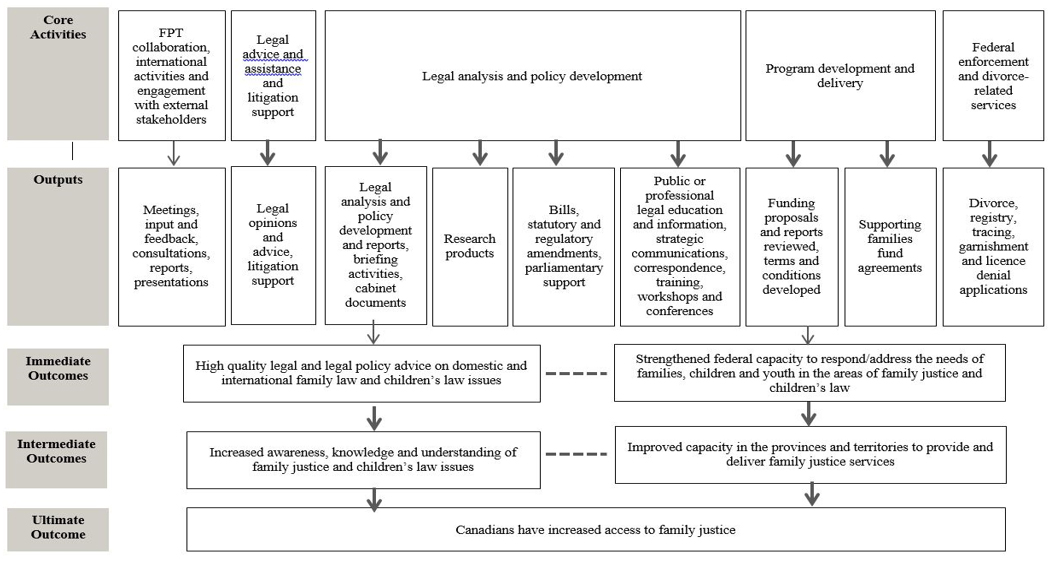
Text version – Logic Model for the Federal Support for Family Justice
The Logic Model for Federal Support for Family Justice outlines the links between the core activities, outputs and outcomes. The logic model illustrates the relationship between these components by using arrows to show its intended effects. Each component follows the other in consecutive order. The Core Activities produce the Outputs, which feed into the Immediate, Intermediate and Ultimate Outcome. Each core activity, output and outcome is individually boxed.
The core activities are:
- FPT collaboration, international activities and engagement with external stakeholders;
- Legal advice and assistance and litigation support;
- Legal analysis and policy development;
- Program development and delivery;
- Federal enforcement and divorce-related services.
The Outputs are:
- Meetings, input and feedback, consultations, reports, presentations;
- Legal opinions and advice, litigation support;
- Legal analysis and policy development and reports, briefing activities, cabinet documents;
- Research products;
- Bills, statutory and regulatory amendments, parliamentary support;
- Public or professional legal education and information, strategic communications, correspondence, training, workshops and conferences;
- Funding proposals and reports reviewed, terms and conditions developed;
- Supporting families fund agreements;
- Divorce, registry, tracing, garnishment and license denial applications.
The Immediate Outcomes are:
- High quality legal and legal policy advice on domestic and international family law and children’s law issues;
- Strengthened federal capacity to respond/address the needs of families, children and youth in the areas of family justice and children’s law.
The Intermediate Outcomes are:
- Increased awareness, knowledge and understanding of family justice and children’s law issues;
- Improved capacity in the provinces and territories to provide and deliver family justice services.
The ultimate outcome is: Canadians have increased access to justice.
A Logic Model has also been developed specifically for the Canadian Family Justice Fund. The Logic Model provided below outlines the priorities, core activities and intended outcomes of the CFJF.
Logic Model for the Canadian Family Justice Fund (2017-2022)
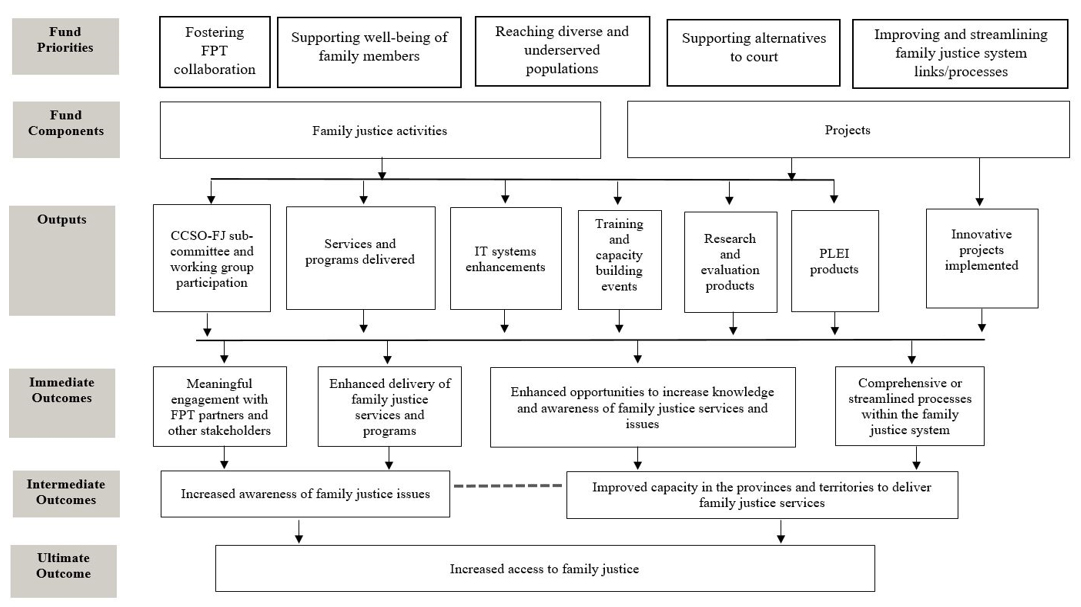
Text version – Logic Model for the Canadian Family Justice Fund (2017-2022)
The Logic Model for the Canadian Family Justice Fund outlines the links between fund priorities, fund components, outputs and outcomes. The logic model illustrates the relationship between these elements by using arrows to show its intended effects. Each element follows the other in consecutive order. The Fund Priorities feed into the Fund Components, which produce the Outputs, Immediate, Intermediate and Ultimate Outcome. Each priority, component, output, and outcome is individually boxed.
The Fund Priorities are:
- Fostering FPT collaboration
- Supporting well-being of family members
- Reaching diverse and undeserved populations
- Supporting alternatives to court
- Improving and streamlining family justice system links/processes
The Fund Components are:
- Family justice activities
- Projects
The Outputs are:
- CCSO-FJ sub-committee and working group participation
- Services and programs delivered
- IT system enhancements
- Training and capacity building events
- Research and evaluation products
- PLEI products
- Innovative projects implemented
The Immediate Outcomes are:
- Meaningful engagement with FPT partners and other stakeholders
- Enhanced delivery of family justice services and programs
- Enhanced opportunities to increase knowledge and awareness of family justice services and issues
- Comprehensive or streamlined processes within the family justice system
The Intermediate Outcomes are:
- Increased awareness of family justice issues
- Improved capacity in the provinces and territories to deliver family justice issues
Appendix C: Methodology
The evaluation relied on multiple lines of evidence that were triangulated and used to arrive to major conclusions. Data collection occurred throughout the period covered under the evaluation (e.g. annual surveys), although the majority of research was completed during 2017 and 2018. The lines of evidence included a document review, a review of project data and files, directed studies, key informant interviews and a focus group. A more detailed description of various data sources is provided below.
Surveys
Several surveys were conducted to assess the outcomes of the Department’s support to family justice. Surveys helped measure the extent to which the FCY Section offered high quality legal and legal policy advice on domestic and international family law and children’s law issues, the extent to which SFF funded PEPs and mediation services increased awareness, knowledge and understanding in the areas of family justice, and the impact of the CRDP, FOAEAA and GAPDA-related training on participants. A separate survey gathered information on the characteristics of cases handled by family law practitioners in Canada and current family law issues.
FCY Partner/Stakeholder Survey
An online survey was administered to key FCY federal contacts who accessed FCY legal or policy advice or litigation support. The survey was administered to measure their awareness of the policy options, legal risks and legal options. The questionnaire was sent to 34 partners/stakeholders who had received legal and/or legal policy advice from the FCY Section, of whom 10 responded.
SFF Funded Exit and Follow-up Surveys
Surveys were administered to participants in the PEP and mediation services through years 2014 and 2018 directly after their participation (Over 16,000 PEP participants and 650 mediation clients have completed surveys over a four-year period (2014-15 through 2017-18). These surveys were conducted to measure expected outcomes of these SFF funded programs, such as the increased awareness, knowledge and understanding of family justice.
FCY Event Surveys
Ten event surveys were conducted between 2014 and 2018 to those participating in training, workshops and conferences hosted by the FCY Section in order to measure awareness, knowledge and understanding of family justice (appropriate to learning events). These surveys were administered to participants involved in training related to the CRDP, FOAEAA and Part I, Division I of GAPDA. A total of 26 participants from six regions participated in the CRDP survey and 20 participants from five regions participated in the FOAEAA and GAPDA surveys.
National Family Law Program Surveys
Two electronic surveys were administered to participants at the 2016 National Family Law Program: one for lawyers and one for judges. The purpose of these surveys was to obtain information on the characteristics of cases handled by family law practitioners in Canada and current family law issues. Surveys were received from 217 participants.
Justice Canada Studies
Several studies were conducted to help identify legal trends, policy gaps, costs, emerging issues and policy needs related to family justice and children’s law, the Department’s mandate with respect to family justice activities, as well as FCY’s legal and legal policy responsibilities.
Environmental Scan (2017-18)
An environmental scan was conducted to examine trends and changes that have occurred in the Canadian landscape for families experiencing separation and divorce and identify international trends with respect to family and children’s law.
Family, Children and Youth Legal and Legal Policy Study (2016)
In 2014, the legal and policy component of the SFI was renewed for two years (2014-2016) while the Supporting Families Fund was renewed for three years (2014-2017). There was a need to report on results of the SFI legal and policy work the Department conducted in advance of renewal. This study explored and documented in more detail the legal and policy work carried out by the FCY Section.
Overview and Assessment of Approaches to Access Enforcement: An Update (2017)
This 2017 study updated an earlier report that undertook a comparative review of legal approaches to the problem of enforcement of access orders, investigated and analyzed Canadian case law and legislation.
Process Mapping and Costing Studies
Eight process mapping and costing studies were undertaken to examine potential cost savings to the family justice system and the individual as a result of financially supporting family justice services through the SFF and CFJF. The studies included five studies that assessed the costs associated with one- and two-step ISO processes. This will provide a baseline for examining the future impact of potential legislative changes. One study compared the costs of having a child support order varied through the courts versus through an administrative recalculation service. Two studies reviewed the costs of court-based family services.
File and Document Review
Two file reviews were conducted with respect to funding provided under the SFF in years 2014-15, 2015-16 and 2016-17. The first file review focused on activities, outputs and achievements reported in annual activity reports submitted by provinces and territories, while the second file review focused on completion reports prepared by NGOs and provinces and territories for pilot projects funded under the SFF. The file reviews were conducted to highlight examples of project outcomes and the ways in which project funding has been used to strengthen capacity, address the needs of families, children and youth, and improve efficiency of the Federal Support for Family Justice.
A review of documents (including performance data in the form of FCY Section Metrics, financial data, CCSO meeting minutes, Speeches from the Throne, briefings, budget documents, the Ministerial Mandate Letter, and departmental planning and reporting documents) was conducted to systematically extract relevant secondary data and information.
Key Informant Interviews
Interviews were conducted with key informants representing the Department (16) and different PT governments (10). The information gathered from these interviews helped inform analysis of the ongoing need for federal support in family justice and how the Department’s family justice activities remain consistent with government priorities and federal roles and responsibilities.
Focus Group
A focus group was held involving 20 representatives from PT governments, members of the CCSO-FJ. The session focused on how the work of the Department and program funding addresses needs in the area of family justice, the effectiveness of the Department in addressing those needs, and how activities could be improved moving forward.
Appendix D: FCY Section Committees and Working Groups
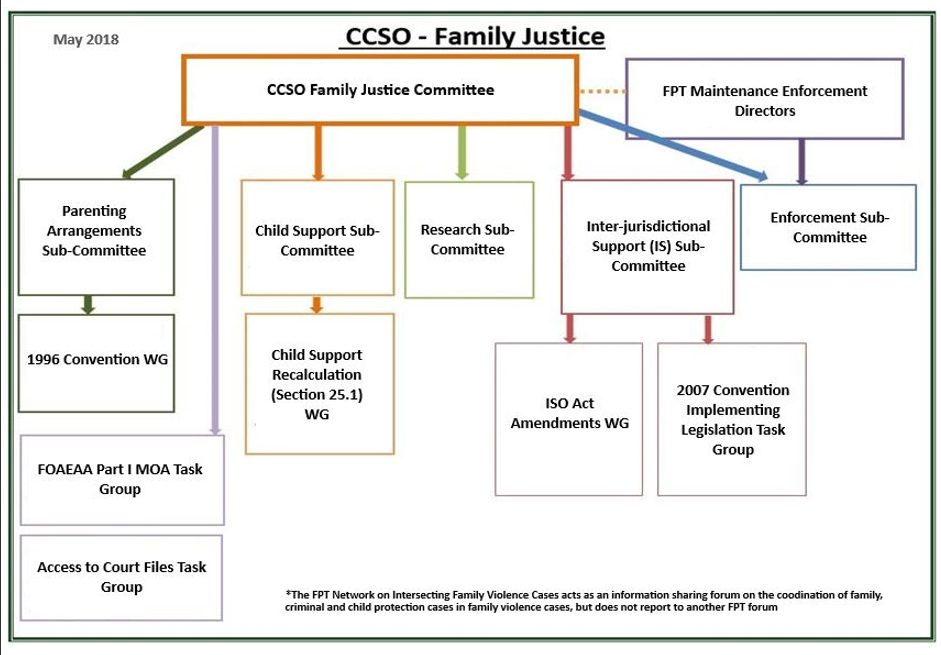
Text version – CCSO - Family Justice
The illustration depicts the FCY Section committees and working groups. Each committee and working group is individually boxed.
The CCSO Family Justice Committee box has arrows pointing to various other sub-committees and working groups, which are:
- The Parenting Arrangements Sub-Committee followed by an arrow pointing to the 1996 Convention WG
- The FOAEAA Part 1 MOA Task Group followed by an arrow pointing to the Access to Court Files Task Group
- The Child Support Sub-Committee followed by an arrow pointing to the Child Support Recalculation (Section 25.1) WG
- The Research Sub-Committee
- The Inter-jurisdictional Support (IS) Sub-Committee followed by an arrow that points to the ISO Act Amendments WG and another arrow that points to the 2007 Convention Implementing Legislation Task Group
The FPT Maintenance Enforcement Directors box has an arrow pointing to the Enforcement Sub-Committee, which the CCSO Family Justice Committee points to as well.
At the bottom right of the figure, there is a note that reads: The FPT Network on Intersecting Family Violence Cases acts as an information sharing forum on the coordination of family, criminal and child protection cases in family violence cases, but does not report to another FPT forum. The figure is dated May 2018 (top left of the illustration).
- Date modified: