
Findings
4.1 Relevance
In addressing the issue of the relevance of the Initiative, the evaluation focussed on two specific dimensions: the appropriateness of the current approach in supporting access to justice in both official languages, and the extent to which the Initiative is capable of responding to the needs of those stakeholders it targets.
4.1.1 Appropriateness of the Current Strategy
The Initiative ensures that official languages considerations are directly integrated in efforts to promote access to justice in Canada. It offers a comprehensive approach that is well aligned with the vision included in the federal action plan on official languages.
The Initiative is related to Justice’s responsibility of ensuring that the federal government is supported by high-quality legal services and that the Canadian justice system is fair, relevant, accessible, and reflective of Canadian values. In so doing, the Initiative operates in a fairly complex ecosystem of institutions and stakeholders that must combine their efforts aimed at access to justice in accordance with the broad framework provided by the Canadian constitution. This includes the formal and constitutionally entrenched recognition that English and French are the official languages of Canada,3 and the quasi-constitutional commitment found in the Official Languages Act that all federal departments and agencies be committed to enhancing the vitality of the English and French linguistic minority communities in Canada, to supporting and assisting their development, and to fostering the full recognition and use of both English and French in the Canadian society.4
The Initiative supports this vision at three complementary levels:
- At the community level, the Initiative provides funding to a range of organizations that promote access to justice in both official languages, in addition to supporting a range of projects and activities that allow members of the OLMCs to be adequately informed about their rights and obligations in their official language.
- At the institutional level, it provides funding to enhance the capacity of the courts and of the justice system more broadly to operate in both official languages, for all matters that require the intervention of the justice system.
- From an engagement perspective, the Initiative allows both community stakeholders and federal, provincial, and territorial governments to network, collaborate and pursue dialogues that specifically focus on the official languages dimensions of access to justice.
Evaluation findings indicate a high level of support for this overall approach, as it fosters a comprehensive strategy to ensure that access to justice in Canada integrates considerations related to official languages. As repeatedly noted during interviews, there are no other means that can achieve what the Initiative is mandated to pursue. In the absence of the Initiative, there would be a significant gap that would jeopardize what has been achieved to date in enhancing access to justice in both official languages.
While enhancements to the Initiative were discussed and raised as part of interviews, and are addressed throughout this report, no broader alternative to the actual strategy pursued by Justice, through the Initiative, has emerged.
Integration in the Federal Action Plan for Official Languages
The Initiative emerged as part of the federal government’s first five-year official languages action plan, covering the period of 2003 to 2008. Since then, every such action plan has integrated a dimension related to the access to justice in both official languages. The most recent iteration of the plan, the Action Plan for Official Languages - 2018-2023: Investing in Our Future makes no exception. In addition to maintaining the levels of funding for justice-related programs and activities, it includes an additional $13.3 million over five years to expand the funding available through the Support Fund and to provide core funding to community organizations promoting access to justice in both official languages.
By framing and linking $2.7 billion5 in funding over five years for a wide range of initiatives covering areas such as education (first and second language), culture, media, employment and economic development, health, immigration and justice, the Action Plan stands at the core of the federal government’s vision of the two official languages, and of its commitment to support OLMCs across Canada. During interviews, stakeholders from all groups consulted emphasized the direct alignment of the Initiative with the Action Plan. In fact, the Initiative is seen as Justice’s most significant contribution to supporting the goals of the Action Plan.6
4.1.2 Alignment with Stakeholder Needs
The Initiative is well aligned with the needs of stakeholders, and efforts have been made to ensure that the full range of needs, including those of more marginalized populations, are taken into account in the implementation of funded activities
The Information Pillar
In terms of the information pillar, evaluation findings confirm the importance of fostering the capacity of citizens to understand their rights and obligations, and the various paths that individuals may pursue to address legal issues. Achieving these goals in Canada requires that citizens be provided with the information they need in either English or French. On that basis, the primary challenge facing all key stakeholders, and the Initiative by extension, consists in identifying the range of target population groups, and ensuring that the organizations serving these individuals and communities be aware of the financial support that the Initiative may provide in order to undertake relevant activities in either English or French.
The GBA+ undertaken by the Official Languages Directorate (see subsection 4.3.2 for further details) has allowed program managers to acquire a broader understanding of the various subgroups of Canadians who could benefit from the activities funded by the Initiative. In particular, needs of newcomers, racialized groups or marginalized populations, vulnerable youth, seniors, and individuals located in remote communities have emerged from this analysis as being particularly relevant. The Initiative has responded by providing funding to a variety of organizations that have tailored their strategy to each of these target groups. Legal information sessions and workshops, online material, legal information clinics, and outreach workers are some of the means by which targeted populations have been reached and served in both English and French.
During interviews, funding recipients emphasized how the flexibility within the management of the Initiative has allowed for critical adjustments to be implemented in response to the COVID-19 pandemic. Considering that in-person activities have always played a predominant role in reaching out to vulnerable, marginalized or disenfranchised individuals and communities, funded organizations have had to rethink and reframe their approach to promptly move to online and distance delivery options. Evaluation findings confirm that the Initiative has succeeded in allowing these changes to be successfully implemented.
While inroads have been made in responding to the needs of various groups of individuals living within the OLMCs, evaluation findings indicate that ongoing research and assessment are expected in order to fully appreciate the range of needs that could be addressed through the Initiative. Arguably and considering the level of funding available, the Initiative cannot address all needs from all potential beneficiary groups. However, evaluation findings indicate that continuing to document the needs using a GBA+ lens can inform future decisions and directions, particularly in funding projects and activities under the information pillar.
As for areas of the law where legal information is most needed, evaluation findings confirm the predominance of civil and administrative law matters. This can include issues related to family law (separation, divorce, child support, and child protection), housing (leases, rental conditions, etc.), labour and employment, succession law, and immigration law. There are also information needs concerning criminal issues, such as family violence. However, the funded organizations do not typically provide information or assistance to individuals under detention, and may provide limited assistance to individuals who have been charged with criminal offences; these services tend to be predominantly offered by legal aid services.
The Training Pillar
Since the period following the establishment of the Initiative’s training component in 2008, a number of organizations have collaborated to enhance the capacity of justice professionals related to their ability to communicate in both official languages. Whereas the range of stakeholders and needs associated with the information component of the Initiative is fairly challenging to circumscribe, the range of stakeholders and needs related to the training pillar is more contained. Ultimately, the goal for the latter component is to ensure that all key justice professionals, such as judges, lawyers (including prosecutors for criminal proceedings), court support workers, and probation officers, be in a position to effectively communicate in both official languages, particularly in the context applicable to their specific duties. To confirm, this is not about being capable of holding a casual conversation in both languages. It is about achieving a level of competence that allows for a full understanding of the nuances associated with the duties undertaken, and providing assurance and confidence to those individuals involved in court proceedings that using either official language will lead to the same treatment and the same outcome.
While the goal may be fairly straightforward, the overall task at hand remains colossal. Historically, efforts related to language training of justice professionals have focused on those operating within the criminal justice system. This reflects the fact that the Parliament has exclusive jurisdiction over criminal law, and that the Criminal Code guarantees the right to a proceeding in French or in English anywhere in Canada (sections 530 and 530.1). Even then, the complexity and specificities of each provincial or territorial court system, the involvement of provincially appointed and federally appointed judges, the critical role of legal aid services, and the involvement of private practice lawyers, among other considerations, have required careful planning in pursuing an overall strategy of enhancing the language capacity of justice officials operating in that area of the law.
Recent amendments made in 2019 to the Divorce Act will now expand the right to proceedings in both official languages for those involved in such matters.7 The language training provided in relation to family law matters will be significantly different than the one provided in the context of criminal law. For instance, while a large share of criminal matters are heard by provincial courts, almost all family law matters are heard by superior court judges. In the context of criminal law matters, the right to proceed in either English or French is provided to the accused, and the justice system is expected to accommodate his or her choice. In the case of family law, the right to proceed in either English or French is given to both parties, which may lead to English, French, or bilingual proceedings.
Evaluation findings indicate that the network of organizations and actors in place is well positioned to identify the needs for language training in a legal setting, and to engage with Justice, through the Initiative, to pursue the appropriate strategies.
As noted during interviews, the range of stakeholders currently involved with the Initiative’s training component covers all relevant areas, from fundamental training in both official languages (in law faculty and colleges), to ongoing language training for professionals, and the formal assessment of the new language skills acquired. In that sense, the Initiative is well aligned with the evolving needs of key stakeholders.
4.2 Effectiveness
4.2.1 Overview of Funded Activities
To help contextualize the information contained in the following subsections, which explore the effectiveness of the Initiative, an overview of the activities funded during the evaluation period is included in this subsection.
In total, 110 projects8 involving 49 organizations were allocated a total of $33.5 million of funding during the period covered by the evaluation. Some of these projects started before 2017-18, while others continued after 2020-21, but all were active during the evaluation period.9 As noted in Table 2, they cover all provinces and territories except Prince Edward Island and Nunavut. A little over half of the projects were located in New Brunswick, Ontario and Manitoba.
| Province/territory | Number of funded projects | Number of funded organizations | Funding allocated (in million $) |
|---|---|---|---|
Newfoundland and Labrador |
7 |
4 |
$0.4 |
Nova Scotia |
8 |
2 |
$1.3 |
New Brunswick |
17 |
6 |
$5.5 |
Quebec |
9 |
7 |
$5.1 |
Ontario |
25 |
11 |
$9.8 |
Manitoba |
18 |
8 |
$6.7 |
Saskatchewan |
5 |
2 |
$1.5 |
Alberta |
7 |
3 |
$1.9 |
British Columbia |
10 |
2 |
$0.9 |
Yukon |
3 |
3 |
$0.2 |
Northwest Territories |
1 |
1 |
$0.1 |
Total |
110 |
49 |
$33.5 |
Source: Administrative data – Total may differ slightly due to rounding
Figure 1 indicates that the largest portion of the funding was allocated to training activities, followed by activities focussed on information. The core funding which is provided to associations of French-speaking lawyers and provincial organizations, represents 7% of the funding allocated.
Figure 1: Distribution of Funding Allocated by Key Component (2017-18 to 2020-21)
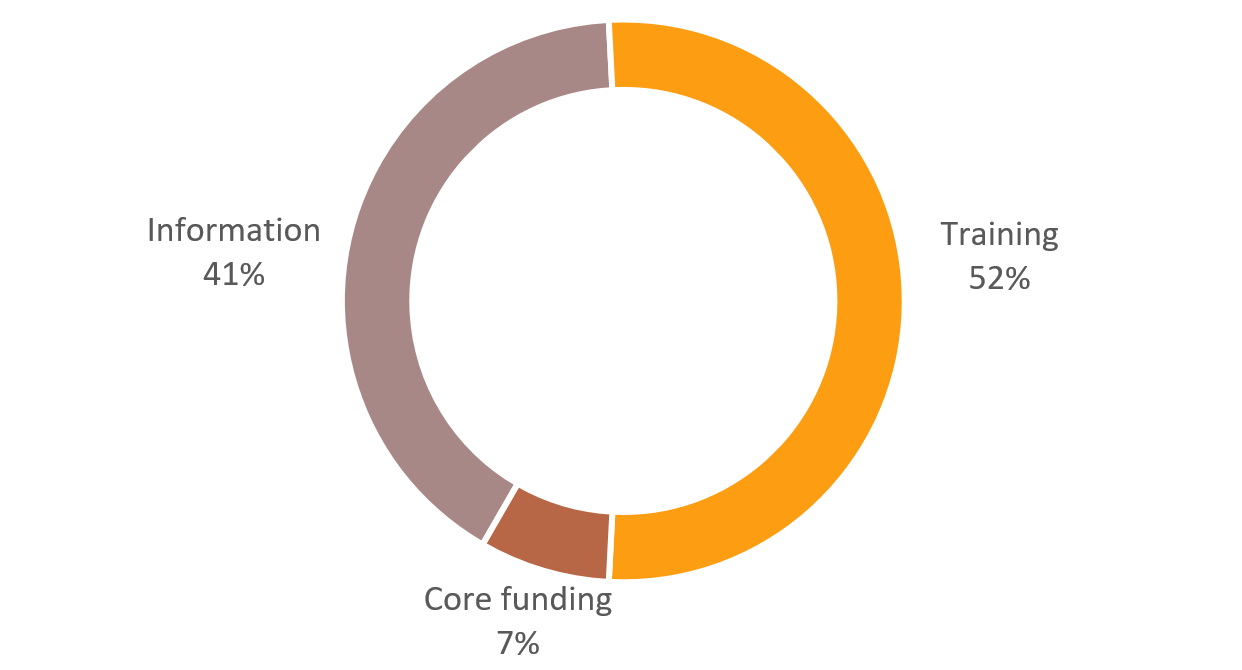
Text version
| Key Component | Allocated Funding | Proportion of Total Allocated Funding |
|---|---|---|
| Training | $ 17,243,466 | 52% |
| Information | $ 13,589,313 | 41% |
| Core funding | $ 2,529,016 | 7% |
(Source: Administrative data – Total may differ slightly due to rounding)
Looking more closely at the different categories of organizations receiving financial support, Figure 2 indicates that the associations of French-speaking lawyers and their national federation (i.e., Fédération des associations de juristes d’expression française de common law [FAJEF] and Association de juristes d’expression française [AJEF]) were provided 35% of the $33.5 million of funding allocated. This includes core funding as well as funding for activities related to both the information and training components. The bulk of the funding allocated to these organizations was directed towards their information-related projects ($8 million), including legal information centres or clinics, online resources (such as CliquezJustice.ca), and many workshops and awareness-raising activities targeting specific groups (youth, new immigrants, seniors, etc.).
Figure 2: Distribution of Funding Allocated Among Key Categories of Funding Recipients (2017-18 to 2020-21)

Text version
| Key Categories of Funding Recipients | Allocated Funding (in million of $) |
|---|---|
| FAJEF and AJEF | $ 11,6 |
| National organizations | $ 7,7 |
| Provincial organizations | $ 4,3 |
| Jurilinguistice centres | $ 4,1 |
| PT governments | $ 2,0 |
| Universities | $ 1,6 |
| Community organizations | $ 1,0 |
| Provincial Courts | $ 1,0 |
(Source: Administrative data – Total may differ slightly due to rounding)
Projects undertaken by national organizations focused almost entirely on the language training of legal professionals. This includes the training offered by organizations such as the Centre canadien de français juridique or Jurilingo, the coordination activities done by the NNJT or the language assessment services offered by KortoJura.
Provincial organizations focused almost exclusively on legal information-related activities. It included the $2 million allocated to Éducaloi in Quebec to offer legal information for English-speaking communities. It also included funding allocated to the Quebec Community Groups Network ($1 million) to undertake provincial-wide consultations in support of a strategic analysis on the need for legal information in English in Quebec among seniors, youth in need of protection or who interact with the justice system, and people who deal with labour-relation issues.
The Initiative also provided funding to the provincial and territorial governments of New Brunswick, Nova Scotia, Newfoundland and Labrador, Ontario, Manitoba, Alberta and the Yukon. The large majority of the activities funded were aimed at enhancing the language capacity of provincial judges. In the case of Ontario, the Initiative has also been supporting the well-established National French Language Institute for Professional Development (FLIPD), which provides an annual one-week intensive training course on French language legal terminology to an average of 100 justice professionals, including prosecutors, court support staff, legal aid duty counsel, as well as some social services agency staff dealing with victim issues. Some information-related activities were also undertaken by the funded PT governments, particularly in the area of family law.
The jurilinguistic centres are focusing on expanding the body of terminology in both English and French for the common law and the civil law, and have been providing translated court decisions. They have also used the funds provided to develop tool kits to enhance the awareness among the general population of their rights and obligations.
The law faculties of the University of Ottawa and the University of Manitoba received funding to provide opportunities for law students to enhance their ability in French Common Law. This has included the newly established Certification in Common Law in French, which is a partnership between the Common Law Faculty of the University of Ottawa and the College of Law of the University of Saskatchewan.
Finally, community organizations in Quebec, Ontario and Alberta received funding to undertake information-related activities focusing on more isolated, marginalized and racialized population groups.
Based on this overview of the projects that were active during the evaluation period, the following subsections explore the impact that these activities have had.
4.2.2 Access to Legal Information in Both Official Languages
The Initiative continues to support significant initiatives that facilitate the development of the required content, the implementation of delivery strategies, and the ongoing assessment of activities related to the access to legal information in both official languages. The evaluation confirms the need to explore strategies to further expand the reach of these activities.
The ultimate goal of the Initiative when it comes to legal information is to secure and support the appropriate partnerships and collaborations to ensure that individuals from OLMCs across Canada are in a position to learn about their rights, obligations, and responsibilities in their official language of choice. The fundamental blocks upon which the achievement of this goal rests include the development of the needed content (e.g. legal information on rights, obligations, and responsibilities) in either or both English and French, based on the target groups, the delivery strategies used to communicate this information (i.e. reference materials, brochures, videos, etc.), and the ongoing monitoring of emerging needs and the resulting adjustments to the activities provided (see Figure 3).
Figure 3: Activity Cycle
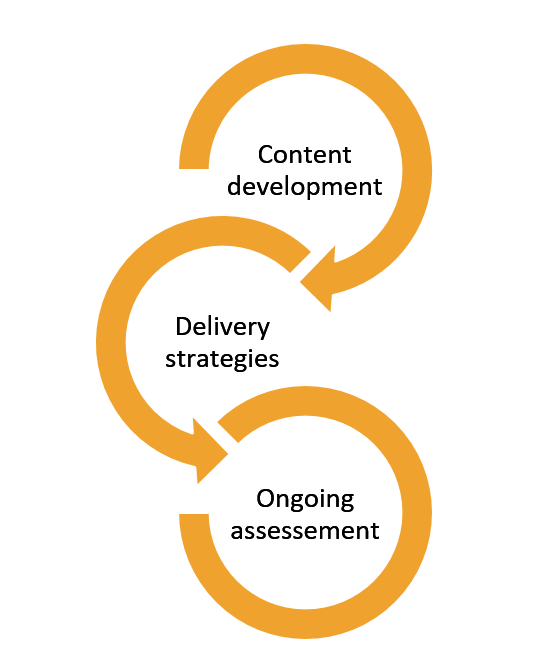
Text version
Figure 3 depicts the flow of the different components of the Initiative’s Activity Cycle. A circular arrow labelled “content development” flows into another circular arrow labelled “delivery strategies”, which lastly flows into a circle labelled “ongoing assessment.”
The assessment of these dimensions cannot be limited to the activities that occurred during the period covered by the evaluation. What is currently in place is the result of efforts initiated in 2003 when the Initiative was first announced. A more informative approach consists of documenting how the work done since 2003 has manifested itself during the period covered by the evaluation.
Evaluation findings point to significant progress made towards the goals set in relation to the information component of the Initiative.
Content Development
Particularly through the work of CliquezJustice, Éducaloi, and the jurilinguistic centres, there is a considerable body of relevant material available in both English (in Quebec) and French (for all other regions of Canada) on the priority areas of the law described in subsection 4.2.1, including family law, housing, labour and employment, succession law, and immigration law. This includes online information, videos, and paper-based documents, all written for a wide audience.
Work has also been undertaken to identify emerging legal information needs. During interviews, representatives of funded organizations noted that the program has adopted a flexible approach to providing legal information that accommodates new priority areas as they emerged. For instance, key informants noted that legal issues around mental health, services to victims of crime, and bankruptcy are expected to require further attention in the future. This is particularly true in the context of the COVID-19 pandemic. It should be noted that existing content has already been produced concerning the pandemic, such as rights and obligations associated with the vaccine process (see Figure 4).
Figure 4: Information on the Vaccine Process

Text version
Figure 4 is a poster for an online article in the French language concerning the rights and obligations associated with the vaccine process.
The title reads, « Vaccination : Avez-vous le droit de refuser ? »
The English translation of the title is, “Vaccination: Do you have the right to refuse?”
And the text under the title reads, “mettez de côté les rumeurs, les mythes et les fausses informations : voici ce qu’il faut savoir sur la vaccination et sur vos droits ! »
The English translation of the text is, “Put aside rumors, myths and false information: here is what you need to know about immunization and your rights!”
(Source: CliquezJustice.ca)
Delivery Strategies
Here again, the work done since 2003 in building a comprehensive delivery approach has led to significant achievements that have continued to progress during the evaluation period. In a number of French-speaking communities, legal information clinics have been successfully established and have reported high levels of activities. For instance, the Centre d’information juridique de l’Ontario has served more than 11 000 individuals between 2015 (the year it was established) and 2020.10
Funding support has also been provided to grassroots organizations that come with an already established trusting relationship with harder to reach and disenfranchised individuals and communities, in order to provide legal information. A case in point is the work of Head & Hands, a well-established community-based organization located in Montreal that has used the funds from the Initiative to hold legal clinics and engage with its client groups in legal awareness activities relevant to them. Also in Quebec, the Côte-Nord Community Justice Centre has received support from the Initiative to organize community meetings, participate in radio shows, engage with individuals through social media, and prepare information kits to address legal issues relevant to those living in the Côte-Nord, which includes many isolated communities. Finally, the Autobus de la Justice in rural Alberta is another illustration of a tailored strategy to reach and address legal issues and concerns of members of the OLMCs.
During interviews, key informants emphasized the need to design delivery strategies that build on the existing strengths of the recipient organizations. However, while a legal information centre may be very successful in providing much needed legal information to the broader community, this same setting might fail to reach some subsections of the targeted population. In other words, some potential beneficiaries will gladly come to the service provider, while in other cases, the service provider will need to meet the beneficiaries in their own environment. For this reason, diversifying delivery strategies and broadening the range of organizations involved in delivering activities related to the information component of the Initiative is essential to ensure that no systemic barriers limit the access of some eligible individuals or groups to the support provided.
As noted in subsection 4.2.1, the COVID-19 pandemic has had a significant impact on organizations delivering legal information activities. While the effects of the pandemic were not strictly speaking a focus of the evaluation, they were nonetheless raised during many of the interviews that were conducted as part of this study. Vulnerable populations have been particularly hard hit by the pandemic, and being unable to reach them in person has proven to be very challenging for many of the funded organizations. As noted during interviews, the quality of the service provided has been affected by moving to online and remote delivery models. Once the pandemic has been largely resolved, it will be important to identify the lessons learned and to determine the best strategy to reconnect with potential beneficiaries that were not in a position to engage with the activities offered during the pandemic.
Ongoing Assessment
During interviews, representatives from funded organizations noted that they regularly reassess their approach, based on the experience acquired and the feedback they received from the individuals they served and from their organizational partners. As previously noted, the Initiative has proven to be flexible enough to allow the organizations to implement required changes to their respective approaches.
In addition, key informants noted that the Advisory Committee provides a unique opportunity to learn about projects and strategies being implemented throughout the country, and to better understand Justice’s vision and priorities when it comes to official languages and access to justice. It was suggested that Justice may wish to hold meetings of the Advisory Committee more regularly to further these opportunities.
4.2.3 Capacity of the Justice System to Operate in Both Official Languages
The Initiative supports activities covering the entire language training cycle and all key functions within the justice system. Key challenges are to expand the regional reach and to facilitate increased partnerships among the key stakeholders.
As noted in subsection 4.1.2, enhancing the capacity of the justice system to operate in both official languages is a significant endeavour, which mobilizes several stakeholders. As illustrated in Figure 5, to be successful, the strategy must cover the entire learning process, from needs identification to the maintenance of an individual’s capacity in an acquired official language.
Figure 5: Key Components of Language Training Activities

Text version
Figure 5 depicts a sequential relationship of the key components of language training activities. The components occur as listed with each component pointing to the next. The process begins with “Needs Identification” and ends with “Maintenance”. The components in the process are:
- Needs Identification
- Training material
- Delivery
- Language Assessment
- Maintenance
Contribution of the Initiative
At the time of the evaluation, the Initiative was undeniably the driving force behind the efforts in Canada to enhance the capacity of the justice system to operate in both official languages. Other players, including some provincial governments, also contribute to these efforts, but evaluation findings leave no doubt that, in the absence of the Initiative, this nation-wide endeavour would largely come to a halt.
As noted in subsection 4.1.2, the Initiative has been supporting the process of identifying needs and establishing priorities, particularly for French-language training outside Quebec. The Initiative has also supported, to some extent, all the other key components of the training continuum:
- Organizations such as the Centre canadien de français juridique, Jurilingo, and the FLIPD have successfully designed and delivered training activities to various categories of justice professionals, using a range of materials, including the resources developed by the jurilinguistic centres. Participants include judges, lawyers (both private lawyers and prosecutors), court support staff, and legal aid duty counsel.
- An increasing number of activities are being offered to justice professionals to maintain the acquired language skills. This includes regular language training sessions and workshops that address various fields of law.
- KortoJura has emerged as the only organization in Canada that systematically assesses language skills in a legal context. The assessment is tailored to the specific functions of the justice system, and applies to capacity in either one of the two official languages.
- Law students are presented with an increasing number of opportunities to build their capacity to practice in both official languages. The Initiative supports the implementation of activities in law faculties at the University of Ottawa and the University of Manitoba. This includes a summer preparatory program that is addressed specifically to immigrant or refugee students who have been accepted into the French common law program at the University of Ottawa and who have limited knowledge of the Canadian context, both in terms of the legal system and the Canadian university setting.
During interviews, representatives of funded organizations noted that these activities allow justice professionals to enhance their abilities and comfort level to operate in both official languages. In particular, the fact that most of these training activities reproduce actual scenarios encountered in the justice system is seen as a best practice. Moreover, allowing learners to better understand both the language and the culture found in the various OLMCs allows them to appropriately contextualize what they hear and determine how to best communicate.
Identified Challenges
Evaluation findings point to two central challenges concerning the Initiative’s training component.
First, activities funded to date cover key groups within the justice system, but not all of them. For instance, judges and prosecutors have historically been the focus of the training activities offered. There are also some activities that are offered to court personnel, legal aid staff lawyers, and other professionals such as probation officers, however some of these activities are not offered in many provinces and territories and the reach has yet to be expanded as capacity is being increased. Other groups, such as private practice lawyers, have largely not required the training offered to date. Yet, with the progressive coming into force of new language rights provisions provided in the Divorce Act11, the ability of private practice lawyers to communicate in both official languages will be essential towards contributing to a meaningful implementation of these new language rights.
Second, establishing strong partnerships among the various organizations involved in the provision of language training is perceived as critical to further expand the reach of the Initiative, both geographically and among all the various groups of professionals who need to operate in both official languages. These partnerships also serve to secure the sustainability of the services offered.
4.2.4 The Advisory Committee and the Federal-Provincial-Territorial Working Group
The Advisory Committee and the FPT Working Group are mature structures that have proven to be valuable in enhancing collaborations among key stakeholders. Facilitating interactions between these two structures would further enhance their respective work.
The Advisory Committee and the FPT Working Group are seen as highly relevant forums to promote coordination, information sharing, and the development of priorities. As noted throughout this report, enhancing access to justice in both official languages requires the involvement of a multitude of government and non-governmental actors. The Advisory Committee and the FPT Working Group are the only means by which these stakeholders can systematically gather and discuss relevant issues or challenges.
Evaluation findings indicate that, while there is value in allowing each group to meet on its own, it would be desirable to explore the possibility of increased opportunities for greater collaboration between the two groups. In practical terms, this means that government representatives from the FPT Working Group could attend, when relevant, a portion of the meeting of the Advisory Committee, and vice versa. This would promote greater transparency on the overall strategy to enhance access to justice in both official languages, as well as the opportunity for a shared vision of all key stakeholders to emerge.
Other improvements that were suggested during interviews are summarized below:
- Once the pandemic is largely resolved, the goal should be to have two meetings per year, including one in-person meeting. The experience of the pandemic has confirmed that videoconferencing is a valid means by which meetings can be held. However, retaining in-person meetings is just as important, as they allow for much richer discussions and networking activities to occur.
- Each meeting should allow for enough time for discussions and, as applicable, work in subgroups. While various presentations are helpful, it is important to ensure that the meetings remain interactive and allow for conversations and dialogue to occur.
- The Advisory Committee should ensure that new voices can be added to reflect the needs and priorities of various groups of potential beneficiaries of the activities funded by the Initiative. Organizations assisting more remote communities, disenfranchised individuals, racialized communities, new immigrants, or LGBTQ2 individuals are some of the examples mentioned during interviews. Their participation can be as guests or as permanent members, as applicable.
4.3 Design and Delivery
4.3.1 Performance Measurement Strategy
Stakeholders are generally satisfied with the current reporting requirements, and the range of information and data provided on funded activities.
At the time of the evaluation, Justice was well positioned to document the activities undertaken with the support of the Initiative. In particular, the Department was receiving annual activity reports from the funded organizations, and could generate annual allocation reports from its grants and contributions management system. Based on this information and other data sources as required, Justice also publishes an annual Review on Official Languages in the section of its web site dedicated to Justice in Official Languages.12 The Justice in Official Languages Newsletter and the Departmental Action Plan for Official Languages 2017-2022 are other documents that either report on activities funded, or provide a broader context in which the Initiative operates within Justice. It is important to emphasize that this information has provided critical input into this evaluation process.
During interviews, representatives from both Justice and the funded organizations indicated that they were satisfied with the current reporting process and requirements. It was noted that the reporting template was modified during the period covered by the evaluation, which led to a more streamlined and efficient reporting process.
Interviews also indicated that more could be done with the information provided through the annual activity reports, to build a richer understanding of the results achieved by the Initiative. A review of a sample of these reports confirmed this statement. These activity reports include fairly detailed information that could be aggregated to produce both qualitative and quantitative insights in the results achieved by the Initiative.
4.3.2 Equity, Diversity, and Inclusion Considerations
Justice has been including considerations related to equity, diversity, and inclusion (EDI) in the ongoing management of the Initiative. To this end, it has conducted a GBA+ and engaged key stakeholders in further exploring these considerations.
There is a clear link between the nature of the activities funded by the Initiative and considerations related to EDI. The very purpose of facilitating access to justice, including access in both official languages, is to ensure that the justice system equally serves all Canadians, regardless of any of their identity dimensions. As noted by the Right Honourable Beverley McLachlin, former Chief Justice of Canada, “The most advanced justice system in the world is a failure if it does not provide justice to the people it is meant to serve.”13
Including EDI considerations in the management of a program such as the Initiative requires careful planning, monitoring and adjustments as required and applying GBA+ can support a better integration of these considerations. GBA+ is an analytical tool used to assess the potential impacts of policies, program, services and initiatives on diverse groups of people with a range of intersecting identity dimensions. Once an analysis has been completed, it is up to program management to consider the information that has been collected and to decide how best to proceed. As such, a GBA+ may support the development of an EDI strategy.
Evaluation findings confirm that EDI considerations have been integrated in the management of the Initiative.
In 2016, the federal government published its Policy on Results and its associated Directive on Results, which set an expectation that “government-wide policy considerations such as gender-based analysis and official languages, where relevant” be integrated in the management of any programs. In order to proceed in accordance with this requirement, the management group responsible for the Initiative carried out a first GBA+, which aimed at better understanding how such an analysis could apply to the Initiative, and set some follow-up actions.
This initial GBA+ provided valuable insights, while also allowing for data gaps to be identified. In particular, the reporting activities associated with the activities funded by the Initiative do not systematically gather identity data on project participants, for either the information or training components. There is also no data that could provide a better understanding of the diversity found in the pool of potential beneficiaries of the activities funded by the Initiative. It is, however, important to emphasize that such gaps are to be expected. This type of data has not been historically collected, and individuals engaging in program activities will always provide such information on a volunteer basis. It is for this reason that GBA+ is considered an ongoing process. The goal is not to achieve a perfect mapping of the identity dimensions of existing or potential program beneficiaries. It is rather to continuously improve on the existing information, and use whatever data is available to reasonably inform the decision-making process.
Evaluation findings indicate that Justice has engaged the Advisory Committee in exploring how EDI considerations could be further integrated in the activities funded and, as described in subsection 4.2.2 of this report, funding has been allocated to a number of organizations that specifically target traditionally disenfranchised or harder to reach communities and individuals. Justice intends to continue exploring ways to better integrate EDI considerations.
Funded organizations are also responding to this call for a more systemic integration of EDI considerations. For instance, the AJEFO adopted, in 2019, a Politique sur la diversité et l’inclusion. This internal policy applies to all employees, Board members, volunteers, and members of the organization. It guides all the strategic planning of the organization, as well as the implementation of its programs and activities. Its fundamental purpose is to ensure that everyone, regardless of any identity dimension, is fully integrated and valued. To further its work on diversity and inclusion, the Association collaborates with a wide range of organizations, including those that participate in the Roundtable of Diversity Associations, which is led by the Toronto Lawyers Association and includes a wide range of other associations representing Arab, Black, Muslim, Somali, and Indigenous lawyers, among others.
4.4 Efficiency
4.4.1 Funding Allocation Process
There is a wide support for the current funding allocation process, including the multi-year funding offered when applicable.
All stakeholders, from both Justice and funded organizations, are generally satisfied with the current process used to allocate funding. The application process, the review of these applications, and the allocation of funding are all seen as operating efficiently.
There is a particularly strong support for multi-year funding, as this approach allows for more stability and facilitates the implementation of the funded activities. Since many of the funded recipients have a long history with the Initiative, this approach appears particularly well suited. There was also the suggestion that, when feasible, the funding could be allocated on a five-year basis, to align with the federal Action Plan for Official Languages. Another suggestion provided would be to implement a fast-track process for project renewals when little to no change is made to the funded activity.
Footnotes
3 Section 16 (1) of the Canadian Charter of Rights and Freedoms.
4 Section 41 (1) of the Official Languages Act, (R.S.C., 1985, c. 31 (4th Supp.).
5 Source: Government of Canada. Action Plan for Official Languages - 2018-2023: Investing in our Future, page 52. https://www.canada.ca/en/canadian-heritage/services/official-languages-bilingualism/official-languages-action-plan/2018-2023.html.
6 The other main component of the Action Plan for Official Languages - 2018-2023 related to justice is the Contraventions Act Fund, which provides funding to ensure that the implementation of the Contraventions Act is carried out in accorda
nce with the applicable language rights.
7 Subsection 23.2(1) of the Divorce Act, which deals with the use of both official languages in divorce proceedings, will come into force incrementally by Order in Council. As of March 1, 2021, the subsection was in force in Manitoba, Yukon and Nunavut.
8 For the purpose of this analysis, the term “project” refers to the set of activities that were approved for funding under the Initiative. It includes various types of training and information activities, as well as the core funding provided to organizations. The same project funded through multiple fiscal years is considered to be a single project.
9 The total value of the 110 projects funded, including all fiscal years covered by these projects, is $85,708,807.
10 Association des juristes d’expression française de l’Ontario. (2020). Rapport annuel 2019-2020, p. 29.
11 Subsection 23.2(1) of the Divorce Act, which deals with the use of both official languages in divorce proceedings, will come into force incrementally by Order in Council. As of March 1, 2021, the subsection was in force in Manitoba, Yukon and Nunavut.
12 Justice in Official Languages: https://www.justice.gc.ca/eng/rp-pr/csj-sjc/franc/index.html.
13 Office of the Commissioner of Official Languages. (2013). Access to Justice in Both Official Languages: Improving the Bilingual Capacity of the Superior Court Judiciary.
https://www.clo-ocol.gc.ca/en/publications/studies/2013/access-to-justice-in-both-official-languages-improving-the-bilingual-capacity-of-the-superior.
- Date modified: