
Department of Justice Canada’s 2026-2027 Departmental Plan
On this page
Copyright information
© His Majesty the King in Right of Canada, as represented by the Minister of Justice and Attorney General of Canada, 2026
ISSN 2371-6908
At a glance
This Departmental Plan details the Department of Justice Canada’s priorities, plans, and associated costs for the three upcoming fiscal years.
These plans align with the priorities outlined in the Mandate Letter, as well as the Department’s mission, raison d’être and operating context.
Key priorities
The Department identified the following key priorities for 2026–27:
- Keeping Canadians safe in our communities and online, as well as strengthening Canadians’ trust in the legal system
- Building a stronger economy and expediting nation-building projects, including by advancing implementation of the United Nations Declaration on the Rights of Indigenous Peoples Act (UN Declaration Act) and the corresponding Action Plan
- Making life more affordable for Canadians by reforming systems, policies and laws so that they better serve Canadians, including by modernizing the Federal Child Support Guidelines to create a more efficient, cost-effective child support system
- Reducing operational costs by modernizing service delivery through digital innovation and adoption of artificial intelligence (AI)
Comprehensive Expenditure Review
The government is committed to restraining the growth of day-to-day operational spending to make investments that will grow the economy and benefit Canadians.
As part of meeting this commitment, the Department is planning the following spending reductions:
- 2026–27: $22.8 million
- 2027–28: $30.9 million
- 2028–29: $43.5 million
It is anticipated that these spending reductions will involve a decrease of approximately 234 full-time equivalents by 2028–29.
The Department will achieve these reductions by doing the following:
- introducing process efficiencies and standardization, which will include:
- amalgamating business units to form a cohesive and integrated operating model.
- reducing redundancies to close gaps and reduce duplication in workflow
- imposing leaner management by reducing the layers of oversight
- leveraging AI by investing in advanced analytics and automation tools to streamline tasks, enhance decision making and focus on higher value strategic work
- exploring opportunities to review limits to access the informal procedure in income tax and GST appeals at the Tax Court of Canada. Increasing these limits, which have not been updated since 2013, will promote cost-effective dispute resolution, and lower litigation cost for Canadians and Canadian businesses and the federal government. These changes will require legislative amendments
The figures in this Departmental Plan reflect these reductions.
Highlights for the Department in 2026–27
Among its many initiatives and activities within the area of federal law, the Department will take steps to strengthen Canadians’ trust in the legal system by improving access to justice (e.g., through funding to support Black victims and survivors of crime and their families), as well as through legislative reform (e.g., Bill C-9, the Combatting Hate Act, Bill C-14,the Bail and Sentencing Reform Act, and Bill C-16, the Protecting Victims Act). To strengthen the Canadian economy, the Department will provide support in modernizing regulatory frameworks to reduce red tape and ensure that laws keep pace with emerging industries and technologies. In parallel, the Department will modernize service delivery through digital innovation and adoption of AI solutions, such as AI-assisted legal research, automated document processing, and secure online platforms for public services.
In 2026–27, total planned spending (including internal services) for the Department is $1,173.7 million and total planned full-time equivalent (FTE) staff (including internal services) is 5,266.
Summary of planned results
The following provides a summary of the results the Department plans to achieve in 2026–27 under its main areas of activity, called “core responsibilities.”
-
Core responsibility 1: Legal Services
The Department will continue to deliver integrated legal advisory, litigation, legislative drafting and regulatory drafting services in support of government-wide priorities, such as:
- building a stronger Canadian economy through major projects and making life more affordable for Canadians
- promoting national and economic security, including on ongoing and evolving issues concerning Canada’s commitment to maximize its economic potential and diversify its trading relationships
- developing strategic litigation positions with client departments and agencies
- advancing reconciliation with Indigenous peoples, including through advice on matters related to section 35 of the Constitution Act, 1982, the duty to consult, Aboriginal title, the honour of the Crown, as well as advice to client departments and agencies working to further the Government of Canada’s commitment to implement the UN Declaration Act and the associated Action Plan
- advancing the Government of Canada’s forward regulatory agenda and the implementation and evolution of the legislative framework
- Planned spending: $273,540,492
- Planned human resources: 3,878
More information about Legal Services can be found in the full plan.
-
Core responsibility 2: Justice System Support
As part of its broad responsibilities for overseeing all matters relating to the administration of justice that fall within federal jurisdiction, the Department will:
- advance criminal law reform and enhance the criminal justice system response to address matters like gender-based violence, the protection of children, bail and sentencing laws, hate crimes in all its forms, and overrepresentation of Indigenous people (through the Indigenous Justice Strategy [IJS]), and of Black people (through Canada’s Black Justice Strategy [CBJS]) in the criminal justice system
- strengthen victims’ rights and continue to advance the Federal Victims Strategy to increase access to justice for victims and survivors of crime
- contribute to a renewed relationship with First Nations, Inuit and Métis by implementing the UN Declaration Act and its related Action Plan and by collaborating to continue implementation of responses to the justice-related Calls for Justice of the National Inquiry into Missing and Murdered Indigenous Women and Girls and Calls to Action of the Truth and Reconciliation Commission
- support the Government of Canada’s commitment to increasing access to justice for vulnerable groups through legislative initiatives (such as by modernizing the Federal Child Support Guidelines to create a more efficient system that better serves families, reducing parental conflict, litigation, and the burden on courts, thus promoting access to justice), and through funding for programs and services that respond to changing conditions affecting the Canadian justice system (such as the Tenant Protection Fund)
- Planned spending: $809,329,738
- Planned human resources: 323
More information about Justice System Support can be found in the full plan.
For complete information on the Department’s total planned spending and human resources, read the Planned spending and human resources section of the full plan.
From the Minister
I am honoured to present the Department of Justice Canada’s 2026–27 Departmental Plan—a roadmap for our ongoing work to create a strong and accessible justice system and keep our communities safe.
The Department delivers high-quality, integrated legal advisory, litigation, legislative and other professional services, as well as providing programs and services to support the justice system.
In the coming year, the Department will continue to advance the public interest and uphold the Canadian Charter of Rights and Freedoms through litigation involving the federal government.
The Department will continue advancing key priorities to strengthen laws, keep communities safe and restore trust in Canada’s justice system. The Department is leading several legislative reforms, including Bill C-9, the Combatting Hate Act, to help ensure that Canadians—no matter their background, beliefs or who they love—feel safe in their communities. We are also supporting Bill C-14, the Bail and Sentencing Reform Act, which proposes stricter bail laws and tougher sentencing laws for serious and violent crimes, and Bill C-16, the Protecting Victims Act, which proposes consequential criminal law reforms to better protect victims and survivors of gender-based violence, keep kids safe, and respond to long-standing concerns about court delays under the Jordan framework. Strengthening our criminal justice system is a collective effort, and Justice Canada will continue to work with law enforcement and with our provincial and territorial partners to make our justice system fair and keep everyone in Canada safe.
The Department continues to advance key initiatives that will help create a fairer, more accessible justice system for all. This includes ongoing work to advance a regional and distinctions-based approach to implementing the Indigenous Justice Strategy. It also includes advancing the implementation of Canada’s Black Justice Strategy which aims to reduce the overrepresentation of Black people in the criminal justice system, including as victims of crime.
The Department is working to build capacity of immigration and refugee legal aid services in the nine provinces where services are available. These efforts would continue to improve access to justice for asylum seekers—and others involved in certain immigration proceedings—who do not have the means to hire legal representation
I encourage everyone to read this Departmental Plan to learn about the Department’s role in strengthening our justice system, protecting the Canadian Charter of Rights and Freedoms, restoring trust in our institutions and keeping all people of Canada safe.
The Honourable Sean Fraser, P.C., K.C., M.P.
Minister of Justice and Attorney General of Canada

The Honourable Sean Fraser, P.C., M.P.
Minister of Justice and Attorney General of Canada
Plans to deliver on core responsibilities and internal services
Core responsibilities and internal services
Core responsibility 1: Legal Services
In this section
Description
The Minister of Justice and Attorney General of Canada provides legal services to the federal government and its departments and agencies. The Minister is responsible for seeing that the administration of public affairs is in accordance with the law. The Minister is also responsible for drafting all government bills and regulations and examining them for inconsistency with the Canadian Charter of Rights and Freedoms. Additionally, the Attorney General is responsible for advising the heads of departments on all matters of law and for conducting all litigation for federal departments or agencies on subjects within the authority or jurisdiction of Canada.
Quality of life impacts
Through the activities detailed in this core responsibility, the Department will contribute to the “Good Governance” domain of the Quality of Life Framework for Canada and to indicators such as the “Confidence in access to fair and equal justice (civil)” and “Confidence in access to fair and equal justice (criminal).” The Department will also contribute to the domains affected by the priorities of its client departments and agencies, such as “Environment,” “Prosperity” and “Health.”
Indicators, results and targets
This section presents details on the Department’s indicators, the actual results from the three most recently reported fiscal years, the targets and target dates for the Legal Services core responsibility. Details are presented by departmental result.
Table 1: Departments and agencies receive high quality legal services.
Table 1 provides a summary of the target and actual results for each indicator associated with the departmental result under the Legal Services core responsibility.
| Departmental Result Indicators | Actual Results | 2026–27 target | Date to achieve target |
|---|---|---|---|
| Client satisfaction mean rating on the overall quality of legal services |
|
8 or greater on a 10-point scale | March 2027 |
| Client satisfaction mean rating on the provision of legal services against the Service Standards |
|
8 or greater on a 10-point scale | March 2027 |
| Percentage of litigation files resolved in a fiscal year that have a successful outcome (settled or adjudicated) from the Crown’s perspective |
|
85% or greater | March 2027 |
Additional information on the detailed results and performance information for the Department’s program inventory is available on GC InfoBase.
Plans to achieve results
The following section describes the planned results for the Legal Services core responsibility in 2026–27.
Departments and agencies receive high quality legal services.
Results we plan to achieve
Economic priorities
The Department will provide legal services to client departments and agencies in support of their initiatives to build a stronger economy, such as on matters relating to the:
- Free Trade and Labour Mobility in Canada Act and the implementation of the removal of internal trade barriers across Canada, including required legislative amendments
- development and implementation of new Canadian measures such as domestic industry support and trade controls (e.g., development and implementation of support to tariff-impacted energy and natural resource sectors)
- preparation of the federal budget and related Budget Implementation Acts. The Department will also support the creation of policy and legislation related to the federal budget process
- Government of Canada’s Red Tape review, which seeks to modernize and reduce burdensome regulatory requirements that pose a barrier to investment and growth. The Department will also continue to provide legal services to support other client departments and agencies in implementing their respective Red Tape Reduction plans and any other government efficiencies initiatives
- legislative work or modifications to Natural Resource Canada’s programs in support of maximizing Canada’s critical mineral production and processing to contribute to Canada’s economic prosperity and national and economic security, including any defence-related strategy or northern sovereignty
- Employment and Social Development Canada’s Workforce Development Action Plan, which aligns with the Build Canada Cabinet Committee’s goal of fostering a resilient labour market that supports economic growth and Canadian sovereignty
- creation of Build Canada Homes, a new federal agency within Housing, Infrastructure and Communities Canada that will work with industry, other orders of government and Indigenous communities to build affordable housing at scale and speed, with a focus on innovative housing technologies
With regard to international trade, the Department will:
- support Canada’s response to the United States (U.S.) tariffs on Canadian goods
- support the negotiation and implementation of free trade agreements, including the Canada-U.S.-Mexico Agreement (CUSMA), Canada-Association of Southeast Asian Nations (ASEAN) Free Trade Agreement, and the Canada-Southern Common Market (Mercosur) Free Trade Agreement
- promote and defend Canadian interests in international litigation, including state-to-state dispute settlement, investor-state dispute settlement and trade remedies
The Department will provide legal services to client departments and agencies in support of the Government of Canada’s commitment to spending less on government operations, such as:
- the Treasury Board of Canada Secretariat in their assessment and recommendations of departmental initiatives responding to fiscal restraint
- the Office of the Chief Human Resources Officer in developing and implementing strategies to streamline labour and employment programs and recourses, and to reduce expenses
- the Office of the Chief Information Officer in its work to support federal departments and agencies in updating and modernizing service delivery through digital innovation and the adoption of AI
The Department will provide legal services to various client departments and agencies on their work with respect to the implementation of the Building Canada Act and the work of the Major Projects Office to fast-track nation-building projects and streamline regulatory assessments for major resource and infrastructure projects. The Department will also provide legal services to:
- Natural Resources Canada to advance fast-tracking nation building projects – whether under the Building Canada Act, through regulatory changes (including nuclear, offshore energy, oil and gas, or electrical transmission), or via commercial-financial transactions
- Transport Canada on the implementation of major infrastructure projects that may be designated under the Building Canada Act, including the Contrecœur Port Terminal Expansion Project
- Public Services and Procurement Canada in the advancement of major infrastructure and construction projects such as the Alexandra Bridge Replacement Project, the Health Centre of Excellence Project, the Cultural Heritage Science Project and the Samuel de Champlain Bridge Project
- Transport Canada and Public Services and Procurement Canada with respect to the High-Speed Rail Initiative connecting Toronto and Quebec City
- the Department of Finance Canada on the funding of projects of national interest
In support of their initiatives aiming to modernize Canada’s regulatory system and legislative framework, the Department will provide legal support to:
- Health Canada to modernize regulatory oversight, compliance and enforcement, and increase regulatory agility for drugs, medical devices and other health products, without compromising safety
- Environment and Climate Change Canada in the development and implementation of the Climate Competitiveness Strategy and several regulatory initiatives such as the industrial carbon pricing regime, the Clean Fuel Regulations and methane regulations
- Public Services and Procurement Canada with respect to ongoing efforts to modernize Canada’s procurement system, including the development and implementation of:
- a new Buy Canadian Policy that aims to support Canadian industries through federal procurement obligations
- reciprocal procurement policies to protect Canadian businesses from unfair trade practices
- a small business set-aside program, which is a means of increasing procurement opportunities for underrepresented groups and Indigenous suppliers
- harmonized procurement regulation, which will consolidate Canada’s complex procurement obligations into one regulatory instrument
- refinements to the contract modernization initiative and electronic procurement system
- the Competition Bureau which supports innovation and competitiveness in the Canadian economy, enhances consumer protection and helps bring down costs for Canadians in sectors such as groceries, housing, telecommunications, entertainment, air transportation and financial services
- Fisheries and Oceans Canada with respect to impact assessment processes and regulatory and statutory processes under the Fisheries Act and the Species at Risk Act, as well as support in developing proposed regulatory and statutory amendments under the Fisheries Act to facilitate a faster and more efficient project review process
Safety and security
The Department will provide legal advice to client departments and agencies to support Canada’s commitment to maximizing its economic potential and diversifying its trading relationships, as well as to ensuring its national security by, among other things, establishing new foreign policies that prioritize Canada’s economic interests, by increasing defence spending, and by diversifying its intelligence partnerships and its information and intelligence sharing capabilities.
The Department will provide legal services to the Department of Finance Canada and the Financial Transactions and Reports Analysis Centre of Canada (FINTRAC) on matters related to financial crime-related policy development and the ongoing administration of the federal anti-money laundering regime, such as:
- supporting the creation of the new Financial Crimes Agency
- prospective amendments to the Proceeds of Crime (Money Laundering) and Terrorist Financing Act, including those that are part of Bill C-2, the Strong Borders Act, and related regulatory initiatives
- the evaluation of Canada’s implementation and effectiveness of measures to combat money laundering, terrorist and proliferation financing, as part of the Financial Action Task Force’s 5th round of mutual evaluations
The Department will provide legal services to client departments and agencies on other priorities concerning public safety and security, including:
- the Office of the Superintendent of Financial Institutions with respect to their expanded mandate and powers to determine whether financial institutions have adhered to adequate policies and procedures to protect themselves against threats to their integrity and security, including foreign interference
- Health Canada in confronting the fentanyl crisis, regulating precursors, and supporting Canada’s Border Plan
- Global Affairs Canada and other client departments and agencies on Canada’s sanctions regime, including with respect to amendments to regulations under the Special Economic Measures Act to list additional entities and measures to pursue the identification, seizure, forfeiture, and redistribution of assets seized under Canada’s sanctions legislation, as well as with respect to related applications
- Public Services and Procurement Canada and the new Secretary of State for Defence Procurement for the creation and establishment of the Defence Investment Agency. Specifically, the Department will provide legal services on:
- overhauling and streamlining defence procurement to support the Government’s commitment to rebuild, rearm and reinvest in the Canadian Armed Forces
- modernizing defence procurement legislation intended to assist the new Agency in carrying out its goals
- Public Safety Canada, the Royal Canadian Mounted Police, the Canadian Security Intelligence Service, Immigration, Refugee and Citizenship Canada, the Canada Border Services Agency, the Communication Security Establishment, the Department of National Defence and the Canadian Armed Forces on:
- ongoing and evolving international and national security incidents and issues. This includes providing advice on the evolving situation in the Middle East and coordination of national security reviews
- ongoing and evolving issues concerning Canada’s trading relationship with the U.S.
Litigation strategies and positions
The Department will collaborate with client departments and agencies on litigation positions that consider all government departments and include early resolution and settlement, resolution through government initiatives and programs or legislative and regulatory reform. A cross-governmental approach will continue to be applied in litigation that may impact several departments, Indigenous groups, provinces, territories, industry, and other key partners and interested parties.
In addition, the Department will continue to:
- work with federal departments and agencies through senior strategic committees to support the review of litigation strategies and the consideration of policy, financial and legal implications of complex litigation involving the Government of Canada
- build partnerships and relationships with other federal departments and agencies through joint learning sessions
- advance approaches to litigation strategies, ensuring consistency with:
- the Canadian Charter of Rights and Freedoms and the Principles guiding the Attorney General of Canada in Charter litigation, our values, and our commitments
- the UN Declaration Act, the Principles respecting the Government of Canada’s relationship with Indigenous Peoples, and the Attorney General of Canada’s Directive on Civil Litigation Involving Indigenous Peoples
Indigenous rights and the path to reconciliation
The Department will continue to provide high quality whole-of-government legal services to client departments and agencies to advance the Government of Canada’s reconciliation agenda on a wide range of initiatives regarding the rights of Indigenous peoples. This includes matters related to:
- section 35 of the Constitution Act, 1982, the duty to consult, the honour of the Crown, fiduciary duties, historical and modern treaties, and litigation
- Aboriginal and treaty rights that have implications for various departments and agencies, Indigenous groups, provinces and territories, and other stakeholders, including in the context of the One Canadian Economy Act
- the ongoing implementation of the UN Declaration Act, including section 5 obligations, and the Action Plan, including by leading training and capacity-building efforts within the Department to ensure that consistent advice is being provided on the UN Declaration Act and the Action Plan by the Department’s counsel to all client departments and agencies
The Department will continue to provide legal services to Crown-Indigenous Relations and Northern Affairs Canada and Indigenous Services Canada in support of ongoing initiatives such as:
- implementation of Indigenous child and family services legislation, including the negotiation and conclusion of coordination agreements pursuant to An Act respecting First Nations, Inuit and Métis children, youth and families
- negotiation and implementation of modern treaties, self-government agreements and other constructive arrangements that reflect a recognition of rights approach and establish a new fiscal relationship with Indigenous peoples
- Nunavut devolution, by which the Government of Canada officially transfers responsibilities over land, resource management, and rights in respect of waters to the Government of Nunavut
- drinking water and wastewater legislation for First Nations
- resolution of specific claims, implementation and evolution of the Specific Claims Tribunal Act, and development of improvements to the Specific Claims Policy and process
- co-development of policy options for a redesign of the federal Addition to Reserve Policy, which aims to streamline the process of creating and adding land to reserves
- implementation of the Truth and Reconciliation Commission’s Calls to Action, including initiatives related to unmarked graves and burial sites associated with Indian Residential Schools
- economic reconciliation and Indigenous business development
- long-term reform of Indigenous Services Canada’s First Nations Child and Family Services Program and the long-term approach to Jordan’s Principle
Other legal services and support
The Department will provide legal services and support to:
- the Clerk of the Privy Council and the Privy Council Office, as well as other federal departments on questions and litigation involving Cabinet confidences
- the Canada Revenue Agency in its sustained efforts to combat tax evasion and avoidance, as well as to protect the fairness and integrity of Canada’s tax system so that Canadians have access to the benefits for which they are eligible
- Canadian Heritage and the Treasury Board of Canada Secretariat in the implementation of An Act for the Substantive Equality of Canada’s Official Languages that modernizes the Official Languages Act, which will ensure that Canada’s two official languages, English and French, are promoted and protected for the benefit of all Canadians
- Canadian Heritage in the independent review of the provisions and operation of the Indigenous Languages Act, which must be done every five years pursuant to section 49 of the Act
- Health Canada to improve access to oral health care services through the Canadian Dental Care Plan
- Fisheries and Oceans Canada with respect to the management of Canadian fisheries and aquaculture, including the negotiation and implementation of fisheries agreements with Indigenous communities, such as the Government of Canada’s Salmon Aquaculture Transition Plan for British Columbia
- the Government of Canada in defending federal constitutional authority to make laws to protect the environment, including through the Canadian Environment Protection Act and its regulations, as well as the Impact Assessment Act
The Department will partner with Global Affairs Canada, Treasury Board of Canada Secretariat and Innovation, Science and Economic Development Canada to influence the ongoing work on AI in the Council of Europe in furtherance of the CETS 225 - Council of Europe Framework Convention on Artificial Intelligence and Human Rights, Democracy and the Rule of Law.
Gender-based Analysis Plus
The Department aims to support the implementation of Gender-based Analysis Plus (GBA Plus) across the public service by integrating intersectional considerations, as relevant, into legal advisory, legislative and regulatory drafting, and litigation services.
Data collection efforts focus on assessing client satisfaction with the integration of GBA Plus and equity, diversity and inclusion considerations into legal services. This process complements the data collection done by client departments and agencies, which are also responsible for collecting initiative-specific data on gender and diversity impacts.
The Department’s primary source of data is the Legal Services Client Feedback Survey, which includes indicators introduced in 2023 to measure the satisfaction of client departments and agencies with the integration of GBA Plus and equity, diversity and inclusion considerations in the provision of legal services. These indicators also assess accessibility features such as barrier-free communication, the physical environment, and respectful interaction. To ensure meaningful analysis, collected data is disaggregated by relevant identity factors, including gender, disability, language, and geographic region. This enables intersectional analysis and helps identify barriers or gaps in service delivery. The data is used by the Department to assess the satisfaction of client departments and agencies with the application of GBA Plus and equity, diversity and inclusion considerations in the provision of legal services, and to identify strengths and potential areas for improvement. Results are reported annually through the Departmental Results Report GBA Plus Supplementary Information Table to support strategic planning and continuous improvement in legal service delivery.
The Department will contribute to advancing GBA Plus priorities by supporting key initiatives that promote equity, inclusion, and reconciliation, particularly in relation to Indigenous rights. For example, the Department will continue to lead and support the implementation of the UN Declaration Act and its Action Plan, including offering accessible training to ensure consistent legal advice across government. Legal support will also be provided for Indigenous child and family services legislation, modern treaties, and self-government agreements. These efforts reflect a recognition-of-rights approach and aim to build equitable relationships with First Nations, Inuit and Métis communities.
In addition, the Department will contribute to the Government of Canada’s broader equity goals by supporting the development of inclusive procurement policies, such as a small business set-aside program for diverse and Indigenous suppliers and by modernizing Canada’s regulatory frameworks to improve accessibility and fairness. The integration of intersectional GBA Plus considerations into legal services, including data collection to measure impacts on diverse groups, supports evidence-based decision-making and ensures that legislative and policy initiatives reflect Canada’s commitment to diversity and inclusion.
Planned resources to achieve results
Table 2: Planned resources to achieve results for Legal Services
Table 2 provides a summary of the planned spending and FTEs required to achieve results.
| Resource | Planned |
|---|---|
| Spending | $273,540,492 |
| FTEs | 3,878 |
Complete financial and human resources information for the Department’s program inventory is available on GC InfoBase.
Program inventory
The Legal Services core responsibility is supported by the following programs:
- Advisory Services
- Litigation Services
- Legislative Services
Additional information related to the program inventory for the Legal Services core responsibility is available on the Results page on GC InfoBase.
Summary of changes to reporting framework since last year
Throughout the French version of the 2026–27 Departmental Results Framework, the first article has been removed from Departmental Result Indicator titles for uniformity of language and formatting.
The description of this core responsibility was amended to capture the legislative and regulatory drafting work under the Legislative Services program.
Core responsibility 2: Justice System Support
In this section
Description
The Department plays an essential role in ensuring a fair, timely and accessible Canadian justice system. This is a shared responsibility among a broad range of players, including Parliament, the judiciary, federal departments and agencies, partners in provincial, territorial and municipal governments, a broad range of non-governmental organizations and stakeholders, and, ultimately, all Canadians.
Quality of life impacts
Through the activities detailed in this core responsibility, the Department will contribute to the “Good Governance” domain of the Quality of Life Framework for Canada and to indicators such as the “Confidence in access to fair and equal justice (civil)” and “Confidence in access to fair and equal justice (criminal).”
Indicators, results and targets
This section presents details on the Department’s indicators, the actual results from the three most recently reported fiscal years, the targets and target dates for the Justice System Support core responsibility. Details are presented by departmental result.
Table 3: Federal laws and policies abide by the rule of law and promote respect for rights and a fair, accessible and relevant legal framework in Canada.
Table 3 provides a summary of the target and actual results for each indicator associated with this departmental result under the Justice System Support core responsibility.
| Departmental Result Indicators | Actual Results | 2026–27 target | Date to achieve target |
|---|---|---|---|
| Canada’s international ranking with respect to the rule of law |
|
Top 10% | March 2027 |
| Percentage of Canadians who have confidence that the Canadian criminal justice system is fair to all people |
|
70% or greater | March 2027 |
| Percentage of Canadians who have confidence that the Canadian criminal justice system is accessible to all people |
|
70% or greater | March 2027 |
| Number of Indigenous partner organizations who participated in the consultation and cooperation process for the development of the Justice Canada annual progress report on implementing the UN Declaration Act on the Rights of Indigenous Peoples ActFootnote 16 |
|
60 | March 2027 |
| Percentage of Justice-led UN Declaration Act Action Plan measures that are actively progressing or have been completedFootnote 20 |
|
100% | March 2027 |
| Index Score on Equality in Laws and PoliciesFootnote 24 |
|
3 or more | March 2027 |
| Index Score on Availability of Publicized Laws and Government DataFootnote 28 |
|
0.77 or greater (Top 10%) | March 2027 |
| Index Score on Civic Participation and Fundamental FreedomsFootnote 32 |
|
0.76 or greater (Top 10%) | March 2027 |
Table 4: The criminal justice system supports alternative ways of responding to the causes and consequences of offending.
Table 4 provides a summary of the target and actual results for each indicator associated with this departmental result under the Justice System Support core responsibility.
| Departmental Result Indicators | Actual results | 2026–27 target | Date to achieve target |
|---|---|---|---|
| Percentage of adult court cases in which a non-custodial sentence was imposed |
|
Between 52% and 56% | March 2027 |
| Percentage of youth court cases in which a non-custodial sentence was imposed |
|
85% or greater | March 2027 |
| Percentage of youth who came into contact with the police and were diverted from the formal criminal justice system through the use of extrajudicial measures Footnote 42 |
|
Between 25% and 35% | March 2027 |
| Number of community-based justice programs supported through the Indigenous Justice ProgramFootnote 46 |
|
At least 211 | March 2027 |
Table 5: Individuals in Canada who experience legal problems have access to appropriate services enabling a fair, timely and accessible justice system.
Table 5 provides a summary of the target and actual results for each indicator associated with this departmental result under the Justice System Support core responsibility.
| Departmental Result Indicators | Actual Results | 2026–27 target | Date to achieve target |
|---|---|---|---|
| Number of full service criminal legal aid applications approved |
|
210,000 or greater | March 2027 |
| Number of Indigenous people who received services from an Indigenous courtworker |
|
80,000 or greater | March 2027 |
| Percentage of available federal funds accessed by provinces, territories, non-governmental organizations and other stakeholders to deliver targeted services consistent with federal priorities |
|
Between 97% and 100% | March 2027 |
| Number of times duty counsel provides assistance in criminal matters |
|
1,000,000 or greater | March 2027 |
| Percentage of Office of the Federal Ombudsperson for Victims of Crime (OFOVC) victim-related inquiries and complaints that have been responded to within 15 business days of contact Footnote 56 |
|
80% or greater | March 2027 |
Additional information on the detailed results and performance information for the Department’s program inventory is available on GC InfoBase.
Plans to achieve results
The following section describes the planned results for the Justice System Support core responsibility in 2026–27.
Federal laws and policies abide by the rule of law and promote respect for rights and a fair, accessible and relevant legal framework in Canada.
Results we plan to achieve:
Indigenous justice, laws and policies
The Department will continue to contribute to a renewed relationship with Indigenous peoples, including through ongoing collaboration with lead federal departments, provinces and territories, and Indigenous partners, to maintain progress in advancing the implementation of the justice-related Calls to Action of the Truth and Reconciliation Commission and the Calls for Justice of the National Inquiry into Missing and Murdered Indigenous Women and Girls.
UN Declaration Act
The UN Declaration Act Action Plan provides a roadmap of concrete actions that the federal government will take, in consultation and cooperation with Indigenous peoples, that reflect the priorities put forward by First Nations, Inuit, Métis, Modern Treaty partners and Indigenous diversity groups. In support of the Action Plan, the Department will:
- work with Indigenous partners, along with lead federal departments and agencies, to prioritize and sequence the implementation of the 181 measures in the Action Plan, and begin work to update the Action Plan beyond 2028
- lead on 18 Action Plan measures, which include measures to ensure consistency of federal laws with the Declaration, and play a lead role in coordinating and reporting on whole-of-government implementation
- provide legal advice, legal policy advice, guidance, training and tools to support implementation of the UN Declaration Act across the Government of Canada
- support the new Action Plan Advisory Committee, made up of Indigenous experts nominated by Indigenous partners
- provide funding, through the Indigenous Partnership Fund, which will continue to support ongoing consultation and cooperation with Indigenous peoples in implementing the United Nations Declaration on the Rights of Indigenous Peoples and the UN Declaration Act. This funding will also support Indigenous peoples’ continued participation in the various implementation, monitoring and oversight processes described in the UN Declaration Act Action Plan
Criminal justice system reform
The Department will advance transformative reforms to strengthen Canada’s criminal justice system.
Legislation related to the criminal justice system
The Department will support Parliament’s consideration of:
- Bill C-9, the Combatting Hate Act, which proposes new offences to better protect access to places of worship, as well as schools, community centres and other specified places, and to address and denounce hate-motivated crime more clearly
- Bill C-14, the Bail and Sentencing Reform Act, which proposes amendments to the Criminal Code, the Youth Criminal Justice Act and the National Defence Act to make bail and sentencing laws stricter for violent and organized crime, home invasions, car theft, and human trafficking – including and especially for repeat offenders. Amendments include establishing a reverse onus for those charged with violent and organized crimes
- Bill C-16, the Protecting Victims Act, which proposes victim-centred legislative reform to the Canadian Victims Bill of Rights, the Criminal Code,the Youth Criminal Justice Act, An Act respecting the mandatory reporting of Internet child pornography by persons who provide an Internet service, the National Defence Act and other Acts. These proposed amendments respond to the Government’s commitments to strengthen responses to gender-based violence, including intimate partner violence, and better protect children
Indigenous Justice Strategy
To address systemic discrimination and the overrepresentation of Indigenous people in the justice system, the Department will take a phased approach to implementation of the federal IJS, in partnership with Indigenous peoples and provinces and territories. The Department will continue to advance innovative approaches to the revitalization of Indigenous laws, legal systems and traditions.
Canada’s Black Justice Strategy
The CBJS aims to address anti-Black racism and the systemic discrimination and overrepresentation of Black people in the criminal justice system, including as victims and survivors of crime. The CBJS will help ensure that all people in Canada receive equal treatment before and under the law. The Department will engage federal departments and agencies, provinces, territories, Black experts and leaders, and other stakeholders to implement Toward Transformative Change: An Implementation Plan for Canada’s Black Justice Strategy.
This work will be guided by the advice of the external Steering Group. The initial investment of $87.5 million, announced in the 2024 Fall Economic Statement for eight departments and agencies over a two-year period, establishes the CBJS by supporting the development of Black-specific services, reports on existing disaggregated data, and training initiatives.
Youth criminal justice system initiatives
The Department will continue to focus on the effectiveness of the youth criminal justice system by:
- developing evidence-based legal policies and responding to emerging youth criminal justice matters
- offering training sessions on the Youth Criminal Justice Act to justice system officials, including on the challenges faced by Indigenous and Black youth who are overrepresented in the youth criminal justice system
- fostering cross-sector collaboration and sharing insights on current trends in youth crime through ongoing work with the provinces, territories, and stakeholders
Family justice system initiatives
The Department will continue to play an integral role in the Canadian family justice system by:
- continuing to operationalize and implement recent amendments to the Family Orders and Agreements Enforcement Assistance Act and its regulations that assist with the determination and enforcement of support obligations in situations where parents do not comply with their income disclosure obligations under federal-provincial and territorial family law legislation. This work will help locate parties who cannot be found and allow for the disclosure of financial information to courts and provincial and territorial entities, thereby increasing the efficiency of federal trace and locate services, improving access to justice, contributing to reducing poverty for families going through separation and divorce, and helping meet Canada’s obligations under the Convention of 23 November 2007 on the International Recovery of Child Support and Other Forms of Family Maintenance
- continuing to review the Federal Child Support Guidelines to ensure a modern child support system that is efficient, cost effective and meets the needs of families. To that end, provinces, territories, experts and other stakeholders will be engaged to inform this legal policy work. The Federal Child Support Guidelines are an important access to justice tool that establish a fair standard of support for children so that they continue to benefit from the financial means of both their parents after separation
Other justice system initiatives
The Department will continue to support a variety of ongoing initiatives that inform policy and program development, implementation and delivery, such as by:
- contributing to the National Action Committee on Access to Justice in Civil and Family Matters to advance an inclusive, and people-centred approach to justice across Canada and internationally
- continuing to participate in Canada’s 2025–2029 National Action Plan on Open Government, advancing open justice commitments aimed at making justice research and data more accessible and user-friendly
The criminal justice system supports alternative ways of responding to the causes and consequences of offending.
Results we plan to achieve:
Specialised programs and services
Through the Youth Justice Services Funding Program, Intensive Rehabilitative Custody and Supervision Program and the Youth Justice Fund, the Department will continue to provide funding support to provincial and territorial governments and community-based organisations for the delivery of youth justice services and programs in order to support the effective implementation of the Youth Criminal Justice Act.
The Department will continue to provide funding to provinces and territories through the Drug Treatment Court Funding Program to help break the cycle of drug use and criminal recidivism, through partnerships among the courts, drug treatment service providers and social service agencies. Drug treatment courts offer the opportunity to complete a court monitored drug treatment program as an alternative to incarceration for eligible offenders with substance use disorders. The Department will continue to contribute to the Canadian Drugs and Substances Strategy led by Health Canada.
The Department will continue to explore opportunities to promote the use of restorative justice and traditional Indigenous justice processes in the criminal justice system. Specifically, through the Indigenous Justice Program, the Department will:
- continue to deliver financial support to Indigenous community-based justice programs that work to address root causes of offending and deliver programming that reflects the justice values, traditions and culture of their community
- continue to work with provincial and territorial partners to support the implementation of Gladue Principles in the justice system, including post-sentence Gladue aftercare community programming
- support the early implementation of the IJS through targeted projects with Indigenous partners
Individuals in Canada who experience legal problems have access to appropriate services enabling a fair, timely and accessible justice system.
Results we plan to achieve:
Victims and survivors of crime
The Department will continue to implement the Federal Victims Strategy (FVS) to increase access to justice for victims and survivors of crime and give them a more effective voice in the criminal justice system.
Drawing on a wide range of policy and program activities, specific emphasis will focus on implementing the victims-focused priorities in federal strategies and national action plans, such as the Missing and Murdered Indigenous Women, Girls and 2SLGBTQQIA+ People National Action Plan (MMIWG and 2SLGBTQQIA+ People National Action Plan) and Federal Pathway to Address Missing and Murdered Indigenous Women, Girls and 2SLGBTQQIA+ People, as well as the National Action Plan to End Gender-Based Violence.
The Department will also undertake national initiatives to:
- increase awareness about the needs of victims, their rights, and services available
- share best practices in victim–centred legislation, policies and services
- undertake capacity building activities on a range of victim issues
- strengthen victims’ rights and advance criminal law reform
In addition, through the Victims Fund, the funding branch of the FVS, the Department will support:
- Black-specific, culturally grounded and accessible supports and services for Black victims and survivors of crime and their families, in alignment with the CBJS, by providing $4.4 million in funding over two fiscal years (2026–2028)
- services for victims and survivors of human trafficking, by providing $1 million annually for three fiscal years (2026–2029)
- the ongoing and emerging needs of victims and survivors of hate crimes through $29.5 million over six years, as provided in Budget 2024
Office of the Federal Ombudsperson for Victims of Crime
The Office of the Federal Ombudsperson for Victims of Crime (OFOVC), which operates at arm’s length from the federal government, will continue to provide direct information, referrals and complaint-review services to victims of crime and their family members or representatives, as well as victim-serving agencies, and other stakeholders. In addition to its direct work with victims, the OFOVC will work to ensure that policy makers and other criminal justice personnel are aware of victims’ needs and able to identify important issues and trends that may negatively affect victims.
Workplace sexual harassment
The Department will support national, provincial, or territorial organizations in enhancing the capacity of legal professionals to provide legal information, advice, and ancillary services to persons who have experienced sexual harassment in the workplace, regardless of income.
Budget 2024 announced $30.6 million over three years in renewed funding to address workplace sexual harassment. The funding will support access to justice for people who have experienced sexual harassment in the workplace, and to work towards safer workplaces.
In addition, public legal education and information projects will support addressing workplace sexual harassment in Canada, specifically supporting those most vulnerable and helping employers to implement programs and policies to support their employees. These projects will increase employees’ and employers’ knowledge of rights and responsibilities in relation to sexual harassment in the workplace.
Other programs and services
The Department will continue to support activities that respond to the changing conditions affecting the Canadian justice system through various funding mechanisms, including:
- the Indigenous Courtwork Program, which will continue to provide funding for Indigenous courtwork services and Gladue Reports that help support Indigenous people in contact with the justice system to obtain fair, just, equitable and culturally relevant treatment. The Indigenous Courtwork Program will also continue to work with Indigenous, provincial and territorial partners to support the delivery of Family Courtwork services
- the Legal Aid Program, which will continue to provide contribution funding to provincial governments and legal aid service providers for the provision of criminal and immigration and refugee legal aid services to economically disadvantaged persons, and to territorial governments for criminal and civil legal aid via access to justice services agreements
- the expanded implementation of Impact of Race and Culture Assessments (IRCA) by supporting more jurisdictions in the preparation of IRCA reports. The Department will also continue to provide funding to train IRCA assessors and justice professionals. IRCA reports help sentencing judges to better understand the effect of racism and discrimination on the offender and their life experience
- the Access to Justice in both Official Languages Support Fund, which provides funding for projects and activities that foster the recognition and use of both English and French in the Canadian justice system and enhance the vitality of official language minority communities. Canada’s Action Plan for Official Languages 2023–2028: Protection-Promotion-Collaboration also includes funding for priorities such as socio-legal support services for official language minority communities, and an enhanced focus on equity, diversity and inclusion, and scientific research
- the Contraventions Act Fund, which supports provinces and territories in ensuring that language rights are respected in relation to the issuing and processing of contraventions tickets
- the Canadian Family Justice Fund, which supports activities and projects that facilitate access to the family justice system for families experiencing separation and divorce, including underserved populations
- the Justice Partnership and Innovation Program, which will continue to support activities that improve access to justice and address emerging justice-related priorities. For example, the Tenant Protection Fund, through $15 million over five years as announced in Budget 2024, will provide project funding for legal services, supports and information for tenants navigating complex legal issues across Canada
Gender-based Analysis Plus
To support the implementation of GBA Plus across its programs under this core responsibility, the Department will continue to strengthen its data collection efforts to assess program impacts on diverse groups. Funding recipients and direct service providers are required to demonstrate how GBA Plus considerations are integrated into their projects. They collect disaggregated data and report to the Department on an annual basis.
To enable intersectional analysis, data is disaggregated by identity factors such as gender, age, Indigenous identity, race and ethnicity, disability, language, and geographic region. This approach supports identifying disparities in access, services, and outcomes, and enables timely measures to address barriers.
Complementing these efforts, the Department will continue to leverage existing data initiatives, while also implementing a new project examining the experiences of Black people in Canada with the criminal justice system, including:
- the Department’s State of the Criminal Justice System Dashboard, which will be expanded to include a new theme focused on Black people involved in the criminal justice system. This enhancement will provide users with a pre-filtered view of indicators that include disaggregated data on Black identity, along with qualitative content highlighting the distinct experiences of Black people in the criminal justice system. This update aligns with the goals of the CBJS and will strengthen the Dashboard’s role in supporting evidence-based policy development
- the Justice Data Modernization Initiative, led by the Department and Statistics Canada, which aims to improve the collection and use of disaggregated data to better understand and address the overrepresentation of Indigenous, Black, and racialized people in the criminal justice system. Using an intersectional lens enables analysis of intersecting identity factors and supports the development of evidence-based and responsive policies and programs to more effectively reduce overrepresentation
- the National Justice Survey, which explores Canadians’ perceptions of justice-related issues, including confidence in the fairness and accessibility of the criminal justice system. Demographic data related to gender, age, Indigenous identity, race, ethno-cultural identity, and region, helps assess how different groups experience and perceive the justice system, and identify systemic barriers
To promote inclusive and equitable outcomes, the Department will prioritize the integration of diverse voices throughout its consultation and engagement activities, including by:
- ensuring active participation in consultations and engagement processes by First Nations, Inuit, and Métis communities, with representation from Indigenous women, Elders, youth, and 2SLGBTQI+ persons. This commitment applies across all phases of IJS implementation, and ongoing work on the revitalization of Indigenous laws, legal systems and traditions, as well as at the administration of justice tables
- continuing to ensure meaningful participation of experts and leaders from Black communities across Canada in the implementation of the CBJS
Planned resources to achieve results
Table 6: Planned resources to achieve results for Justice System Support
Table 6 provides a summary of the planned spending and FTEs required to achieve results.
| Resource | Planned |
|---|---|
| Spending | $809,329,738 |
| FTEs | 323 |
Complete financial and human resources information for the Department’s program inventory is available on GC InfoBase.
Program inventory
The Justice System Support core responsibility is supported by the following programs:
- Legal Policies, Laws and Governance
- Legal Representation
- Contraventions Regime
- Drug Treatment Court Funding Program
- Victims of Crime
- Youth Justice
- Family Justice
- Indigenous Justice
- Justice System Partnerships
- Ombudsperson for Victims of Crime
Additional information related to the program inventory for the Justice System Support core responsibility is available on the Results page on GC InfoBase.
Summary of changes to reporting framework since last year
The description of this core responsibility was amended to align with the language in the Departmental Result used to describe the Canadian justice system.
The title of this core responsibility in French was amended to better align with the English title and improve the translation quality.
The following Departmental Results were renamed to clarify their scope and impacts, enabling the enhancement of performance measurement and results reporting:
- “Justice Canada and policies abide by the rule of law and promote respect for rights and a fair, accessible and relevant legal framework in Canada” was renamed to “Federal laws and policies abide by the rule of law and promote respect for rights and a fair, accessible and relevant legal framework in Canada”
- “Canadians in contact with the justice system have access to appropriate services enabling a fair, timely and accessible justice system” was renamed to “Individuals in Canada who experience legal problems have access to appropriate services enabling a fair, timely and accessible justice system”
The following Departmental Result Indicators were removed to improve the relevance, validity and reliability of performance measurement at the Department:
- Number of constitutional challenges in the provincial and territorial courts of appeal and the Supreme Court of Canada
- Number of youths receiving specialized treatment through the Intensive Rehabilitative Custody and Supervision program
- Number of restorative justice programs available
- Percentage of Office of the Federal Ombudsperson for Victims of Crime client inquiries or complaints that are assessed and acted upon
The following Departmental Result Indicators were added to expand reporting to new areas:
- Number of Indigenous partner organizations who participated in the consultation and cooperation process for the development of the Justice Canada annual progress report on implementing the UN Declaration Act on the Rights of Indigenous Peoples Act
- Percentage of Justice-led UN Declaration Act Action Plan measures that are actively progressing or have been completed
- Index Score on Equality in Laws and Policies
- Index Score on Availability of Publicized Laws and Government Data
- Index Score on Civic Participation and Fundamental Freedoms
- Percentage of youth who came into contact with the police and were diverted from the formal criminal justice system through the use of extrajudicial measures
- Number of community-based justice programs supported through the Indigenous Justice Program
- Percentage of Office of the Federal Ombudsperson for Victims of Crime victim-related inquiries and complaints that have been responded to within 15 business days of contact
The following Departmental Result Indicators were renamed for clarity:
- “Percentage of adult court cases which received a non-custodial sentence” was renamed to “Percentage of adult court cases in which a non-custodial sentence was imposed”
- “Percentage of youth court cases which received a non-custodial sentence” was renamed to “Percentage of youth court cases in which a non-custodial sentence was imposed”
- “Percentage of federal funds accessed by provinces, territories, non-governmental organizations and other stakeholders to deliver targeted services consistent with federal priorities” was renamed to “Percentage of available federal funds accessed by provinces, territories, non-governmental organizations and other stakeholders to deliver targeted services consistent with federal priorities”
Throughout the 2026–27 Departmental Results Framework in French, the Department has aligned the translation used for specific terms for uniformity of language and formatting:
- the first article was removed from Departmental Result Indicator titles
- references to “règle de droit” are now “primauté du droit”
- references to “juste” are now “équitable”
Internal services
In this section
Description
Internal services are the services that are provided within a department so that it can meet its corporate obligations and deliver its programs. There are 10 categories of internal services:
- acquisition management services
- communications services
- financial management services
- human resources management services
- information management services
- information technology services
- legal services
- materiel management services
- management and oversight services
- real property management services
Plans to achieve results
This section presents details of the department’s plans to achieve results and meet targets for internal services.
Digital and data capabilities
The Department will continue to enable its digital and data capabilities to better inform legal, policy, and program decisions, and to help manage strategic risks related to data, information, and cybersecurity, by:
- continuing to strengthen its overall security posture in support of the Government of Canada’s Enterprise Cyber Security Strategy
- modernizing the Access to Information and Privacy request processing system by deploying ATIPXpress. This initiative will replace legacy software to enhance efficiency and compliance and improve service delivery to Canadians
- continuing to deliver targeted Microsoft Power BI training and implement change management measures under the departmental Data Strategy to support the transition to cloud-based analytics. These efforts will strengthen internal data capabilities and promote data-driven decision-making
- supporting the Open Data Initiative through the Justice Sustainable Development Strategy
- advancing the digitization pilot to support the transition toward a paperless file system
- continuing discussions with the Treasury Board of Canada Secretariat on the implementation of a new Financial Management System under the Digital Comptrollership Program to support financial transformation and modernization
Human resources management
The Department is committed to building a future-ready, inclusive, and resilient workforce by fostering a safe, supportive, and healthy work environment, by:
- enhancing its departmental Centre for Workplace Access-Ability, Health and Wellness to better support employees with accommodation needs and improve the management of accommodation solutions
- monitoring departmental use of the digital GC Workplace Accessibility Passport, launched in late 2025, to assess its effectiveness in streamlining accommodation processes
- advancing the implementation of the Government of Canada’s MyGCHR system, with full deployment expected by June 2026. This transition will streamline human resources operations and improve data integration
- implementing measures from its Mental Health Action Plan, including mental health training and the development of an organizational health dashboard
- continuing implementation of the Values and Ethics Action Plan (including new training, awareness campaigns) and publishing an annual report on misconduct and wrongdoing
- developing a comprehensive Official Languages Monitoring Framework under the Official Languages Action Plan
- continuing to implement a modernized staffing framework, under the internal Staffing Modernization Project, including lean staffing processes, improved human resources technologies and automation solutions, and updated tools and guidance. These changes will support more effective service delivery and strengthen collaboration between managers and clients
Supporting a diverse, inclusive work environment
The Department is committed to cultivating an equitable, diverse, inclusive, and barrier-free workplace, and will continue implementing measurable actions in response to the Office of the Auditor General of Canada’s audit on inclusion in the workplace for racialized employees and to the Dr. Zellars’ report on Black executives, notably by:
- advancing initiatives under the departmental Anti-Racism and Anti-Discrimination Results Framework and monitoring progress through its Anti-Racism, Equity, Diversity and Inclusion Culture Change Initiative and its performance measurement framework
- supporting the implementation of training components tied to the Employment Equity Plan and the Anti-Racism and Anti-Discrimination Results Framework, under its Corporate Learning Plan. Training will include topics such as anti-racism, anti-ableism, neurodiversity, unconscious and implicit bias, systemic racism, and conflict resolution. The Department will also continue training for human resources professionals on anti-racism, anti-Black racism, and anti-oppression
- continuing its participation in the Government of Canada’s Information Technology Apprenticeship Program for Indigenous Peoples, led by Employment and Social Development Canada, which provides a pathway to employment in the federal public service for Indigenous individuals interested in information technology
- reviewing grievance and Harassment and Violence Prevention complaint processes through a trauma-informed and equity lens
- implementing a new case management system for Labour Relations, Harassment and Violence Prevention, and Duty to Accommodate to improve data reliability and support better trend analysis
The Ombuds Informal Resolutions Services Office will continue to support informal, preventive and restorative efforts with regard to workplace conflict, harassment and discrimination for all Justice employees, including by:
- providing confidential, independent and impartial spaces to discuss workplace issues such as, but not limited to, harassment, discrimination or racism in the workplace, without fear of judgment or reprisal
- supporting the Exit Interview Initiative by meeting with employees from equity groups who are departing or transitioning between groups or positions within the Department
- continuing to equip Department employees with the tools necessary for collaboration, reinforcing workplace relationships to improve productivity, and fostering healthier workplaces where employees are motivated to deliver high-quality services
Sustainable development
The Department will advance initiatives under the Justice Sustainable Development Strategy by integrating environmentally responsible practices into its operations, including by:
- developing a national consolidation plan to consolidate and reduce underutilized office space and initiating work with Public Services and Procurement Canada to plan the release of underutilized space
- modernizing its print and imaging environment through the Managed Print Service. This initiative will upgrade devices, software, supplies, and support systems to reduce costs, improve security, increase efficiency, and lower environmental impact
- further embedding sustainability into procurement practices by ensuring that 100% of procurement specialists and materiel management officers complete mandatory training on green procurement within one year of their appointment. This measure will strengthen the Department’s capacity to make environmentally responsible purchasing decisions and contribute to broader federal sustainable development goals
Inclusive communications
Building on its commitment to clear, accessible, and inclusive communications, the Department will ensure that all departmental messaging, branding, and use of logos are closely aligned with the Government of Canada’s recently updated Directive on the Management of Communications and Federal Identity. This will support a consistent and recognizable public presence, helping to reinforce confidence in the Department’s communications.
In addition, the Department will implement a new departmental strategy to proactively address misinformation and disinformation related to its mandate. This approach aims to ensure that the public and stakeholders have access to information that is accurate, timely, and presented in both official languages.
Finally, the Department remains committed to meeting the information and engagement needs of its employees by maintaining an up-to-date and accessible internal website. This resource will continue to serve all employees, including those in legal services units, by offering timely updates and information in an accessible, inclusive and user-centred format.
Planned resources to achieve results
Table 7: Planned resources to achieve results for internal services this year
Table 7 provides a summary of the planned spending and FTEs required to achieve results.
| Resource | Planned |
|---|---|
| Spending | $90,865,301 |
| FTEs | 1,065 |
Complete financial and human resources information for the Department’s program inventory is available on GC InfoBase.
Planning for contracts awarded to Indigenous businesses
Table 8: Percentage of contracts planned and awarded to Indigenous businesses
Table 8 presents the current, actual results with forecasted and planned results for the total percentage of contracts the Department awarded to Indigenous businesses.
| 5% reporting field | 2024–25 actual result | 2025–26 forecasted result | 2026–27 planned result |
|---|---|---|---|
| Total percentage of contracts with Indigenous businesses | 6.4% | 5% | 5% |
The Department expects to continue to meet the minimum Indigenous procurement target of 5%.
The Department’s annual Indigenous Procurement Plan includes a detailed analysis of procurement activities that support future Indigenous procurement initiatives. To achieve its targets, the Department will maintain a multi-faceted approach, including by:
- raising awareness of Indigenous procurement among stakeholders
- integrating Indigenous considerations into the Procurement Review Board process
- promoting procurement voluntary set-asides to Indigenous businesses
- conducting outreach through reverse trade shows with Indigenous businesses
- monitoring and reporting Indigenous procurement activities monthly to ensure progress towards targets
Department-wide considerations
In this section
Related Government Priorities
United Nations 2030 Agenda for Sustainable Development and the UN Sustainable Development Goals
The Department will continue to lead the Government of Canada’s efforts to advance Sustainable Development Goal (SDG) 16: “Peace, Justice, and Strong Institutions,” by championing a people-focused approach to justice in all aspects of its work, such as:
- furthering domestic and international research and policy initiatives aimed at strengthening the rule of law, reinforcing public trust, and enhancing equal access to justice for all, including in United Nations forums and with partners such as the Organization of Economic Cooperation and Development, Pathfinders for Peaceful, Just and Inclusive Societies, and the Justice Action Coalition
- serving as co-chair of the Open Government Partnership’s Coalition on Justice. Through the Coalition, the Department will facilitate peer learning and exchange on efforts to design and deliver accessible, equitable and inclusive justice responses
- advancing a wide range of priority initiatives contributing to a renewed relationship with Indigenous peoples, as well as the work related to the IJS, the Federal Pathway to Address Missing and Murdered Indigenous Women, Girls and 2SLGBTQQIA+ People, the MMIWG and 2SLGBTQQIA+ People National Action Plan, the National Inquiry into Missing and Murdered Indigenous Women and Girls’ Calls for Justice, and the Truth and Reconciliation Commission’s Calls to Action
- implementing the UN Declaration Act and Action Plan, while supporting Indigenous capacity for sustained contributions, as well as measures to ensure consistency of federal laws with the UN Declaration
- strengthening the justice system’s responsiveness to various issues, including through legislative reform and funding for programs and services related to increasing access to justice (e.g., through the provision of legal information and advice to Canadians to better understand their rights and obligations)
Through its work, the Department will support other SDGs, such as those relating to health, safety and security, social and economic well-being, and the environment (SDG 3: Good Health and Well-Being; SDG 8: Decent Work and Economic Growth; SDG 10: Reduced Inequalities; SDG 13: Climate Action.)
More information on the Department’s contributions to Canada’s Federal Implementation Plan on the 2030 Agenda and the Federal Sustainable Development Strategy can be found in the 2023–2027 Justice Sustainable Development Strategy.
Artificial Intelligence
In alignment with broader Government of Canada initiatives on AI and innovation and guided by the Action Committee on Modernizing Court Operations, the Department will continue to modernize legal services delivery and aim to realize efficiencies through digital innovation and adoption of AI tools, such as Otto, the departmental AI assistant/tool. The Department will improve productivity and optimize resources by using AI to:
- assist with legal research, analysis, drafting, and translation
- automate the processing of large volumes of information
- improve efficiencies in request processing, streamline correspondence, and support operating procedures and training
For example, the Department will summarize information obtained from departments and Indigenous partners, while maintaining the integrity and security of the data collected, in the preparation of the fifth annual UN Declaration Act Annual Report.
The Department will prepare for further AI adoption by:
- identifying ways, through the newly created AI & Technology Committee, in which technology and AI can be used to improve efficiency in areas such as reviewing litigation, summarizing facts and improving legal research tools
- procuring legal research subscription tools that integrate generative AI with proprietary publications and datasets
- continuing to modernize its digital infrastructure through transitioning from legacy systems to cloud-native or hybrid environments, consolidating digital platforms, and sourcing AI solutions to support departmental business processes. These efforts align with Shared Services Canada-led modernization initiatives
- implementing digital reskilling and resource realignment efforts, which will include targeted training to help employees leverage automation and AI technologies. This is supported by an annual learning needs analysis to ensure training aligns with business requirements
- finalizing its AI and Data Governance Framework to support responsible AI use and mitigate data-related risks
- tabling the departmental AI Strategy, supported by a companion AI Policy for Justice. These documents are in alignment with the AI Roadmap and will define departmental goals, roles, and responsibilities for the design, development, and implementation of AI in the legal space
- supporting the priorities of client departments and agencies with strategic, solution oriented legal advice that supports their plans for the adoption of AI
Key Risks
The Department operates in a dynamic and complex legal and policy landscape. Achieving its mandate depends on maintaining strong, collaborative relationships with client departments and agencies, partners, and stakeholders. There is a risk that the Department may be unable to cultivate and maintain productive relationships, particularly in a changing fiscal environment, affecting its ability to meet priorities. As legal practices and priorities and demands of client departments and agencies for legal services continue to evolve, the Department could face new challenges in meeting expectations of its client departments and agencies in some areas, and in delivering effective and fiscally sustainable services. Moreover, the broad and diverse scope of justice issues and the multi-tiered nature of Canada’s justice system require the involvement and collaboration of many partners and stakeholders to achieve justice system-related priorities and expected results.
To address this area of risk, the Department will continue to reinforce strategic partnerships with client departments and agencies in the delivery of legal services by working to improve business processes, conducting meaningful legal risk assessments, and delivering client-centric services. The Department will also continue to undertake joint planning with clients to help ensure legal resources are aligned to government priorities. By cultivating its relationships with client departments and agencies, the Department will be positioned to navigate new situations and to act as a trusted partner, providing the legal services needed to advance such priorities as enhancing Canada’s prosperity, national and economic security, and domestic and international trade.
The Department will also actively maintain productive relationships with justice system partners and stakeholders through respectful consultations and cooperation. This will enable the Department to contribute to more effective decision making that will respond to today’s challenges with increasingly forward-looking and innovative laws, policies, and programs.
Internally, the Department will actively manage strategic risks that could affect its capacity to deliver services, including cybersecurity, employee wellness, data and information, and the workplace of the future. Targeted initiatives to address these risks are detailed in the Internal Services section of this Departmental Plan.
Planned spending and human resources
This section provides an overview of the Department’s planned spending and human resources for the next three fiscal years and of planned spending for 2026–27 with actual spending from previous years.
Spending
This section presents an overview of the Department's planned expenditures from 2023–24 to 2028–29.
Figure 1 presents the Department’s planned spending in 2026–27 by core responsibility and for internal services.
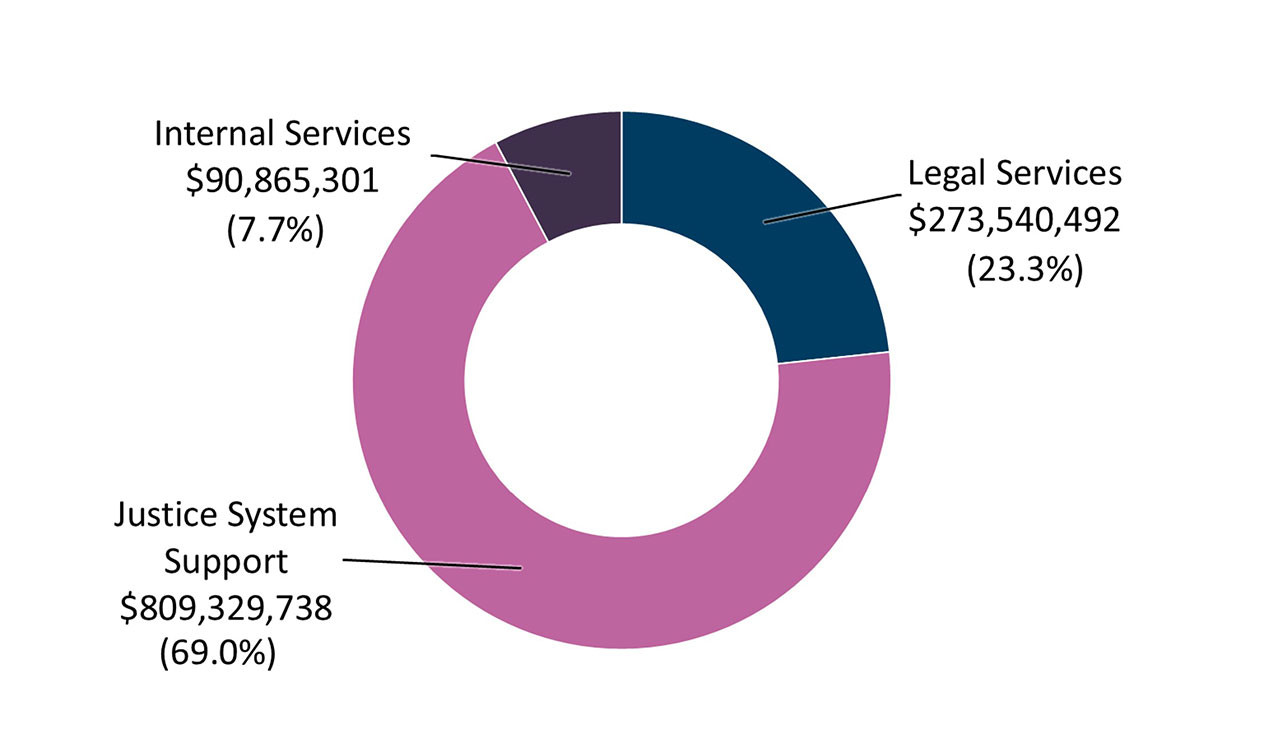
Text description of Figure 1
Figure 1 chart shows that $809.3 million (or 69.0%) of net planned spending is allocated to the Justice System Support core responsibility, $273.5 million (or 23.3%) of net planned spending is allocated to the Legal Services core responsibility and $90.9 million (or 7.7%) of net planned spending is allocated to support internal services. This represents total planned spending of $1,173.7 million.
Analysis of planned spending by core responsibility
The 2026–27 planned spending by core responsibility reflects the financial resources approved in the Main Estimates, including spending reductions for the Comprehensive Expenditure Review (CER) announced in Budget 2025.
As the primary provider of legal services to federal government departments and agencies, the Department has a Vote-Netted Revenue (VNR) authority to collect and spend revenue (respendable revenue) received from the provision of such services. For departmental reporting, this respendable revenue reduces total departmental authorities and operating expenditures.
The Legal Services core responsibility planned spending of $273.5 million is net of planned legal services revenues of $460.0 million (see Table 11). Planned 2026–27 Legal Services spending will focus on continuing to deliver legal advisory, litigation and legislative services in areas such as advancing reconciliation with Indigenous peoples, economic priorities to build a stronger economy, international trade, and safety and security.
The Justice System Support core responsibility planned spending of $809.3 million (see Table 11) includes both operating planned spending of $63.7 million and Grants and Contributions planned spending of $745.6 million. Justice System Support spending for 2026–27 will primarily focus on Grants and Contributions in the following programs:
- Criminal Legal Aid
- Youth Justice Services Funding Program
- Immigration and Refugee Legal Aid
- Victims Fund
- Indigenous Justice Program
Internal services planned spending of $90.9 million is net of planned legal services revenues of $67.0 million (see Table 11). Planned 2026–27 internal services spending focuses mainly on strengthening and modernizing digital and data capabilities, enhancing and modernizing human resource management, cultivating an equitable, diverse, inclusive and barrier-free workplace, and advancing initiatives under the Justice Sustainable Development Strategy.
Budgetary performance summary
Table 9: Three-year net spending summary for core responsibilities and internal services (dollars)
Table 9 presents the Department’s spending over the past two years and forecasted spending in the current year by core responsibility and for internal services. Amounts for the 2025–26 fiscal year are forecasted based on spending as of October 31, 2025.
| Core responsibilities and internal services | 2023–24 actual expenditures | 2024–25 actual expenditures | 2025–2026 forecast spending |
|---|---|---|---|
| Legal Services | 226,652,246 | 428,770,838 | 277,016,203 |
| Justice System Support | 750,690,516 | 791,967,257 | 844,441,441 |
| Subtotal | 977,342,762 | 1,220,738,095 | 1,121,457,644 |
| Internal services | 132,643,466 | 130,203,030 | 120,873,372 |
| Total | 1,109,986,228 | 1,350,941,125 | 1,242,331,016 |
Analysis of actual and forecast spending over the past three years
The Department’s spending has fluctuated over the three-year period from 2023–24 ($1,110.0 million) to 2025–26 ($1,242.3 million).
The $240.9 million increase from 2023–24 to 2024–25 is largely explained by one-time retroactive payments, increases in salary spending and an associated increase in the employee benefit plan (statutory) resulting from the ratification of various collective agreements, and an increase of funding in grants and contributions.
The $108.6 million decrease from 2024–25 to 2025–26 is largely explained -by the implementation of spending reductions for the Refocusing Government Spending initiative announced in Budget 2023 and the 2023 Fall Economic Statement and the one-time retroactive payments included in 2024–25. Additionally, there is an offsetting increase in grants and contributions forecast spending under the Justice System Support core responsibility related to initiatives announced in Budget 2024, the Fall Economic Statement 2024 as well as an off-cycle budget decision. These increases are mainly in the following programs:
- Immigration and Refugee Legal Aid Program
- Victims Fund
- Criminal Legal Aid Program
- Justice Partnership and Innovation Program
More financial information from previous years is available on the Finances section of GC Infobase.
Table 10: Three-year planned net spending on core responsibilities and internal services (dollars)
Table 10 presents the Department’s planned spending over the next three years by core responsibility and for internal services.
| Core responsibilities and internal services | 2026–27 planned spending | 2027–28 planned spending | 2028–29 planned spending |
|---|---|---|---|
| Legal Services | 273,540,492 | 263,337,114 | 258,185,364 |
| Justice System Support | 809,329,738 | 757,120,137 | 693,437,928 |
| Subtotal | 1,082,870,230 | 1,020,457,251 | 951,623,292 |
| Internal services | 90,865,301 | 92,370,320 | 85,586,415 |
| Total | 1,173,735,531 | 1,112,827,571 | 1,037,209,707 |
Analysis of the next three years of spending
The Department’s planned spending shows a decrease from $1,173.7 million in 2026–27 to $1,037.2 million in 2028–29. This $136.5 million decrease is mainly due to changes in grants and contributions funding.
The decreases in grants and contributions planned spending are explained by funding reprofiles, reductions to funding profiles and the sunsetting of temporary funding mainly in the following programs:
- Immigration and Refugee Legal Aid
- Justice Partnership and Innovation Program
- Indigenous Justice Program
- Legal Advice for Complainants of Workplace Sexual Harassment
- Access to Justice in Both Official Languages
- Youth Justice Fund
- Impact of Race and Culture Assessments
- Victims Fund
More detailed financial information on planned spending is available on the Finances section of GC Infobase.
Table 11: Budgetary gross and net planned spending summary (dollars)
Table 11 reconciles planned gross spending with planned net spending for 2026–27.
| Core responsibilities and internal services | 2026–27 planned gross spending | 2026–27 planned revenues netted against spending | 2026–27 planned net spending (authorities used) |
|---|---|---|---|
| Legal Services | 733,540,492 | 460,000,000 | 273,540,492 |
| Justice System Support | 809,329,738 | 0 | 809,329,738 |
| Subtotal | 1,542,870,230 | 460,000,000 | 1,082,870,230 |
| Internal services | 157,865,301 | 67,000,000 | 90,865,301 |
| Total | 1,700,735,531 | 527,000,000 | 1,173,735,531 |
Analysis of budgetary gross and net planned spending summary
The table above reflects the Department’s planned gross spending for 2026–27, which includes the VNR authority of $527.0 million.
The Department’s VNR authority is notionally distributed between the Legal Services core responsibility and internal services. The actual revenues distributed between programs could vary depending on numerous factors, such as changes to legal service rates approved periodically by Treasury Board, fluctuation in client departments’ demand for legal services, and the actual amount of revenue collected in excess of, or less than, the authority.
Figure 2 presents VNR over time.
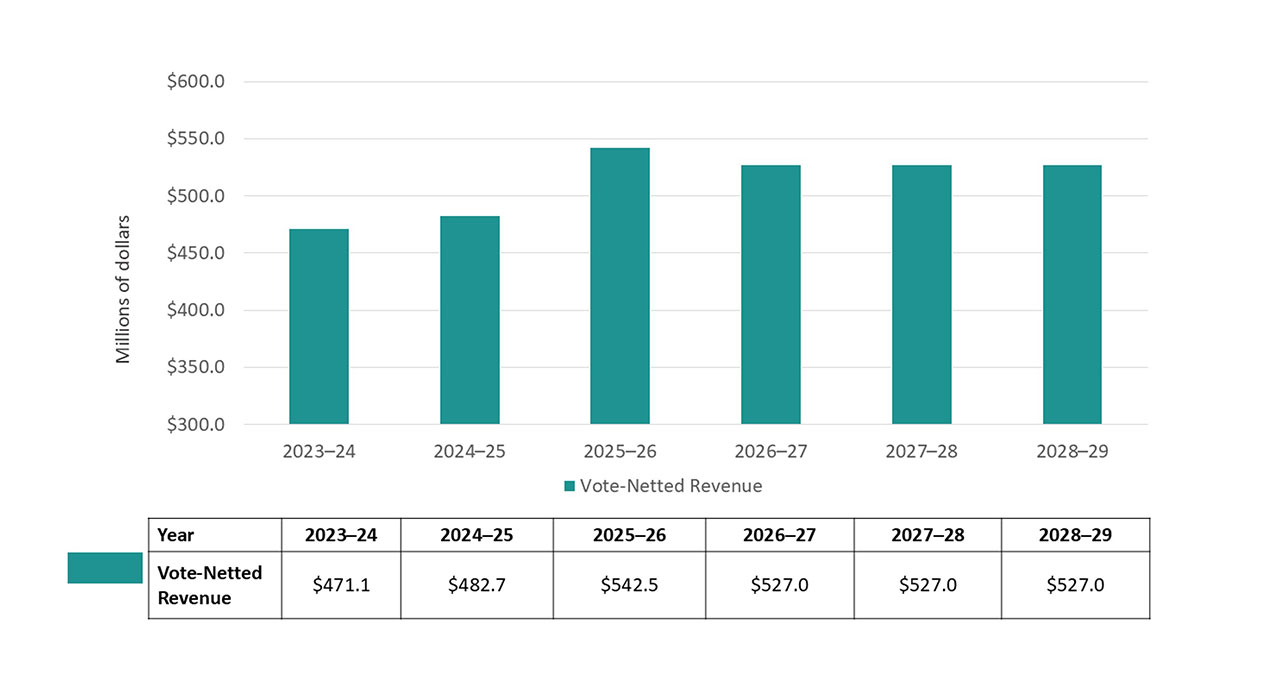
Text description of Figure 2
This vertical column graph represents departmental VNR trends for six fiscal years for the Department. The graph presents a timeline (in fiscal years) on the horizontal axis and the amount of dollars (in millions of dollars) on the vertical axis. The timeline on the horizontal axis shows six columns: one for each fiscal year from 2023–24 on the left through to 2028–29. The columns for fiscal years 2023–24 and 2024–25 show actual VNR, while the column for fiscal year 2025–26 shows forecasted VNR and the columns for fiscal years 2026–27 to 2028–29 show planned VNR.
The amount in millions of dollars on the vertical axis ranges from 300.0 on the bottom to 600.0 on the top. Each column displays the amount of VNR per fiscal year. This information is also displayed numerically below each column to indicate the precise amount of VNR (in millions of dollars) for each of the six fiscal years presented.
The first column of the timeline, representing fiscal year 2023–24, displays $471.1 million in actual VNR.
The second column of the timeline, representing fiscal year 2024–25, displays $482.7 million in actual VNR.
The third column of the timeline, representing fiscal year 2025–26 displays $542.5 million in forecasted VNR.
The fourth, fifth and sixth columns of the timeline, representing fiscal years 2026–27 to 2028–29, each display $527.0 million in planned VNR.
Analysis of vote-netted revenue over time
The Department’s forecasted VNR, as of October 31, 2025, is expected to reach $542.5 million in 2025–26. This forecast is higher than actual VNR for 2024–25 ($482.7 million) due to increased legal services rates resulting from ratified collective agreements and demand for legal services for a broad variety of client departments and agencies in such areas as tax, Indigenous matters, immigration, and border services.
Information on the alignment of the Department’s spending with Government of Canada’s spending and activities is available on GC InfoBase.
Funding
This section provides an overview of the Department's net voted and statutory funding for its core responsibilities and for internal services. For further information on funding authorities, consult the Government of Canada budgets and expenditures.
Figure 3 summarizes the department's approved net voted and statutory funding from 2023–24 to 2028–29.
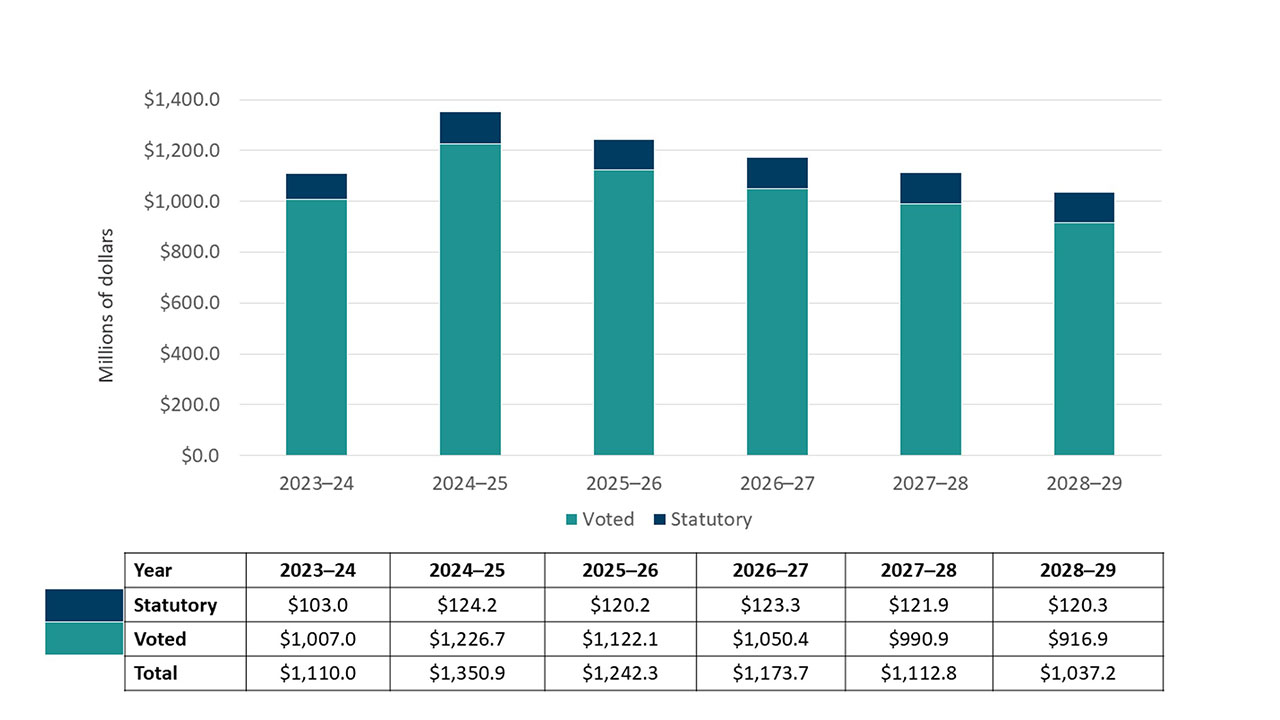
Text description of figure 3
This vertical stacked column graph represents departmental spending trends for six fiscal years for the Department. The graph presents a timeline (in fiscal years) on the horizontal axis and the amount of dollars (in millions of dollars) on the vertical axis. The timeline on the horizontal axis shows six columns, one for each fiscal year from 2023–24 on the left through to 2028–29. The columns for fiscal years 2023–24 and 2024–25 show actual spending, while the column for fiscal year 2025–26 shows forecast spending and the columns for fiscal years 2026–27 to 2028–29 show net planned spending.
The amount in millions of dollars on the vertical axis ranges from $0 on the bottom to $1,400.0 on the top. Each column displays an accumulated total of departmental spending for two categories of funding: statutory and voted. These two categories of funding are also displayed numerically below each column to indicate the amount of spending (in millions of dollars) for each of the six fiscal years presented.
The first column of the timeline, representing fiscal year 2023–24, displays $103.0 million in statutory spending and $1,007.0 million in voted spending, for a total actual spending of $1,110.0 million.
The second column of the timeline, representing fiscal year 2024–25, displays $124.2 million in statutory spending and $1,226.7 million in voted spending, for total actual spending of $1,350.9 million.
The third column of the timeline, representing fiscal year 2025–26, displays $120.2 million in statutory spending and $1,122.1 million in voted spending, for a total forecast spending of $1,242.3 million.
The fourth column of the timeline, representing fiscal year 2026–27, displays $123.3 million in statutory spending and $1,050.4 million in voted spending, for a total net planned spending of $1,173.7 million.
The fifth column of the timeline, representing fiscal year 2027–28, displays $121.9 million in statutory spending and $990.9 million in voted spending, for a total net planned spending of $1,112.8 million.
The sixth and final column of the timeline, representing fiscal year 2028–29, displays $120.3 million in statutory spending and $916.9 million in voted spending, for a total net planned spending of $1,037.2 million.
Analysis of statutory and voted funding over a six-year period
Variance between 2025–26 forecast spending and 2026–27 net planned spending
The Department’s planned spending for 2026–27 ($1,173.7 million) projects a net decrease of $68.6 million compared with forecast spending for 2025–26 ($1,242.3 million). The decrease is mainly under the Justice System Support core responsibility due to sunsetting of temporary grants and contributions funding, mainly for the Justice Partnership and Innovation Program, Victims Fund, and the Canadian Family Justice Fund.
Additionally, there is a decrease in planned spending for internal services attributable to expenditures related to funding from Treasury Board Central Votes (such as the Operating Budget Carry Forward and paylist requirements) and forecasted transition support measure expenditures related to the work force adjustments required to meet reductions announced in Budget 2023, the 2023 Fall Economic Statement and Budget 2025. These expenditures are included in 2025–26 forecast spending, however 2026–27 and future years reflects only funds to be approved through the Main Estimates.
Variance from 2026–27 net planned spending to 2028–29 net planned spending
The Department’s planned spending projects a decrease from 2026–27 ($1,173.7 million) to 2028–29 ($1,037.2 million). This $136.5 million overall reduction is mainly in the Justice System Support core responsibility and is attributable to decreases in funding and sunsetting of temporary funding announced in previous federal budgets (related to initiatives approved under Budget 2022, Budget 2024 and the 2024 Fall Economic Statement).
For further information on the Department’s departmental appropriations, consult the 2026–27 Main Estimates.
Future-oriented condensed statement of operations
The future-oriented condensed statement of operations provides an overview of the Department’s operations for 2025–26 to 2026–27.
Table 12: Future-oriented condensed statement of operations for the year ended March 31, 2027 (dollars)
Table 12 summarizes the expenses and revenues which net to the cost of operations before government funding and transfers for 2025–26 to 2026–27. The forecast and planned amounts in this statement of operations were prepared on an accrual basis. The forecast and planned amounts presented in other sections of the Departmental Plan were prepared on an expenditure basis. Amounts may therefore differ.
| Financial information | 2025–26 forecast results | 2026–27 planned results | Difference (planned results minus forecasted) |
|---|---|---|---|
| Total expenses | 1,890,814,707 | 1,806,824,432 | (83,990,275) |
| Total revenues | 542,548,484 | 527,000,000 | (15,548,484) |
| Net cost of operations before government funding and transfers | 1,348,266,223 | 1,279,824,432 | (68,441,791) |
Analysis of forecasted and planned results
Total expenses are forecasted to decrease by $84.0 million, from $1,890.8 million in 2025–26 to $1,806.8 million in 2026–27. This variance is mainly explained by the following:
- planned spending reductions due to Budget 2023, Budget 2024 and Budget 2025 reduction exercises
- expenditures related to funding from Treasury Board Central Votes (such as the Operating Budget Carry Forward)
- changes to funding for various initiatives and programs, including the Justice Partnership and Innovation Program and the Victims Fund
The variance in revenues shows a decrease $15.5 million, from $542.5 million in 2025–26 to $527.0 million in 2026–27, which represents the difference between the legal services revenue forecast for 2025–26 and the approved VNR authority for 2026–27. Although demand for legal services is expected to remain high, only the amounts approved in the Main Estimates are presented for future years for consistency purposes.
A more detailed Future-Oriented Statement of Operations and associated Notes for 2026–27, including a reconciliation of the net cost of operations with the requested authorities, is available on the Department’s website.
Human resources
This section presents an overview of the Department’s actual and planned human resources from 2023–24 to 2028–29.
Table 13: Actual human resources for core responsibilities and internal services
Table 13 shows a summary of human resources, in FTEs, for the Department’s core responsibilities and for its internal services for the previous three fiscal years. Human resources for the 2025–26 fiscal year are forecasted as of October 31, 2025.
| Core responsibilities and internal services | 2023–24 actual FTEs | 2024–25 actual FTEs | 2025–26 forecasted FTEs |
|---|---|---|---|
| Legal Services | 3,897 | 4,043 | 3,952 |
| Justice System Support | 390 | 374 | 347 |
| Subtotal | 4,287 | 4,417 | 4,299 |
| Internal services | 1,156 | 1,237 | 1,117 |
| Total | 5,443 | 5,654 | 5,416 |
Analysis of human resources over the last three years
Actual FTEs fluctuated over the three-year period from 2023–24 (5,443 FTEs) to 2025–26 (5,416 FTEs). From 2023–24 to 2024–25, the Legal Services core responsibility and internal services increased by 146 FTEs and 81 FTEs respectively, largely explained by an increase in the workforce to meet the increased demand for legal services and additional resources needed to support the operational needs for the Department. These increases were more than reversed by 2025–26 due to staffing restrictions and workforce adjustments required to meet reductions announced in Budget 2023 and the 2023 Fall Economic Statement.
Table 14: Human resources planning summary for core responsibilities and internal services
Table 14 shows information on human resources, in FTEs, for each of the Department’s core responsibilities and for its internal services planned for the next three years.
| Core responsibilities and internal services | 2026–27 Planned FTEs | 2027–28 Planned FTEs | 2028–29 Planned FTEs |
|---|---|---|---|
| Legal Services | 3,878 | 3,836 | 3,807 |
| Justice System Support | 323 | 317 | 317 |
| Subtotal | 4,201 | 4,153 | 4,124 |
| Internal services | 1,065 | 1,057 | 1,055 |
| Total | 5,266 | 5,210 | 5,179 |
Analysis of human resources for the next three years
Overall, there is a decreasing trend in FTEs over the three-year period from 2026–27 (5,266 FTEs) to 2028–29 (5,179 FTEs). This is largely explained by workforce adjustments required to meet reductions announced in Budget 2023, the 2023 Fall Economic Statement and Budget 2025.
Supplementary information tables
The following supplementary information table is available on the Department’s website:
Information on the Department’s departmental sustainable development strategy can be found on the Department's website.
Federal tax expenditures
This Departmental Plan does not include information on tax expenditures.
The tax system can be used to achieve public policy objectives through the application of special measures such as low tax rates, exemptions, deductions, deferrals and credits. The Department of Finance Canada publishes cost estimates and projections for these measures each year in the Report on Federal Tax Expenditures.
This report also provides detailed background information on tax expenditures, including descriptions, objectives, historical information and references to related federal spending programs as well as evaluations and GBA Plus of tax expenditures.
Corporate information
Departmental profile
Appropriate minister:
The Honourable Sean Fraser, P.C., K.C., M.P.
Institutional head:
Marie-Josée Hogue
Ministerial portfolio:
Justice
Enabling instrument(s):
Year of incorporation / commencement:
1868
Departmental contact information
Mailing address:
Department of Justice Canada
284 Wellington Street
Ottawa, Ontario
Canada K1A 0H8
Telephone:
613-957-4222
TTY:
1-800-465-7735
Email:
Website(s):
Definitions
List of terms
- appropriation (crédit)
- Any authority of Parliament to pay money out of the Consolidated Revenue Fund.
- budgetary expenditures (dépenses budgétaires)
- Operating and capital expenditures; transfer payments to other levels of government, departments or individuals; and payments to Crown corporations.
- core responsibility (responsabilité essentielle)
- An enduring function or role performed by a department. The intentions of the department with respect to a core responsibility are reflected in one or more related departmental results that the department seeks to contribute to or influence.
- Departmental Plan (plan ministériel)
- A report on the plans and expected performance of an appropriated department over a 3-year period. Departmental Plans are usually tabled in Parliament each spring.
- departmental result (résultat ministériel)
- A consequence or outcome that a department seeks to achieve. A departmental result is often outside departments’ immediate control, but it should be influenced by program-level outcomes.
- departmental result indicator (indicateur de résultat ministériel)
- A quantitative measure of progress on a departmental result.
- departmental results framework (cadre ministériel des résultats)
- A framework that connects the department’s core responsibilities to its departmental results and departmental result indicators.
- Departmental Results Report (rapport sur les résultats ministériels)
- A report on a department’s actual accomplishments against the plans, priorities and expected results set out in the corresponding Departmental Plan.
- full-time equivalent (équivalent temps plein)
- A measure of the extent to which an employee represents a full person-year charge against a departmental budget. For a particular position, the full-time equivalent figure is the ratio of number of hours the person actually works divided by the standard number of hours set out in the person’s collective agreement.
- Gender-based Analysis Plus (GBA Plus) (analyse comparative entre les sexes plus [ACS Plus])
-
Is an analytical tool used to support the development of responsive and inclusive policies, programs, and other initiatives. GBA Plus is a process for understanding who is impacted by the issue or opportunity being addressed by the initiative; identifying how the initiative could be tailored to meet diverse needs of the people most impacted; and anticipating and mitigating any barriers to accessing or benefitting from the initiative. GBA Plus is an intersectional analysis that goes beyond biological (sex) and socio-cultural (gender) differences to consider other factors, such as age, disability, education, ethnicity, economic status, geography (including rurality), language, race, religion, and sexual orientation.
Using GBA Plus involves taking a gender- and diversity-sensitive approach to our work. Considering all intersecting identity factors as part of GBA Plus, not only sex and gender, is a Government of Canada commitment.
- government priorities (priorités gouvernementales)
- For the purpose of the 2026–27 Departmental Plan, government priorities are the high-level themes outlining the government’s agenda in the 2025 Speech from the Throne.
- horizontal initiative (initiative horizontale)
- An initiative where two or more federal departments are given funding to pursue a shared outcome, often linked to a government priority.
- Indigenous business (enterprise autochtones)
- Requirements for verifying Indigenous businesses for the purposes of the Departmental Results Report are available through the Indigenous Services Canada Mandatory minimum 5% Indigenous procurement target website.
- non‑budgetary expenditures (dépenses non budgétaires)
- Non-budgetary authorities that comprise assets and liabilities transactions for loans, investments and advances, or specified purpose accounts, that have been established under specific statutes or under non-statutory authorities in the Estimates and elsewhere. Non-budgetary transactions are those expenditures and receipts related to the government's financial claims on, and obligations to, outside parties. These consist of transactions in loans, investments and advances; in cash and accounts receivable; in public money received or collected for specified purposes; and in all other assets and liabilities. Other assets and liabilities, not specifically defined in G to P authority codes are to be recorded to an R authority code, which is the residual authority code for all other assets and liabilities.
- performance (rendement)
- What a department did with its resources to achieve its results, how well those results compare to what the department intended to achieve, and how well lessons learned have been identified.
- performance indicator (indicateur de rendement)
- A qualitative or quantitative means of measuring an output or outcome, with the intention of gauging the performance of a department, program, policy or initiative respecting expected results.
- plan (plan)
- The articulation of strategic choices, which provides information on how a department intends to achieve its priorities and associated results. Generally, a plan will explain the logic behind the strategies chosen and tend to focus on actions that lead to the expected result.
- planned spending (dépenses prévues)
-
For Departmental Plans and Departmental Results Reports, planned spending refers to those amounts presented in Main Estimates.
A department is expected to be aware of the authorities that it has sought and received. The determination of planned spending is a departmental responsibility, and departments must be able to defend the expenditure and accrual numbers presented in their Departmental Plans and Departmental Results Reports.
- program (programme)
- Individual or groups of services, activities or combinations thereof that are managed together within the department and focus on a specific set of outputs, outcomes or service levels.
- program inventory (répertoire des programmes)
- Identifies all the department’s programs and describes how resources are organized to contribute to the department’s core responsibilities and results.
- result (résultat)
- A consequence attributed, in part, to a department, policy, program or initiative. Results are not within the control of a single department, policy, program or initiative; instead, they are within the area of the department’s influence.
- statutory expenditures (dépenses législatives)
- Expenditures that Parliament has approved through legislation other than appropriation acts. The legislation sets out the purpose of the expenditures and the terms and conditions under which they may be made.
- target (cible)
- A measurable performance or success level that a department, program or initiative plans to achieve within a specified time period. Targets can be either quantitative or qualitative.
- voted expenditures (dépenses votées)
- Expenditures that Parliament approves annually through an appropriation act. The vote wording becomes the governing conditions under which these expenditures may be made.
- Date modified: