
Access to justice and family justice services: Results from the 2025 National Family Law Survey of Legal Advisers and Family Justice Professionals
October 2026
Introduction
The Department of Justice Canada has conducted biennial surveys on the experiences and practices of Canadian family legal practitioners since 1998.Footnote 1 These surveys collect information about the characteristics of family law cases and various family law issues. The 2025 National Family Law Survey focused specifically on the experiences of practitioners with some of the Divorce Act amendments that came into force on March 1, 2021, and with the public legal education and information materials that Justice Canada developed on the Divorce Act amendments.
This report presents the results of the access to justice and family justice services related questions in the 2025 National Family Law Survey. These findings help inform the development of family law policy and programs in Canada.
Methodology
Historically, the National Family Law Surveys were administered at the National Family Law Program Conference. Since 2018, the questionnaire has been distributed as an online survey to increase the number of responses. In 2025, the distribution of the National Family Law Survey was expanded for the first time to include other family justice professionals, such as mediators, arbitrators, and parenting coordinators.
The data collection period for the 2025 National Family Law Survey was from January 13 to March 11, 2025. Three versions of the survey were circulated: one for legal advisers;Footnote 2 one for family justice professionals; and one for judges. The surveys were similar; however, certain questions were only asked in one of the three surveys and at times, the questions were altered to reflect the distinctions between the professions.
The survey was distributed to legal advisers through the Federation of Law Societies of Canada and the Canadian Bar Association’s Family Law Section. Family justice professionals were invited to participate through Family Mediation Canada and nine provincial mediation and alternative dispute resolution organizations. Some practitioners and organizations were contacted based on the recommendations of members of the Coordinating Committee of Senior Officials – Family Justice, a federal-provincial-territorial committee. Efforts were also made to distribute the survey through judicial organizations to judges who hear family law cases. In total, 178 legal advisers, 97 family justice professionals and 6 judges answered the survey. Since the response rate from judges was low, the experiences of judges will not be included in this report. Where comparisons are made, only differences that are statistically significant at the 95% confidence level are presented in this report.
Limitations
The Department of Justice Canada used a snowball sampling approachFootnote 3 to distribute the survey to legal advisers and family justice professionals across Canada. The demographic information collected from respondents as well as the low response rate show that the sample is not representative of those working in the field. For example, a high proportion of responses came from the Prairies (56% of legal adviser respondents and 52% of family justice professional respondents), as well as from professionals who always or almost always take on family law matters (74% of legal advisers and 75% of family justice professionals) and have been working in the area for at least 10 years (75% of legal advisers and 62% of family justice professionals). As such, the results in this report should not be generalized as representing the experiences of all legal advisers and family justice professionals.
Findings
More than half of respondents indicated that family justice services increase access to justice, reduce the need for court intervention, and help resolve the issues that were in dispute.
Family justice services are private or public services that are designed to help people deal with issues that can arise in the context of separation or divorce. These services include dispute resolution services (e.g., mediation), child support recalculation services, child support enforcement services, and other programs like parent education programs.
As shown in Figure 1 below, most respondents reported that family justice services increase access to justice for most of their clients (61% of legal advisers and 73% of family justice professionals). Family justice professionals were significantly more likely than legal advisers to report that these services reduce the need for court intervention (76% and 53%, respectively), help resolve the issues that were in dispute (78% and 52%), reduce conflict (80% and 44%) and lead to better outcomes for the children (74% and 33%) for most of their clients.Footnote 4 Overall, few respondents (14% of legal advisers and 2% of family justice professionals) disagreed with all the statements about family justice services.
Figure 1. Percentage of legal advisers and family justice professionals by the impact of family justice services, 2025
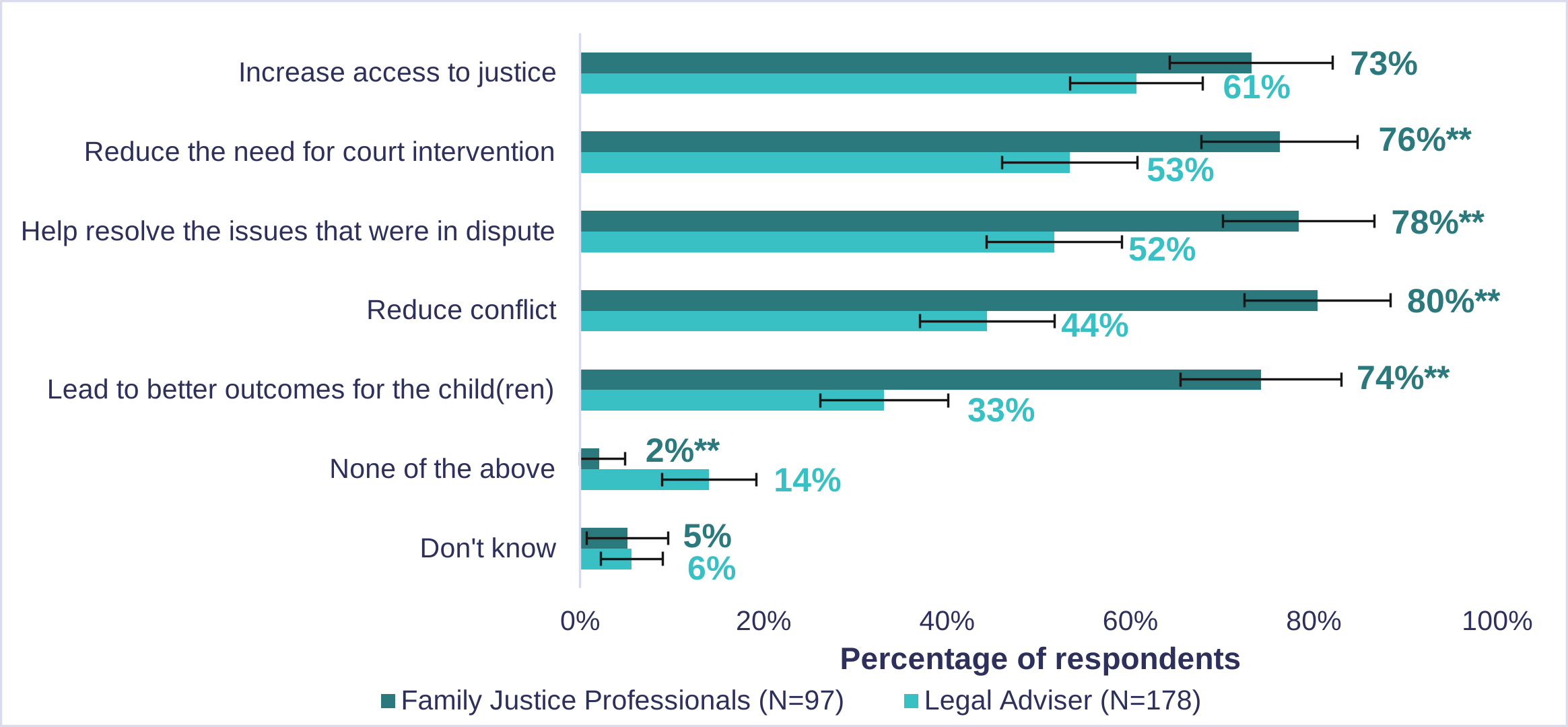
Figure 1. Percentage of legal advisers and family justice professionals by the impact of family justice services, 2025 – Text version
This image is a grouped horizontal bar chart entitled “Percentage of legal advisers and family justice professionals by the impact of family justice services, 2025.” It compares responses from two groups: Legal Advisers (N=178) and Family Justice Professionals (N=97). The horizontal axis shows the percentage of respondents from 0% to 100%, and the vertical axis shows perceived impacts of family justice services. Each bar includes error bars indicating confidence intervals on the reported percentages.
Percentage of respondents who identified that family justice services increase access to justice
- 73% of family justice professionals
- 61% of legal advisers
Percentage of respondents who identified that family justice services reduce the need for court intervention
- 76%Figure 1 footnote ** of family justice professionals (significantly different from legal advisers)
- 53% of legal advisers
Percentage of respondents who identified that family justice services help resolve the issues that were in dispute
- 78%Figure 1 footnote ** of family justice professionals (significantly different from legal advisers)
- 52% of legal advisers
Percentage of respondents who identified that family justice services reduce conflict
- 80%Figure 1 footnote ** of family justice professionals (significantly different from legal advisers)
- 44% of legal advisers
Percentage of respondents who identified that family justice services lead to better outcomes for the child(ren)
- 74%Figure 1 footnote ** of family justice professionals (significantly different from legal advisers)
- 33% of legal advisers
Percentage of respondents who selected “none of the above”
- 2%Figure 1 footnote ** of family justice professionals (significantly different from legal advisers)
- 14% of legal advisers
Percentage of respondents who don’t know the impact of family justice services
- 5% of family justice professionals
- 6% of legal advisers
More than one in three legal advisers and half of family justice professionals reported that family violence services increase the safety of the victim and increase access to justice.
Respondents were specifically asked about services for families experiencing family violence, such as the Family Court Support Worker Program, safety planning support, legal clinics and community agencies. Family justice professionals were significantly more likely than legal advisers to report that family violence services increase access to justice (73% and 35%, respectively), increase the safety of the victim (69% and 42%) and lead to better outcomes for the child (62% and 23%) for most of their clients.Footnote 5 Similarly, family justice professionals were also significantly more likely to indicate that these services help resolve the issues that were in dispute (59%), reduce conflict (57%) and reduce the need for court intervention (53%) for most of their clients, compared to legal advisers (21%, 16% and 15%, respectively). The lower proportions reported among legal advisers may be, in part, due to the significantly higher percentage of legal advisers who reported not knowing the impact of family violence services on their clients (20%) compared to family justice professionals (7%). Overall, few legal advisers (13%) and family justice professionals (5%) selected none of the statements about the impact of family violence services and a further 12% of legal advisers and 7% of family justice professionals were unaware of services for families.
Almost two in five legal advisers reported more consistently providing information about available family justice services since the Divorce Act amendments came into force.
The 2021 Divorce Act amendments introduced a new provision that makes it a duty of legal advisers to inform their clients about the family justice services that might assist them. Approximately two in five (38%) legal advisers agreedFootnote 6 that they more consistently provide information about available family justice services to their clients since the amendments came into force. A similar proportion (37%) indicated that they neither agree nor disagree that they more consistently provide information about these services.
The remaining legal advisers (24%) disagreed that they more consistently provide information about family justice services to their clients post-amendments. However, this may be, in part, because these legal advisers were already providing information about these services prior to the 2021 amendments. The amendments had the objective of reinforcing these existing practices by requiring legal advisers to inform their clients about available services. Based on the survey results, it appears that the amendments have helped to reinforce and promote this practice, as a considerable proportion indicated providing this information more consistently.
Over four in five respondents reported that their clients obtain information about family justice services from them.
Respondents were given a long list of possible ways their clients could potentially obtain information about family justice services. Most legal advisers (88%) and family justice professionals (84%) indicated that their clients obtain information about these services from them. As mentioned above, since it is legal adviser’s duty to inform their clients about family justice services, this finding preliminarily shows that the new amendments are being implemented as intended.
Family justice professionals were significantly more likely than legal advisers to report that their clients obtain information about family justice services through provincial or territorial government websites (76% and 44%, respectively), court services (72% and 53%), a lawyer or family justice professional referral service (70% and 34%), parent education programs (58% and 35%), other websites for family justice professionals (53% and 31%), and public legal education and information associations (47% and 30%).Footnote 7 Over half of legal advisers (60%) also indicated that their clients obtain family justice service information from friends and family members, although this finding did not statistically differ from that of family justice professionals (49%).
When interpreting these results, it is important to remember that legal advisers and family justice professionals are only aware of where their clients have obtained information from when clients disclose it to them. As such, it is possible that clients could be obtaining information about family justice services from other sources that the respondents were unaware of.
Half of legal advisers indicated that they more consistently encourage clients to use family dispute resolution processes and almost half reported that more clients are agreeing to use these processes since the amendments came into force.
Since the 2021 Divorce Act amendments came into force, legal advisers have had the duty to encourage their clients to attempt to resolve family law matters through a family dispute resolution process, unless due to the circumstances of the case it would clearly not be appropriate to do so. Half (50%) of legal advisers agreed that the Divorce Act amendments led them to more consistently encourage their clients, where appropriate, to use family dispute resolution processes to attempt to resolve their family law matters. Less than two in five (18%) legal advisers disagreed that they more consistently encourage their clients to use these processes, and a further 30% neither agreed nor disagreed with the statement.
Almost half of legal advisers (47%) also agreed that more of their clients are using family dispute resolution processes to try to resolve their family law matters since the amendments came into force. Since a similar proportion of legal advisers indicated more consistently encouraging their clients to use these out-of-court processes, this could be, in part, why respondents have found that more of their clients are agreeing to use these processes. Almost one in four (22%) neither agreed nor disagreed, and less than one-third (28%) disagreed that more of their clients are agreeing to use these out-of-court processes.
Two in five legal advisers and over half of the family justice professionals reported that the amendments that expanded the situations when child support amounts can be calculated or recalculated outside of the courts promote access to justice.
The 2021 amendments introduced new provisions that provide legislative authority to designated provincial child support services to calculate initial child support amounts in the context of divorce proceedings and expanded the situations where they could recalculate child support amounts when spouses have a support order under the Divorce Act. As shown in Figure 2 below, two in five (40%) legal advisers and one in two (54%) family justice professionals agreed that these new provisions promote access to justice by expanding the situations when child support amounts can be calculated or recalculated outside of the courts. Less than one in five respondents (18% of legal advisers and 10% of family justice professionals) disagreed that these provisions promote access to justice. Legal advisers were also significantly more likely to have neither agreed nor disagreed that the new provisions promote access to justice (36%) compared to family justice professionals (18%).Footnote 8
While the 2021 amendments allow for the creation of services to calculate child support under the Divorce Act, at the time of the survey, none of the provinces and territories had entered into an agreement with the federal government. For recalculation services, three provincial and territorial governments had signed agreements to take advantage of the expanded eligibility under the amended Divorce Act. As such, it is important to consider that the access to justice that these new provisions could provide under the 2021 amendments had not yet been realized across the country when legal advisers and family justice professionals responded to the survey.
Figure 2. Percentage of legal advisers and family justice professionals by agreement or disagreement that the new calculation/recalculation provisions promote access to justice, 2025
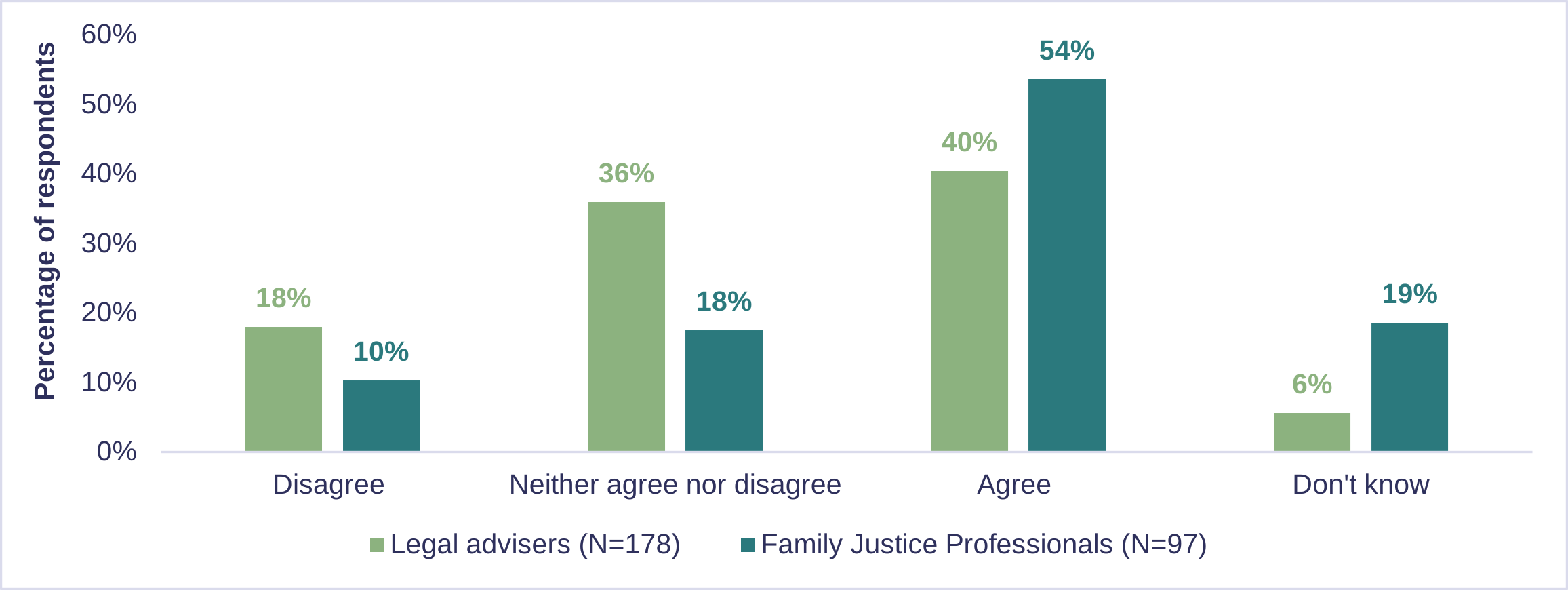
Figure 2. Percentage of legal advisers and family justice professionals by agreement or disagreement that the new calculation/recalculation provisions promote access to justice, 2025 – Text version
This image is a grouped vertical bar chart entitled “Percentage of legal advisers and family justice professionals by agreement or disagreement that the new calculation/recalculation provisions promote access to justice, 2025.” It compares responses from two groups: Legal Advisers (N=178) and Family Justice Professionals (N=97). The vertical axis shows the percentage of respondents from 0% to 60%, and the horizontal axis shows respondents’ level of agreement that the new calculation/recalculation provisions promote access to justice.
Percentage of respondants who disagree that the new calculation/recalculation provisions promote access to justice
- 18% of legal advisers
- 10% of family justice professionals
Percentage of respondants who neither agree nor disagree that the new calculation/recalculation provisions promote access to justice
- 36% of legal advisers
- 18% of family justice professionals
Percentage of respondants who agree that the new calculation/recalculation provisions promote access to justice
- 40% of legal advisers
- 54% of family justice professionals
Percentage of respondants who don’t know if the new calculation/recalculation provisions promote access to justice
- 6% of legal advisers
- 19% of family justice professionals
Where the official language rights provision is in force, one in four legal advisers and one in three family justice professionals reported that their clients have a greater ability to access proceedings in the official language of their choice.
When the 2021 Divorce Act amendments came into force, an official language provision was introduced that specifies that proceedings can be conducted in either or both official languages. At the time of the survey, this provision was in force in five jurisdictions, notably the Yukon, Nunavut, Saskatchewan, Manitoba and Ontario, as they were the jurisdictions that were ready to implement the provision.Footnote 9
More than half (57%) of legal advisers and almost two in five (39%) family justice professionals reported that the official language rights provision was not in force in their jurisdiction. This means that the new provisions were in force among 43% of legal advisers and 61% of family justice professionals. Of these respondents, one in four (25%) legal advisers and over one in three (37%) family justice professionals indicated that their clients have a greater ability to access proceedings in the official language of their choice. Less than a quarter of these respondents (15% of legal advisers and 10% of family justice professionals) reported that their clients did not have a greater ability to access proceedings in their official language of their choice, and a further 60% of legal advisers and 53% of family justice professionals did not know.
Conclusion
This report summarizes responses from the 2025 National Family Law Survey on access to justice and family justice services. Overall, most respondents reported that family justice services increase access to justice and help resolve the issues that are in dispute. Most family justice professionals and one-third of legal advisers also indicated that the services for family violence increase access to justice and increase the safety of the victim.
The results in this report focus mostly on legal professionals’ experiences with the Divorce Act amendments that came into force in 2021. One of these changes is that designated provincial child support services now have the authority to calculate child support orders for proceedings under the Divorce Act or recalculate the amount of child support for orders under the Divorce Act in expanded situations. Most family justice professionals indicated that this new provision promotes access to justice by expanding the situations when child support can be calculated or recalculated outside the courts. Other recent changes include the duty of legal advisers to inform their clients about available family justice services and to encourage them to attempt to resolve their family law matter through a family dispute resolution process, where appropriate. Four years after the amendments came into force, at the time the survey was circulated, half of legal advisers were reportedly encouraging their clients more consistently to resolve their matters through a family dispute resolution process and about half of their clients were agreeing to use these alternative processes.
Regarding family justice services, almost two in five legal advisers indicated that they more consistently provide information about these services to their clients since the amendments came into force. The reason that less than half of legal advisers reported more consistently providing information about family justice services to their clients since the Divorce Act changes is likely because most legal advisers were already providing information about these services to their clients prior to the amendments. This explanation is consistent with the responses from the 2016 National Family Law Program survey, which showed that 91% of legal adviser respondents indicated that their clients receive information about family justice services from them.Footnote 10
The survey also included a question about the official language provision that came into force in 2021. While most respondents indicated that this provision was not in force in their jurisdiction at the time of the survey, where the provision was in force, one-quarter of legal advisers and one-third of family justice professionals reported that the new provision gave their clients a greater ability to access proceedings in the official language of their choice. It will be important to continue to ask professionals about their experiences with the official language amendment as the provision is implemented in other jurisdictions and as they handle more cases involving this provision, especially since a considerable portion of respondents were not able to comment on the impact of the provision at the time of the survey.
While some of the findings point towards a positive step, such as an increase in clients agreeing to use family dispute resolution processes, it is important to remember that these findings cannot be generalized as representing the experiences of all family law professionals in Canada, as only a small proportion of legal advisers (n=178) and family justice professionals (n=97) answered the survey. As mentioned above, the survey was circulated less than four years after the amendments came into force and it can take time for the impact of legislative changes to become apparent. Ongoing monitoring of the updated legislation will help to inform whether more changes are observed over time.
For more information, please contact:
Rsd-drs@justice.gc.ca
Access to justice and family justice services: Results from the 2025 National Family Law Survey of Legal Advisers and Family Justice Professionals
J4-212/2026E-PDF
978-1-100-00851-6
- Date modified: