
Section 2 – General Results: All Service Users
This section of the report presents results based on feedback from all Cycle V service users who reported having received Justice Canada legal services in the 12 months prior to the survey. These results include client contacts identified by LEX who were outside the traditional target population of EX-minus-1 level and above in the NCR and the EX-minus-2 level and above in the regions. As a result, historical comparability is unavailable for this section. See Section 3 for a historical comparison of eligible survey elements for senior-ranking service users.
2.1 Survey Response
From October 3rd, 2023, to April 28th, 2025, the CFS was administered to potential service users across 45 departments and agencies. Specifically, 71,876 potential users of the Department’s legal services received a survey invitation. In total, 6,831 individuals, out of 19,551 respondents,Footnote 7 reported having used Justice Canada legal services in the 12 months preceding the survey (see Annex D for response data and Annex E for a profile of all service users).
Exhibit 1: Number of Service Users by Legal Service TypeFootnote 8
| All Service Users | Legal Advisory Services | Litigation Services |
Legislative Drafting Services | Regulatory Drafting Services |
|---|---|---|---|---|
| 6,831 | 5,940 (87.0%) | 2,099 (30.7%) | 336 (4.9%) | 737 (10.8%) |
2.2 Survey Results
Mean satisfaction ratings, across all survey elements, regardless of service type, ranged from 8.1 to 9.6. To view results by individual element, see Annex B.
2.2.1 Client Satisfaction with Overall Quality of Legal Services
Clients were asked to rate their satisfaction with the overall qualityFootnote 9 of the legal services they received from the Department. As indicated in the following table, overall quality ratings across all four service types surpassed the departmental target of 8.0, indicating that the users of the Department’s legal services were, collectively, satisfied with the overall quality of services provided.
Exhibit 2: Satisfaction Ratings for Overall Quality of Legal Services by Legal Service Type
| Cycle V (2023-25) |
|
|---|---|
| Legal Advisory Services | 8.6 (±0.0) (Strong) |
| Litigation Services | 8.5 (±0.1) (Strong) |
| Legislative Drafting Services | 8.9 (±0.1) (Strong) |
| Regulatory Drafting Services | 8.7 (±0.1) (Strong) |
2.2.2 Client Satisfaction with Service Dimensions
The table below provides the composite ratings for each of the three service dimensions of client satisfaction. When broken down by legal service type, all composite ratings for each service dimension exceeded the departmental target.
Exhibit 3: Composite Ratings by Service Dimension and Service Type
| Legal Advisory Services | Litigation Services | Legislative Drafting Services | Regulatory Drafting Services | |
|---|---|---|---|---|
| Responsiveness of Legal Services | 8.1 (±0.1) (Positive) |
8.2 (±0.1) (Positive) |
8.7 (±0.1) (Strong) |
8.4 (±0.1) (Strong) |
| Timeliness of Legal Services | 8.3 (±0.0) (Positive) |
8.5 (±0.1) (Strong) |
8.9 (±0.1) (Strong) |
8.4 (±0.1) (Strong) |
| Usefulness of Legal Services | 8.6 (±0.0) (Strong) |
8.6 (±0.1) (Strong) |
8.9 (±0.1) (Strong) |
8.8 (±0.1) (Strong) |
2.3 Legal Advisory Services
Of the 5,940 service users who reported having received legal advisory services, the majority (4,968 or 83.6%) indicated that they had received their services from the Legal Service Unit dedicated to their department or agency (Annex F). Additionally, 397 (6.7%) users indicated that their service provider was “Unknown”, 190 (3.2%) selected the National Litigation Sector, and 189 (3.2%) selected “A Centre of Expertise” from the service provider picklist. As observed in Exhibit 4 below, most legal advisory services users reported receiving legal advice ‘less than once per month’.
Exhibit 4: Frequency of Legal Advisory Services Received
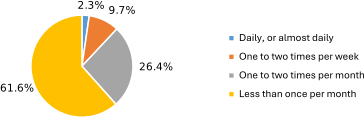
Exhibit 4: Frequency of Legal Advisory Services Received – Text version
Exhibit 4 shows the distribution of how frequently respondents received legal advisory services, as illustrated by a four-segment pie chart. The majority of respondents, 61.6%, reported receiving services less than once per month, making this by far the most common frequency. Another 26.4% indicated receiving services one to two times per month, while 9.7% received services one to two times per week. Only 2.3% of respondents reported accessing legal advisory services daily or almost daily. Overall, the results indicate that most clients engage with legal advisory services on an infrequent, monthly or less-than-monthly basis.
2.3.1 Client Satisfaction
The survey results indicate that clients of legal advisory services were, in general, satisfied with the overall quality of services they received (average rating of 8.6). As indicated in the chart below, 4,780 (80.5%) of legal advisory service users rated their satisfaction with the overall quality of the services provided as either at or above the departmental target of 8.0.
Exhibit 5: Distribution of Satisfaction Ratings for Overall Quality of Legal Advisory Services
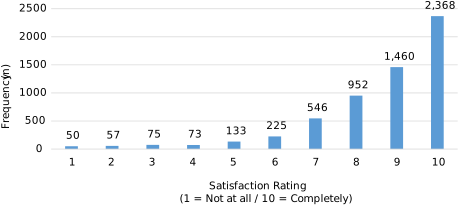
Exhibit 5: Distribution of Satisfaction Ratings for Overall Quality of Legal Advisory Services – Text version
Exhibit 5 presents the distribution of satisfaction ratings for the overall quality of legal advisory services using a bar chart with ratings ranging from 1 (Not at all) to 10 (Completely). The number of responses increases steadily across the scale, beginning with 50 responses for a rating of 1, 57 for 2, 75 for 3, and 73 for 4. Moderate ratings show slightly higher frequencies, with 133 responses for a rating of 5 and 225 for 6. The distribution then rises sharply at the higher end of the scale, with 546 responses for a rating of 7, 952 for 8, 1,460 for 9, and peaking at 2,368 responses for a rating of 10. Overall, the pattern is strongly skewed toward high satisfaction, with ratings of 8, 9, and 10 comprising the majority of responses.
All elements of legal advisory services exceeded the departmental target of 8.0 and ranged from 8.1 to 9.1 (see Exhibit 6 below).
Exhibit 6: Satisfaction Ratings for Legal Advisory Services Elements
| Cycle V (2023-25) | n | ||
|---|---|---|---|
| Overall Quality of Legal Advisory Services | 8.6 (±0.0) (Strong) |
5,939 | |
| Responsiveness | Provided timely status updates with respect to our services | 8.1 (±0.1) (Positive) |
5,355 |
| Timeliness | Responded in a timely manner to requests for legal services | 8.2 (±0.0) (Positive) |
5,860 |
| Negotiated mutually acceptable deadlines | 8.3 (±0.1) (Positive) |
4,401 | |
| Met mutually acceptable deadlines | 8.4 (±0.1) (Strong) |
4,857 | |
| Usefulness | Fully understood the nature of the problem/issue(s) for which you received assistance | 8.8 (±0.0) (Strong) |
5,912 |
| Provided consistent legal advice | 8.7 (±0.0) (Strong) |
5,794 | |
| Provided legal advice that reflects a whole-of-government approach (i.e., considered issues and priorities across government departments/agencies) | 8.7 (±0.0) (Strong) |
4,896 | |
| Worked with you to identify, explain and mitigate legal risks | 8.7 (±0.0) (Strong) |
5,600 | |
| Provided clear and practical legal advice to support your mandate | 8.6 (±0.0) (Strong) |
5,793 | |
| Involved you in the development of legal strategy and positions | 8.3 (±0.1) (Positive) |
4,014 | |
| Identified means to prevent or resolve legal disputes at the earliest opportunity | 8.5 (±0.1) (Strong) |
3,900 | |
| Provided effective support for treaty negotiation (advice, drafting, conduct) | 9.1 (±0.4) (Strong) |
31 | |
2.3.2 Service User Comments
To better understand client experiences, service user comments were categorized as positive, negative, or neutral/mixed. As illustrated in the sentiment distribution chart below, nearly two-fifths of the comments received regarding legal advisory services were negative. While this may reflect genuine concerns, it is also consistent with the broader trend that clients are more likely to provide feedback when they have experienced challenges.
Exhibit 7: Legal Advisory Services – Responses by Sentiment Score
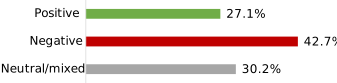
Exhibit 7: Legal Advisory Services – Responses by Sentiment Score – Text version
The exhibit presents a horizontal bar chart illustrating the distribution of sentiment categories. The largest proportion of responses was negative, accounting for 42.7% of the total. This is followed by neutral or mixed sentiment at 30.2%, while positive sentiment represented the smallest share at 27.1%. Overall, the results show that negative sentiment was the most commonly expressed among respondents, with positive sentiment trailing behind both neutral/mixed and negative categories.
General Sentiment towards Legal Advisory Services
Client feedback towards legal advisory services varied, with many service users from various departments and agencies commending the professionalism, expertise, and collaborative spirit of counsel. Clients frequently highlighted the high quality of legal advice, noting its clarity, practicality, and alignment with operational needs. Legal teams were valued partners in complex files and negotiations, and their responsiveness, especially under manageable workloads, was appreciated. Stable legal contacts and effective coordination contributed to consistent and reliable support. Moreover, clients recognized the importance of legal services and expressed a desire for continued collaboration, training, and knowledge-sharing to enhance mutual understanding and service delivery.
The feedback also revealed several areas for improvement. Timeliness emerged as a salient concern, with delays often attributed to heavy workloads, staff shortages, and turnover. Inconsistencies in legal advice, across lawyers, regions, and over time, led to confusion and operational inefficiencies. Some clients felt underserved due to communication issues, overly technical language, or advice that lacked actionable recommendations. Resource constraints and capacity challenges further strained service delivery, prompting calls for better staffing, clearer service standards, and more client-centric approaches. Despite these issues, the overall sentiment leaned toward constructive engagement, with clients offering thoughtful recommendations to strengthen legal advisory services and better support government operations.
2.4 Litigation Services
Of the 2,099 service users who reported having received litigation services, 805 (38.4%) identified “The National Litigation Sector (including regional offices across the country)” as their service provider, 738 (35.2%) identified “Unknown” as their service provider and 364 (17.3%) identified “A Legal Services Unit (LSU) or specialized unit offering litigation services” as their service provider (Annex F). As observed in Exhibit 8 below, most litigation service users reported receiving litigation services two times or less per month.
Exhibit 8: Frequency of Litigation Services Received
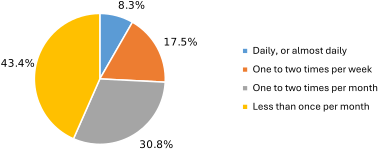
Exhibit 8: Frequency of Litigation Services Received – Text version
Exhibit 8 presents a pie chart illustrating how frequently respondents received litigation services. The largest proportion, 43.4%, reported receiving litigation services less than once per month, making infrequent use the most common pattern. Another 30.8% accessed litigation services one to two times per month, while 17.5% reported using these services one to two times per week. A smaller share, 8.3%, indicated receiving litigation services daily or almost daily. Overall, the distribution shows that most respondents engaged with litigation services on a less-than-monthly or monthly basis, with comparatively fewer requiring frequent or daily support.
2.4.1 Client Satisfaction
The survey results indicate that clients of litigation services were, in general, satisfied with the overall quality of the services they received (average rating of 8.5). As indicated in the chart below, 1,679 (80.0%) of litigation service users rated their satisfaction with the overall quality of the services provided as either at or above the departmental target of 8.0.
Exhibit 9: Distribution of Satisfaction Ratings for Overall Quality of Litigation Services
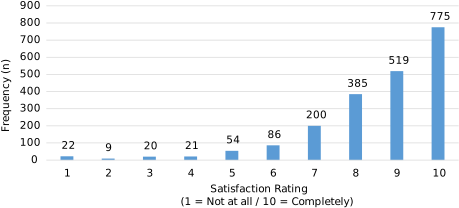
Exhibit 9: Distribution of Satisfaction Ratings for Overall Quality of Litigation Services – Text version
Exhibit 9 presents a bar chart showing the distribution of satisfaction ratings for the overall quality of litigation services on a scale from 1 (Not at all) to 10 (Completely). The chart shows relatively low frequencies for ratings at the lower end of the scale, with 22 responses for a rating of 1, 9 for 2, 20 for 3, and 21 for 4. Responses increase moderately for mid-range ratings, with 54 for 5 and 86 for 6. Higher ratings show a pronounced rise in frequency: 200 responses for a rating of 7, 385 for 8, 519 for 9, and peaking at 775 for a rating of 10. Overall, the distribution is strongly skewed toward the upper end of the scale, indicating high satisfaction among respondents with the quality of litigation services.
All elements of litigation services exceeded the departmental target, with mean satisfaction ratings ranging from 8.2 to 8.9 (see Exhibit 10).
Exhibit 10: Satisfaction Ratings for Litigation Services Elements
| Cycle V (2023-25) | n | ||
|---|---|---|---|
| Overall Quality of Litigation Services | 8.5 (±0.1) (Strong) |
2,091 | |
| Responsiveness | Provided timely status updates with respect to our services | 8.2 (±0.1) (Positive) |
1,965 |
| Timeliness | Responded in a timely manner to requests for legal services | 8.4 (±0.1) (Strong) |
1,904 |
| Negotiated mutually acceptable deadlines | 8.4 (±0.1) (Strong) |
1,658 | |
| Met mutually acceptable deadlines | 8.6 (±0.1) (Strong) |
1,734 | |
| Usefulness | Fully understood the nature of the problem/issue(s) for which you received assistance | 8.7 (±0.1) (Strong) |
2,056 |
| Provided consistent legal advice | 8.7 (±0.1) (Strong) |
2,020 | |
| Provided legal advice that reflects a whole-of-government approach (i.e., considered issues and priorities across government departments/agencies) | 8.6 (±0.1) (Strong) |
1,665 | |
| Worked with you to identify, explain and mitigate legal risks | 8.6 (±0.1) (Strong) |
1,939 | |
| Provided clear and practical legal advice to support your mandate | 8.5 (±0.1) (Strong) |
1,955 | |
| Involved you in the development of legal strategy and positions | 8.3 (±0.1) (Positive) |
1,756 | |
| Identified means to prevent or resolve legal disputes at the earliest opportunity | 8.4 (±0.1) (Strong) |
1,611 | |
| Informed you of the issues/developments which may impact your case | 8.7 (±0.1) (Strong) |
2,029 | |
| Fully prepared you to give testimony in a proceeding | 8.9 (±0.1) (Strong) |
356 | |
2.4.2 Service User Comments
To better understand client experiences, service user comments were categorized as positive, negative, or neutral/mixed. As shown in the sentiment distribution chart below, a significant portion of the feedback received regarding litigation services was negative. While this may reflect legitimate concerns, it also aligns with the broader pattern that clients are more inclined to share feedback following difficult or contentious experiences.
Exhibit 11: Litigation Services – Responses by Sentiment Score

Exhibit 11: Litigation Services – Responses by Sentiment Score – Text version
Exhibit 11 displays a horizontal bar chart summarizing sentiment scores related to litigation services. The largest proportion of responses was negative, representing 46.6% of all sentiment classifications. This is followed by neutral or mixed sentiment at 29.0%, while positive sentiment accounted for the smallest share at 24.4%. Overall, the distribution indicates that negative sentiment was the most common among respondents evaluating litigation services, with fewer expressing neutral/mixed or positive views.
General Sentiment towards Litigation Services
Client feedback towards litigation services provided by the Department highlighted several positive aspects, with many clients commending the professionalism, competence, and dedication of legal counsel. High-quality legal advice, strong courtroom preparation, and effective collaboration in complex cases were frequently mentioned. Specific individuals and teams received praise for their responsiveness and support, particularly in high-profile matters. Clients appreciated clear communication, strategic guidance, and respectful engagement, especially when counsel demonstrated expertise in specialized areas like tax, immigration, and national security. The National Litigation Sector and several regional offices stood out for their service excellence, and suggestions for more training and mentoring were seen as constructive steps toward sustaining quality.
The feedback also pointed to several areas needing improvement. Clients expressed concerns about delays, inconsistent communication, and frequent changes in assigned counsel, which disrupted continuity and caused frustration. Some felt excluded from key decisions or noted a lack of understanding of departmental realities, leading to misaligned legal advice. Persistent challenges included staffing limitations, cautious litigation approaches, and inefficiencies in file management, though these were often recognized as opportunities for targeted improvements. There were also calls for better coordination across legal service units, clearer billing practices, and more proactive engagement. Despite these challenges, the overall tone of the feedback leaned toward constructive criticism, with clients offering thoughtful suggestions to enhance service delivery and strengthen collaboration.
2.5 Legislative Drafting Services
Of the 336 legislative drafting services users, 247 (73.5%) reported having received their services from the “Legislation Section of the Legislative Services Branch” (Annex F). A total of 46 service users indicated that their service provider was “Unknown,” while 26 selected “Other,” and 17 identified “Finance Canada – Tax Counsel Division” as their service provider.
The majority (206 or 61.3%) of legislative drafting services users reported being actively involved in less than two legislative drafting projects within the 12 months prior to being surveyed. Also, most (88.7%) service users reported having received some extent of help from drafting services in developing policy to be expressed in legislation.
2.5.1 Client Satisfaction
The survey results indicate that clients of legislative drafting services were, in general, very satisfied with the overall quality of legislative drafting services they received (average rating of 8.9). As indicated in the chart below, 298 (88.7%) of legislative drafting service users rated their satisfaction with the overall quality of the services provided as either at or above the departmental target of 8.0.
Exhibit 12: Distribution of Satisfaction Ratings for Overall Quality of Legislative Drafting Services
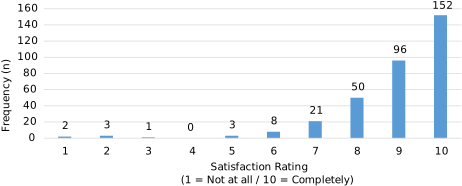
Exhibit 12: Distribution of Satisfaction Ratings for Overall Quality of Legislative Drafting Services – Text version
Exhibit 12 presents a bar chart illustrating the distribution of satisfaction ratings for the overall quality of legislative drafting services on a scale from 1 (Not at all) to 10 (Completely). Very few respondents selected ratings at the lower end of the scale, with 2 responses for a rating of 1, 3 for 2, 1 for 3, and 0 for 4. Slightly higher frequencies appear in the mid-range, with 3 responses for a rating of 5 and 8 for 6. Higher satisfaction ratings show a pronounced increase: 21 responses for a rating of 7, 50 for 8, 96 for 9, and the highest frequency of 152 responses for a rating of 10. Overall, the distribution is heavily skewed toward high satisfaction, with ratings of 8, 9, and 10 representing the clear majority of responses.
All elements of legislative drafting services exceeded the departmental target, with mean satisfaction ratings ranging from 8.7 to 9.1 (see Exhibit 13).
Exhibit 13: Satisfaction Ratings for Legislative Drafting Services Elements
| Cycle V (2023-25) | n | ||
|---|---|---|---|
| Overall Quality of Legislative Drafting Services | 8.9 (±0.1) (Strong) |
336 | |
| Responsiveness | Provided timely status updates with respect to our services | 8.7 (±0.1) (Strong) |
318 |
| Timeliness | Responded in a timely manner to requests for legal services | 8.7 (±0.2) (Strong) |
319 |
| Negotiated mutually acceptable deadlines | 8.9 (±0.2) (Strong) |
282 | |
| Met mutually acceptable deadlines | 9.0 (±0.1) (Strong) |
313 | |
| Usefulness | Fully understood the nature of the problem/issue(s) for which you received assistance (as expressed in the drafting instructions and drafts of the bills) | 8.9 (±0.1) (Strong) |
322 |
| Proposed appropriate solutions for issues raised during drafting | 9.0 (±0.1) (Strong) |
315 | |
| Provided consistent legal advice | 8.9 (±0.1) (Strong) |
326 | |
| Provided legal advice that reflects a whole-of-government approach (i.e., considered issues and priorities across government departments/agencies) | 8.9 (±0.1) (Strong) |
293 | |
| Worked with you to identify, explain and mitigate legal risks | 8.9 (±0.1) (Strong) |
315 | |
| Provided clear and practical legal advice to support your mandate | 8.8 (±0.1) (Strong) |
325 | |
| Prepared draft legislative texts to meet your policy and program objectives | 9.1 (±0.1) (Strong) |
303 | |
2.5.2 Service User Comments
To better understand client experiences, service user comments were categorized as positive, negative, or neutral/mixed. As illustrated in the sentiment distribution chart below, most of the feedback received regarding legislative drafting services was positive (42.5%), with fewer comments falling into the neutral/mixed (35.0%) or negative (22.5%) categories. While the lower proportion of negative feedback may suggest a generally favorable client experience, it is important to consider that clients are often more motivated to provide input when they encounter challenges.
Exhibit 14: Legislative Drafting Services – Responses by Sentiment Score

Exhibit 14: Legislative Drafting Services – Responses by Sentiment Score – Text version
Exhibit 14 presents a horizontal bar chart summarizing sentiment scores related to legislative drafting services. The largest share of responses was positive, accounting for 42.5% of all sentiment classifications. This is followed by neutral or mixed sentiment at 35.0%, while negative sentiment represented the smallest proportion at 22.5%. Overall, the results show that respondents expressed predominantly positive views about legislative drafting services, with comparatively fewer negative assessments.
General Sentiment towards Legislative Drafting Services
Feedback on legislative drafting services highlighted a generally positive experience with the Department’s Legislative Services Branch. Legislative drafters were consistently described as professional, knowledgeable, and courteous, delivering high-quality work even under tight timelines. Many users reported excellent service across multiple projects and praised specific teams and individuals for their responsiveness and dedication. The Legislative Services Branch was recognized for its strong support of government-wide legislative initiatives. Suggestions for improvement included offering regular training and increasing transparency to help policy clients and public servants better understand the drafting process.
Despite these strengths, several challenges were noted. Some users experienced delays, unclear timelines, and coordination issues between drafters and other Justice Canada units. High staff turnover and limited availability, particularly during summer months, caused disruptions. Confusion around roles and responsibilities, limited access for policy clients, and instances of impractical legal advice were also noted. Nonetheless, the feedback leaned toward the positive, emphasizing the professionalism of many drafters and offering constructive recommendations to improve collaboration, flexibility, and client engagement.
2.6 Regulatory Drafting Services
Of the 737 service users who reported having received regulatory drafting services, 429 (58.2%) indicated that their service provider was the “Legislative Services Branch (specialized in regulatory drafting)” (Annex F). There were 194 (26.3%) service users who indicated that their service provider was “Unknown” and 95 (12.9%) users selected “Other”.
The majority (479 or 65.0%) of regulatory drafting services users reported being actively involved in less than three regulatory drafting projects within the 12 months prior to being surveyed. Also, most (92.2%) service users of regulatory drafting services required some extent of help from drafting services in clarifying policy to be expressed in regulations.
2.6.1 Client Satisfaction
The survey results indicate that clients of regulatory drafting Services, in general, were satisfied with the overall quality of the services they received (average rating of 8.7). As indicated in the chart below, 631 (85.6%) of regulatory drafting service users rated their satisfaction with the overall quality of the services provided as either at or above the departmental target of 8.0.
Exhibit 15: Distribution of Satisfaction Ratings for Overall Quality of Regulatory Drafting Services
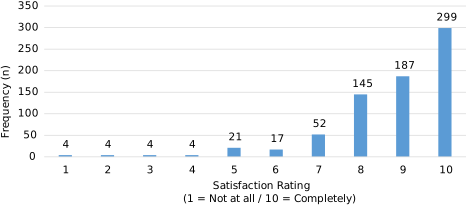
Exhibit 15: Distribution of Satisfaction Ratings for Overall Quality of Regulatory Drafting Services – Text version
Exhibit 15 presents a bar chart showing the distribution of satisfaction ratings for the overall quality of regulatory drafting services on a scale from 1 (Not at all) to 10 (Completely). Responses at the lower end of the scale were minimal, with 4 responses each for ratings of 1, 2, 3, and 4. Mid-range ratings showed slightly higher frequencies, with 21 responses for a rating of 5 and 17 for 6. The number of responses increased substantially for higher satisfaction levels: 52 responses were recorded for a rating of 7, 145 for 8, 187 for 9, and a peak of 299 responses for a rating of 10. Overall, the distribution is strongly skewed toward high satisfaction, with ratings of 8, 9, and 10 representing the overwhelming majority of responses.
All regulatory drafting services elements exceeded the departmental target of 8.0, with satisfaction ratings ranging from 8.3 to 9.0 (see Exhibit 16).
Exhibit 16: Satisfaction Ratings for Regulatory Drafting Services Elements
| Cycle V (2023-25) | n | ||
|---|---|---|---|
| Overall Quality of Regulatory Drafting Services | 8.7 (±0.1) | 737 | |
| Responsiveness | Provided timely status updates with respect to our services | 8.4 (±0.1) (Strong) |
677 |
| Timeliness | Responded in a timely manner to requests for legal services | 8.3 (±0.1) (Positive) |
703 |
| Negotiated mutually acceptable deadlines | 8.5 (±0.1) (Strong) |
602 | |
| Met mutually acceptable deadlines | 8.6 (±0.1) (Strong) |
643 | |
| Usefulness | Fully understood the nature of the problem/issue(s) for which you received assistance | 8.8 (±0.1) (Strong) |
713 |
| Proposed appropriate solutions for issues raised during drafting (including optimal means to implement policies or programs, whether through legislative, regulatory or administrative tools, or a combination) | 8.8 (±0.1) (Strong) |
701 | |
| Provided consistent legal advice | 8.8 (±0.1) (Strong) |
705 | |
| Provided legal advice that reflects a whole-of-government approach (i.e., considered issues and priorities across government departments/agencies) | 8.8 (±0.1) (Strong) |
598 | |
| Worked with you to identify, explain and mitigate legal risks | 8.8 (±0.1) (Strong) |
668 | |
| Provided clear and practical legal advice to support your mandate | 8.7 (±0.1) (Strong) |
695 | |
| Prepared draft regulatory texts to meet your policy and program objectives | 9.0 (±0.1) (Strong) |
617 | |
2.6.2 Service User Comments
To better understand client experiences, service user comments were categorized as positive, negative, or neutral/mixed. As illustrated in the sentiment distribution chart below, feedback regarding regulatory drafting services was most often neutral or mixed (40.2%), followed by positive (34.5%) and negative (25.3%) sentiments. This distribution suggests a nuanced client experience, where many comments reflect both strengths and areas for improvement. As with other service types, clients may be more inclined to provide feedback when they encounter challenges.
Exhibit 17: Regulatory Drafting Services – Responses by Sentiment Score
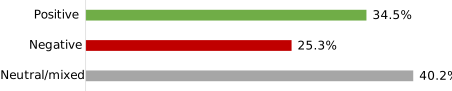
Exhibit 17: Regulatory Drafting Services – Responses by Sentiment Score – Text version
Exhibit 17 presents a horizontal bar chart showing sentiment scores related to regulatory drafting services. The largest share of responses fell into the neutral or mixed category at 40.2%, indicating that many respondents expressed neither strongly positive nor strongly negative views. Positive sentiment accounted for 34.5% of responses, while negative sentiment represented the smallest proportion at 25.3%. Overall, the results suggest that perceptions of regulatory drafting services were predominantly neutral or positive, with comparatively fewer respondents expressing negative views.
General Sentiment towards Regulatory Drafting Services
The feedback towards regulatory drafting services reflected a generally positive experience with the Department. Clients consistently praised the high quality of legal advice and drafting, describing legal counsel as professional, knowledgeable, and flexible. Many respondents appreciated the proactive communication, strategic insight, and dedication of legal counsel and drafters, especially under tight deadlines. The presence of specialized regulatory drafting services within Justice Canada was valued, and several individuals and teams were commended for their responsiveness and collaborative approach. Suggestions for improvement, such as clearer written advice and stronger alignment with operational realities, were framed constructively and aimed at enhancing already strong relationships.
Despite the overall positive tone, the feedback also revealed several challenges. Delays in receiving legal opinions and draft regulations were a recurring concern, often linked to capacity constraints and high workloads. Inconsistencies in drafting, overly cautious legal advice, and coordination issues, particularly when drafters changed mid-project, created confusion and extra work. Some respondents found the process difficult to navigate and called for clearer guidance, better tracking systems, and more consistent application of conventions. While these issues posed risks to timelines and program delivery, stakeholders remained solution-oriented and expressed a strong interest in working collaboratively to address systemic barriers.
2.7 Overall Considerations Elements
The CFS includes general questions that are not specific to the legal service type(s) selected, which are referred to as Overall Considerations elements.
2.7.1 Client Satisfaction with Overall Considerations Elements
As depicted in the table below, mean satisfaction ratings were “strong – surpassed target” for all Overall Considerations elements. Results ranged from 9.1 to 9.6, indicating that the Department is performing very well for this category of elements.
Exhibit 18: Satisfaction Ratings for Overall Considerations
| Cycle V (2023-25) | n | |
|---|---|---|
| Courteousness/respectfulness of the legal service provider | 9.5 (±0.0) (Strong) |
6,751 |
| Legal services were provided in the official language of your choice, in accordance with applicable policies on language of work | 9.6 (±0.0) (Strong) |
6,520 |
| Ease with which the correct service provider to meet your needs was identified | 9.1 (±0.0) (Strong) |
6,151 |
| Satisfaction with access mode: Email or messaging | 9.1 (±0.0) (Strong) |
6,662 |
| Satisfaction with access mode: Telephone or video | 9.2 (±0.0) (Strong) |
5,658 |
| Satisfaction with access mode: In person | 9.1 (±0.1) (Strong) |
1,941 |
2.7.2 Experience with Legal Training
Service users were asked to provide information on their experience with the legal training and/or information they had received. As indicated in Exhibit 19 below, the overall satisfaction rating was “strong – surpassed target” for those who reported having received legal information or training, with an average rating of 8.8.
Exhibit 19: Overall Satisfaction with Information/Training Received
| Cycle V (2023-25) | n | |
|---|---|---|
| Information/training received | 8.8 (±0.1) (Strong) |
866 |
Of the 6,831 total service users, 871 (12.8%) indicated that they had participated in one or more information or outreach sessions (including formal or informal training) on roles, responsibilities or legal processes/products provided by the Department. The majority of these respondents specified that they had received information/training for legal advisory services (Exhibit 20).
Exhibit 20: Information/Training Received by Service Type
| Service Users | Legal Advisory Services | Litigation Services |
Legislative Drafting Services | Regulatory Drafting Services |
|---|---|---|---|---|
| 871 | 576 (66.1%) | 344 (39.5%) | 49 (5.6%) | 77 (8.8%) |
2.7.3 Knowledge of Service Standards
The Department incorporates the Service Standards for the Provision of Legal Services to Government in each of its legal service agreements with client departments and agencies. Service users were asked to rate their knowledge of the Service Standards. Of the 6,831 service users, 39.1% rated their knowledge of the Service Standards as “very good” or “good”, while 48.1% rated their knowledge as “fair” or “poor”. The remaining 12.8% of service users were “unable to assess” their knowledge of the Standards (Exhibit 21).
Exhibit 21: Knowledge of Service Standards (All legal services combined)
| Very Good | Good | Fair | Poor | Unable to Assess |
|---|---|---|---|---|
| 1,440 (21.1%) | 1,231 (18.0%) | 1,468 (21.5%) | 1,815 (26.6%) | 877 (12.8%) |
Service user knowledge of the Department’s Service Standards has consistently been found to coincide with service user ratings of satisfaction. For Cycle V, service users who rated their knowledge of the Service Standards as “very good” or “good” provided more favourable ratings, by a statistically significant difference (†), than those who rated their knowledge as “fair” or “poor”, across most survey elements. This is illustrated with the overall quality ratings displayed in Exhibit 22 below.
Exhibit 22: Overall Quality of Legal Services by Knowledge of Service Standards
| Very Good or Good Knowledge | Fair or Poor Knowledge |
|
|---|---|---|
| Legal Advisory Services † | 9.0 (±0.0) (Strong) |
8.4 (±0.1) (Strong) |
| Litigation Services † | 8.8 (±0.1) (Strong) |
8.4 (±0.1) (Strong) |
| Legislative Drafting Services † | 9.2 (±0.2) (Strong) |
8.8 (±0.2) (Strong) |
| Regulatory Drafting Services † | 9.0 (±0.1) (Strong) |
8.6 (±0.1) (Strong) |
2.8 Gender-Based Analysis Plus and Equity, Diversity and Inclusion
The Department is dedicated to ensuring that its activities align with the Government of Canada’s commitments to GBA Plus and EDI. GBA Plus and EDI considerations help to ensure that federal government legislation, policies, programs and other initiatives are responsive, inclusive and reflective of diverse experiences and realities in order to address inequities and barriers.Footnote 10
Service users were asked if GBA Plus and EDI considerations were integrated, as applicable, in the legal services received. Of the 6,831 service users, 752 selected “yes”, 319 users selected “sometimes”, 494 users selected “no”, and the remaining 5,266 users selected “not applicable”. As indicated in Exhibit 23 below, service users provided a “strong – surpassed target” satisfaction rating (9.0)Footnote 11 regarding the integration of GBA Plus and EDI considerations into legal services.
Exhibit 23: Satisfaction with GBA Plus and EDI Integration
| Cycle V (2023-25) | n | |
|---|---|---|
| Integration of GBA Plus and EDI considerations, as applicable, into the legal services you received | 9.0 (±0.1) (Strong) |
1,043 |
2.8.1 Results Disaggregated by Gender and Language
For the first time in the CFS series, service users were asked to self-identify their gender and first official language. As indicated in Exhibit 24, just over half of service users self-identified as a woman (53.9%).
Exhibit 24: Service Users by Gender
| Man | Woman | Non-binary | Two-spirit | Prefer not to say | Prefer to self-identify |
|---|---|---|---|---|---|
| 2,760 (40.4%) | 3,681 (53.9%) | 13 (0.2%) | 4 (0.1%) | 368 (5.4%) | 5 (0.1%) |
Men and women reported similar levels of satisfaction across most survey elements. However, as shown below, male service users reported a statistically significant (†) higher overall satisfaction rating than their female counterparts for both legal advisory and litigation services.
Exhibit 25: Overall Quality of Legal Services by Service User Gender
| Men | Women | |
|---|---|---|
| Legal Advisory Services † | 8.7 (±0.1) (Strong) |
8.6 (±0.1) (Strong) |
| Litigation Services † | 8.7 (±0.1) (Strong) |
8.5 (±0.1) (Strong) |
| Legislative Drafting Services | 8.9 (±0.2) (Strong) |
9.0 (±0.2) (Strong) |
| Regulatory Drafting Services | 8.8 (±0.1) (Strong) |
8.8 (±0.1) (Strong) |
The majority of service users (70.9%) identified English as their first official language. Satisfaction with the overall quality of legal services was consistent among service users who identified English or French as their first official language, regardless of service type.
Exhibit 26: Overall Quality of Legal Services by Service User First Official Language
| English | French | |
|---|---|---|
| Legal Advisory Services | 8.6 (±0.0) (Strong) |
8.6 (±0.1) (Strong) |
| Litigation Services | 8.6 (±0.1) (Strong) |
8.5 (±0.1) (Strong) |
| Legislative Drafting Services | 8.9 (±0.2) (Strong) |
9.0 (±0.2) (Strong) |
| Regulatory Drafting Services | 8.7 (±0.1) (Strong) |
8.8 (±0.2) (Strong) |
While satisfaction was high for both groups, users who selected English as their first official language reported significantly higher satisfaction with the provision of services in the official language of their choice, in accordance with applicable policies on language of work.
Exhibit 27: Client Satisfaction with Services Provided in the Official Language of Choice
| English | French | |
|---|---|---|
| Legal services were provided in the official language of your choice, in accordance with applicable policies on language of work † | 9.8 (±0.0) (Strong) |
9.2 (±0.1) (Strong) |
2.8.2 Accessibility of Legal Services Provided
As outlined in the Accessibility Plan for the Department of Justice Canada, the Department is committed to providing barrier-free services with respect to accessibility for people with disabilities. Of the 6,831 total service users, 442 (6.5%) identified as a person with a disability. As illustrated in Exhibit 28 below, the overall level of satisfaction with the accessibility of legal services provided by the Department was “strong – surpassed target” (average rating of 9.2).Footnote 12
Exhibit 28: Overall Satisfaction with Accessibility of Legal Services
| Cycle V (2023-25) | n | |
|---|---|---|
| Accessibility of legal services provided | 9.2 (±0.1) (Strong) |
366 |
Service users who self-reported as a person with a disability were asked to rate their level of agreement with three statements concerning the accessibility of the Department’s legal services. Exhibit 29 presents the results for all three of these statements.
Exhibit 29: Accessibility of Services
| Strongly disagree | Disagree | Neutral | Agree | Strongly agree | Don’t know or n/a | Total Users | |
|---|---|---|---|---|---|---|---|
| JUS offered barrier-free communications (i.e., hearing, speaking, reading, writing, or plain language) | 30 (6.8%) |
8 (1.8%) |
114 (25.8%) | 131 (29.6%) | 159 (36.0%) | 0 | 442 |
| JUS buildings and occupied spaces offer a physical environment that is fully accessible (i.e., pathways, entrances, washrooms) | 5 (1.1%) |
0 | 30 (6.8%) | 19 (4.3%) | 22 (5.0%) |
365 (82.8%) | 441 |
| JUS service providers were respectful of my disability during interactions | 19 (4.3%) |
2 (0.5%) |
188 (42.9%) | 80 (18.3%) | 148 (33.8%) | 1 | 438 |
Survey results indicate that most users found the Department’s services to be accessible. Over one-third (36.0%) strongly agreed that communications were barrier-free, while 29.6% agreed. Physical accessibility of buildings was less frequently rated, with 82.8% selecting “Don’t know or not applicable,” suggesting limited direct experience or awareness. Regarding respectful interactions with persons with disabilities, 33.8% strongly agreed and 18.3% agreed, though 42.9% remained neutral.
While these findings reflect generally positive perceptions of accessibility, a small but meaningful proportion of respondents (6.8% and 4.3%, respectively) strongly disagreed that communications were barrier-free or that service providers were respectful of their disability. These perspectives, though limited in number, underscore the importance of continued efforts to ensure that all users experience the Department’s services as inclusive and respectful. Enhancing communication practices and reinforcing respectful engagement can help strengthen service delivery and ensure that accessibility is consistently upheld across all interactions.
- Date modified: