
The Department of Justice Canada’s 2025–26 Departmental Results Report
Contents
Copyright information
Department of Justice Canada
2025–26 Departmental Results Report
The Honourable Sean Fraser, P.C., K.C., M.P.
Minister of Justice and Attorney General of Canada
© His Majesty the King in Right of Canada, as represented by the Minister of Justice and Attorney General of Canada, 2026
ISSN: 2371-6908
Aussi disponible en français sous le titre : Rapport sur les résultats ministériels 2025-2026 du ministère de la Justice Canada
At a glance
This Departmental Results Report details the Department of Justice Canada's (the Department) actual accomplishments against the plans, priorities and expected results outlined in its 2025–26 Departmental Plan.
These results align with the priorities outlined in the May 21, 2025, mandate letter from the Prime Minister, as well as with the Department's mission, raison d'être and operating context.
Key priorities
In the 2025–26 Departmental Plan, the Department identified the following key priorities for 2025–26:
- improving access to justice in Canada, particularly for Black, Indigenous and racialized people, and supporting victims and survivors of crime
- delivering on the Government of Canada's reconciliation agenda and addressing systemic discrimination and racism
- keeping Canadians safe in our communities and online
- supporting the needs of the courts
Based on the new direction set out in the Prime Minister's mandate letter dated May 21, 2025, the Department's key priorities for 2025–26 were updated as follows:
- keeping Canadians safe in our communities and online, as well as strengthening Canadians' trust in the legal system
- delivering on the Government of Canada's reconciliation agenda and addressing systemic discrimination and racism
- building a stronger economy and expediting nation-building projects
- making life more affordable for Canadians by reforming systems, policies and laws so that they better serve Canadians
- reducing operational costs by modernizing service delivery through digital innovation and responsible adoption of artificial intelligence (AI)
Highlights
The Department supported the Government of Canada in delivering one of the most ambitious criminal justice reform agendas in recent memory, through three major bills: the Combatting Hate Act, the Bail and Sentencing Reform Act, and the Protecting Victims Act. Together, these measures strengthened public safety by increasing protections against hate crimes, reinforcing the bail and sentencing framework, better protecting victims and survivors, and strengthening safeguards for children against sexual exploitation and abuse. Among its many initiatives and activities within areas of federal responsibility, the Department contributed to improving access to justice by providing significant financial support for the delivery of legal aid services across Canada. It also took steps to improve access to justice for victims and survivors of crime through a range of policy actions and program investments undertaken under the Federal Victims Strategy. To address systemic discrimination and overrepresentation in the Canadian justice system, the Department advanced the implementation of the federal Indigenous Justice Strategy, co-developed with First Nations, Inuit and Métis; as well as Canada's Black Justice Strategy. The Department strengthened the Canadian economy by providing support on legislation such as the Free Trade and Labour Mobility in Canada Act and the Building Canada Act, as well as on the establishment of the Major Projects Office. In parallel, the Department modernized its service delivery and supported legal work through the responsible adoption of AI solutions.
- Total actual spending (including internal services): $1,208,241,315
- Total full-time equivalent staff (including internal services): 5,351
For detailed information on the Department's total spending and human resources, read the Spending and human resources section of this report.
Summary of results
The following provides a summary of the results the Department achieved in 2025–26 under its core responsibilities (its main areas of activity).
-
Core responsibility 1: Legal Services
- Actual spending: $284,420,207
- Actual human resources: 3,908
The Department delivered integrated legal advisory, litigation, legislative drafting and regulatory drafting services in support of government-wide priorities, such as:
- building one Canadian economy, bringing down costs for Canadians and helping them to get ahead, and making housing more affordable
- advancing reconciliation with Indigenous peoples, including through advice on matters related to section 35 of the Constitution Act, 1982, the duty to consult, Aboriginal title, the honour of the Crown, as well as advice to client departments and agencies working to further the Government of Canada's commitment to implement the United Nations Declaration on the Rights of Indigenous Peoples Act (UN Declaration Act) and the associated Action Plan
- advancing the Government of Canada's forward regulatory agenda and the implementation and evolution of the legislative framework
- protecting Canadian sovereignty and keeping Canadians safe, through measures that include addressing financial crimes and money laundering
- developing strategic litigation positions with client departments and agencies
For more information on the Department's activities related to Legal Services, read the "Results: What we achieved" section of this report.
-
Core responsibility 2: Justice System Support
- Actual spending: $817,159,102
- Actual human resources: 339
As part of its broad responsibilities for overseeing all matters relating to the administration of justice that fall within federal jurisdiction, the Department:
- advanced criminal law reform to keep communities safe and improve public safety, including strengthening bail and sentencing frameworks and better protecting children and victims of gender-based and intimate partner violence
- contributed to a renewed relationship with First Nations, Inuit and Métis by implementing the UN Declaration Act and its related Action Plan, and responded to the justice-related Calls for Justice of the National Inquiry into Missing and Murdered Indigenous Women and Girls and Calls to Action of the Truth and Reconciliation Commission
- continued to advance the Federal Victims Strategy to strengthen victims' rights and increase access to justice for victims and survivors of crime
- supported Canada’s participation and engagement within international forums, thus aiding in improving international cooperation
For more information on the Department’s activities related to Justice System Support, read the "Results: What we achieved" section of this report.
From the Minister
I am pleased to present the Department of Justice Canada's 2025–26 Departmental Results Report. This report summarizes the work done by the Department during the period of April 1, 2025, to March 31, 2026.
Under its mandate, the Department provides legal advice to the Government and federal government departments and agencies, represents the Crown in civil litigation and before administrative tribunals, and drafts legislation. It also ensures a bilingual and bijural national legal framework within areas of federal law.
Throughout the last fiscal year, the Department ensured the progression of several Government of Canada priorities. Some were already established, such as keeping Canadians safe in our communities and online, addressing systemic racism and discrimination, and advancing reconciliation with Indigenous peoples.
However, our country faces a series of crises, and the Government of Canada has had to use different governance approaches, which has led to the addition of new priorities for the Department: building a stronger economy and accelerating projects of national interest, making life more affordable for Canadians by reforming systems, policies and legislation to better serve Canadians and, finally, reducing operational costs by modernizing service delivery through digital innovation and responsible adoption of artificial intelligence.
In this context, the Department provided legal support to departments and agencies on their major projects, notably in the areas of infrastructure and economic development. For example, the Department contributed to the development of the Free Trade and Labour Mobility in Canada Act and the Building Canada Act, and the establishment of the Major Projects Office and the new federal agency, Build Canada Homes.
During this year, major bills were introduced in Parliament, such as:
- the Combatting Hate Act (Bill C-9)
- the Bail and Sentencing Reform Act (Bill C-14)
- the Protecting Victims Act (Bill C-16)
With regard to reconciliation with Indigenous peoples, the Department continued to implement the Indigenous Justice Strategy. The Department has also participated in the negotiation and implementation of modern treaties and self-government agreements. In addition, it helped respond to the Calls to Action of the Truth and Reconciliation Commission and the Calls for Justice of the National Inquiry into Missing and Murdered Indigenous Women and Girls. The Department also held many bilateral discussions with Indigenous peoples as part of the implementation of the United Nations Declaration on the Rights of Indigenous Peoples Act Action Plan.
In addition, the Department carried out the implementation plan of Canada's Black Justice Strategy, which aims to address anti-Black racism and systemic discrimination. Thanks to the Department's program funding and through four departments, many community-based projects have been made possible in the provinces and territories.
The Department continued its efforts to make the justice system more fair, accessible and relevant. Under the Federal Victims Strategy, the Department funded numerous projects and services aimed at improving access to justice for victims and survivors of crime, including new policies and initiatives and targeted program investments, such as the Community Support and Healing for Families initiative.
Internally, the Department continued to emphasize an inclusive, accessible and healthy workplace. It also improved its digital tools and its responsible use of artificial intelligence, notably with the launch of its secure artificial intelligence platform "Otto".
In closing, I would like to extend my sincere gratitude to the Department's employees who, day after day, carry out work in which they can take immense pride. Their professionalism and dedication merit great recognition.
The Honourable Sean Fraser, P.C., K.C., M.P.
Minister of Justice and Attorney General of Canada

Results: what we achieved
Core responsibilities and internal services
Core responsibility 1: Legal Services
In this section
Description
The Minister of Justice and Attorney General of Canada provides legal services to the federal government and its departments and agencies. The Minister is responsible for seeing that the administration of public affairs is in accordance with the law. The Minister is also responsible for examining all government bills and all government regulations for inconsistency with the Canadian Charter of Rights and Freedoms. Additionally, the Attorney General is responsible for advising the heads of departments on all matters of law and for conducting all litigation for federal departments or agencies on subjects within the authority or jurisdiction of Canada.
Quality of life impacts
Through the activities detailed in this core responsibility, the Department contributed to the "Good Governance" domain of the Quality of Life Framework for Canada and to indicators such as the "Confidence in access to fair and equal justice (civil)" and "Confidence in access to fair and equal justice (criminal)." The Department also contributed to the domains affected by the priorities of its client departments and agencies, such as "Prosperity."
Progress on results
This section details the Department's performance against its targets for the departmental result under core responsibility 1: Legal Services.
Table 1 presents the target, the date to achieve the target and the actual result for each indicator under Legal Services over the past three fiscal years.
| Departmental result indicators | Target | Date to achieve target | Actual results |
|---|---|---|---|
| Client satisfaction mean rating on the overall quality of legal services. | 8 or greater on a 10-point scale | March 2026 |
|
| Client satisfaction mean rating on the provision of legal services against the Service Standards. | 8 or greater on a 10-point scale | March 2026 |
|
| Percentage of litigation files resolved in a fiscal year that have a successful outcome (settled or adjudicated) from the Crown's perspective. | 85% or greater | March 2026 |
|
The Results section of the Infographic for the Department on GC Infobase provides additional information on results and performance related to its program inventory.
Details on results
The following section describes the results for Legal Services in 2025–26 compared with the planned results set out in its Departmental Plan for the year.
Departments and agencies receive high quality legal services
Results achieved:
Safety and security
The Department provided legal services to client departments and agencies on priorities concerning public safety and security, including:
- Canadian Heritage in its development of policy options and approaches for legislation relating to online harms
- Public Safety Canada, the Royal Canadian Mounted Police and the Canada Border Services Agency to support the Government of Canada's commitments on firearms and to strengthen measures to control the flow of illegal guns into Canada. For example, the Department continued to provide extensive advice on:
- the implementation of the Assault-Style Firearm Compensation Program
- the implications of extending the Amnesty OrderFootnote 7 in light of a legal challenge before the Supreme Court of Canada
- post-Amnesty Order enforcement options
- Public Safety Canada and the Royal Canadian Mounted Police while options are being explored to reform the federal government's approach to supporting First Nations and Inuit police services
- Public Safety Canada, the Royal Canadian Mounted Police, the Canadian Security Intelligence Service, Immigration, Refugees and Citizenship Canada, the Canada Border Services Agency, the Communications Security Establishment Canada, the Department of National Defence and the Canadian Armed Forces on initiatives concerning national security, such as by advising on findings from national security review bodies
- Innovation, Science and Economic Development Canada to promote economic security and combat foreign interference through the implementation of amendments to the Investment Canada Act. The Department also supported Innovation, Science and Economic Development Canada through the preparation of draft regulations and assistance with targeted stakeholder consultations
Financial crimes and money laundering
Regarding the continued development of policies and legislation on financial crimes, money laundering, and the integrity of financial institutions, the Department provided legal advice to:
- the Department of Finance Canada on proposed legislative measures, including with respect to:
- the development, interpretation and implementation of the Proceeds of Crime (Money Laundering) and Terrorist Financing Act, including legislative amendments to the Act to introduce new ministerial directive powers
- the expansion of the Financial Transaction and Reports Analysis Centre of Canada's (FINTRAC) ability to register money services businesses for greater regulatory scrutiny
- the operation of cryptocurrency automated teller machines
- the Treasury Board of Canada Secretariat and the Department of Finance Canada on the creation of the proposed Financial Crimes Agency through Bill C-29, the Financial Crimes Agency Act
- the Office of the Superintendent of Financial Institutions Canada in support of its expanded mandate under the Budget Implementation Act, 2023, No. 1. This has included the delivery of targeted training, as well as ongoing legal and strategic advice to assist in interpreting and implementing its increased oversight role in assessing whether federally regulated financial institutions have adequate policies and procedures to address risks to their integrity and security, including threats such as foreign interference
Economic priorities
The Department provided legal services to federal client departments and agencies in support of their initiatives to build a stronger economy and to help make life more affordable for Canadians, such as:
- the Department of Finance Canada on matters relating to housing affordability, anti-money laundering, defence agency, major projects, tariffs related measures, health care, dental care, tax policy, and legislative drafting services relating to federal taxation, as well as on measures that were included in:
- the Budget 2025 Implementation Act, No.1 and Bill C-31, the Budget 2025 Implementation Act, No.2 (e.g., tax, spending, and policy changes)
- Bill C-30, the Spring Economic Update 2026 Implementation Act (e.g., housing, infrastructure, and cost-of-living relief)
- the Making Life More Affordable for Canadians Act (e.g., tax cut, first-time home buyers' rebate, permanent removal of the federal consumer fuel charge)
- the Canada Groceries and Essentials Benefit Act (e.g., increased financial support to help Canadians manage the costs of everyday essentials)
- Health Canada, Employment and Social Development Canada, Public Services and Procurement Canada, and the Treasury Board of Canada Secretariat in continuing to implement the new Canadian Dental Care Plan
- the Competition Bureau in monitoring and enforcing competition in the market, targeting key affordability sectors (e.g., food, housing, telecommunications) using a proactive, consumer‑focused enforcement approach, as well as in matters relating to the Prime Minister's announcement on the affordability of groceries and other essentials
- the Canada Revenue Agency in its sustained efforts to combat tax evasion and avoidance and ensure the fairness and integrity of the tax system, including by preparing risk assessments and sharing lessons learned after court decisions. The Department also provided litigation services in support of the Canada Revenue Agency by defending eligibility decisions for COVID-19 emergency benefits
- Public Services and Procurement Canada to advance the development and implementation of the Buy Canadian Framework applicable to procurements conducted by federal departments and agencies, as well as Crown corporations. The Buy Canadian Framework was launched on December 16, 2025
- the Department of Finance Canada in the issuance of Canadian-dollar-denominated green bonds, including $1 billion in a new 30-year bond
Key infrastructure and major projects
The Department provided legal support to client departments and agencies on initiatives relating to housing, infrastructure and major projects, including:
- Transport Canada on the High-Speed Rail initiative, including on Indigenous consultation obligations, land acquisition strategies, environmental and other federal regulatory requirements, and the development of legislative and regulatory proposals (e.g., High-Speed Rail Network Act)
- the Privy Council Office and National Resources Canada in the passing of One Canadian Economy Act. The Free Trade and Labour Mobility in Canada Act promotes free trade and labour mobility by removing federal barriers to the movement of goods, services and workers within Canada. The Building Canada Act enables the Government to streamline federal approval processes to get major projects built faster
- the Privy Council Office on the establishment of the Major Projects Office as a special operating agency, created to help identify projects that are in Canada's national interest and accelerate their development
- Housing, Infrastructure and Communities Canada on the Build Canada Homes initiative, particularly on legislative development and drafting support to set up a Crown corporation, real property and asset matters, and the negotiation, interpretation and amendment of agreements needed to move Build Canada Homes into active operations. Bill C-20, the Build Canada Homes Act, was tabled in the House of Commons on February 5, 2026
- Public Services and Procurement Canada in relation to the disposal of federal real properties for housing purposes
Red Tape Review
On July 9, 2025, to support the Government's commitment to lowering costs for Canadians and strengthening the economy, the Government launched the Red Tape Review, seeking to reduce regulatory burden by streamlining and modernizing regulations to improve efficiency, service delivery and innovation. The Department provided legal advice and regulatory drafting services to support numerous departments in meeting such commitments. Examples include:
- Health Canada in the modernization of the clinical trial regulatory framework and an Order providing for reliance on decisions of, or documents produced by, foreign regulatory authorities in respect of certain drugs, as published in the Canada Gazette, Part 1
- the Canadian Food Inspection Agency in reducing red tape to support the competitiveness and resiliency of the agricultural sector, as published in the Canada Gazette, Part 2
- Transport Canada in enhancing the clarity of regulatory requirements respecting personnel qualifications, training, and licensing, as published in the Canada Gazette, Part 2
- Environment and Climate Change Canada in simplifying testing requirements so that it is easier and more affordable for the industry to comply with regulations, as published in the Canada Gazette, Part 2
Economic reconciliation
In support of economic reconciliation, the Department provided legal services to:
- Natural Resources Canada on the implementation of the Indigenous Loan Guarantee Program, led by the Department of Finance Canada
- Indigenous Services Canada in its implementation of the current Procurement Strategy for Indigenous Businesses, litigation support, and its elaboration of a new Procurement Strategy for Indigenous Business policy and Indigenous Business Directory policy
- Crown-Indigenous Relations and Northern Affairs Canada and Indigenous Services Canada on their policy updates and updated resources and tools for federal officials to support their work in fulfilling their economic reconciliation and business development functions, as well as on the following initiatives:
- co-development of initiatives under the First Nations Fiscal Management Act, including proposed amendments to enable financing within the regime for Indigenous Special Purpose Vehicles, self-governing Indigenous groups and not-for-profit organizations providing public services to Indigenous communities
- initiatives to modernize the First Nation Land Management regime, including the Lands Advisory Board's proposal for Crown-Indigenous Relations and Northern Affairs Canada and Indigenous Services Canada to devolve the First Nation Land Registry
- ongoing regulatory initiatives under the First Nations Commercial and Industrial Development Act
- additions to reserve initiatives, resulting in over 50 reserves being set apart for First Nations in 2025–26
Indigenous rights and the path to reconciliation
The Department continued to provide legal services to a wide range of client departments and agencies on new and complex issues related to the rights of Indigenous peoples, including matters relating to section 35 of the Constitution Act, 1982, and the UN Declaration Act. In addition, the Department:
- provided support to Crown-Indigenous Relations and Northern Affairs Canada to update the 2011 guidelines for federal officials to fulfil the Crown's duty to consult Indigenous peoples and accommodate impacts on their rights
- continued to support the implementation of Indigenous child and family services legislation, including work related to 21 active coordination agreement tables and 15 concluded coordination agreements pursuant to An Act respecting First Nations, Inuit and Métis children, youth and families. The Department also provided litigation support on a range of child and family services-related litigation
- supported work towards the implementation of the Nunavut Lands and Resources Devolution Agreement, which calls for full implementation of the transfer of land and resource management responsibilities to the Government of Nunavut on April 1, 2027. The Department has advised on consultations with implicated Indigenous Rights Holders and is working with legislative drafters in relation to the required legislation
- provided 54 legal opinions regarding outstanding specific claims, and supported Crown-Indigenous Relations and Northern Affairs Canada in settling 27 specific claims
- supported potential revisions to the Addition to Reserve Policy, in which Crown-Indigenous Relations and Northern Affairs Canada conducted significant engagement with Indigenous representatives. This work resulted in the implementation of nine interim changes to the Addition to Reserve Policy
The Department also provided extensive legal support to Crown-Indigenous Relations and Northern Affairs Canada, Indigenous Services Canada and other client departments on the negotiation and implementation of modern treaties, self-government agreements and other constructive arrangements, including the:
- Government of Canada's work to implement the Chiix̲uujin / Chaaw K̲aawgaa "Big Tide (Low Water)" Haida Title Lands Agreement
- three new proposed modern treaties in British Columbia. These agreements were ratified by K'ómoks in March 2025, Kitselas in April 2025, and Kitsumkalum in November 2025
- Bill C-10, the Commissioner for Modern Treaty Implementation Act, co-developed with modern treaty partners, which proposes the appointment of a Commissioner for Modern Treaty Implementation
- negotiations with respect to Métis recognition and self-government
- Bill C-27, the Final Self Government Agreement for the Tlegohli Got'ine Act and related consultation
With respect to the management of Canadian fisheries and aquaculture, the Department provided continued legal services to client departments and agencies, including Fisheries and Oceans Canada and Crown-Indigenous Relations and Northern Affairs Canada, on matters such as:
- the negotiation of fisheries agreements with Indigenous communities (e.g., the Reconciliation Agreement for Fisheries Resources between the A-Tlegay Member Nations and A-Tlegay Fisheries Limited Partnership and His Majesty the King in Right of Canada)
- the development of the open net-pen salmon aquaculture transition plan
Advancing digital government
To modernize service delivery and improve how benefits and services are delivered to Canadians, the Department provided legal advice and support to the Treasury Board of Canada Secretariat and associated client departments and agencies on:
- major information technology (IT) and digital projects requiring Treasury Board approval. These projects include Employment and Social Development Canada's Benefits Delivery Modernization program, Immigration, Refugees and Citizenship Canada's Digital Platform Modernization Project, and Public Services and Procurement Canada's Industrial Security Systems Transformation Project
- the revision of the Policy on Service and Digital and the Directive on Service and Digital
- the development of the Treasury Board of Canada Secretariat's white paper on digital sovereignty by identifying and framing the legal issues impacting digital sovereignty, particularly as they relate to the application of foreign and domestic legal regimes to the providers of digital services, as well as the international agreements governing the procurement of said services
- the Government's development, procurement and use of AI and other technologies; and in support of the priorities listed in the Government of Canada's AI Strategy for the Federal Public Service 2025-2027. This included the establishment of the Justice Canada Centre for Artificial Intelligence and Technology Law, a centre of expertise providing strategic legal advisory services on matters related to AI and other technologies
Labour and employment
The Department provided integrated legal advisory and litigation services to the Treasury Board of Canada Secretariat, the Public Service Commission of Canada, and other client departments and agencies in labour, employment and human rights matters, including:
- individual discrimination and harassment, sexual assault allegations, workplace violence, Public Servants Disclosure Protection Act files, labour arbitration, and related grievances
- employment equity, accessibility, anti-racism and workplace restoration, including support to the Action Plan for Black Public Servants, Thompson class action, and two Canadian Human Rights Commission complaints alleging anti-Black systemic discrimination
The Department also provided legal advice to the Office of the Chief Human Resources Officer on the implementation and application of the Pay Equity Act in the core public administration.
Official languages
The Department supported the Treasury Board of Canada Secretariat and Canadian Heritage in the ongoing implementation of the Act for the Substantive Equality of Canada's Official Languages by providing legal services and training on the interpretation of the new provisions, as well as:
- the development of proposed regulations to implement Part VII of the Official Languages Act (titled Regulations on Official Languages (Advancement of Equality of Status and Use of English and French), which were tabled before Parliament on December 9, 2025), ensuring that regulatory proposals aligned with substantive equality objectives
- the development of new processes to support the Treasury Board of Canada Secretariat carry out its responsibility to monitor and audit federal institutions for their compliance with official languages requirements, and to assess the effectiveness and efficiency of related federal policies and programs
- the proposed Official Languages Administrative Monetary Penalties Regulations, which were tabled before Parliament on November 26, 2025
Other key legal services and support
The Department provided legal services and support to:
- the Clerk of the Privy Council and the Privy Council Office, as well as other federal departments, on questions and litigation involving Cabinet confidences
- the Privy Council Office on matters related to Governor-in-Council appointments and performance management
- the Treasury Board of Canada Secretariat in the development of its proposals for the statutory review of the Access to Information Act, which have now been presented for public consultations
- Global Affairs Canada on a wide variety of legal issues related to Canada's 2025 Presidency of the Group of Seven (G7) and hosting of the 2025 G7 Leaders' Summit, including in the areas of contracting and procurement, real property, intellectual property, privacy, Charter rights, the Crown's duty to consult, and privileges and immunities
- Innovation, Science and Economic Development Canada on legislation aiming to modernize the Personal Information Protection and Electronic Documents Act by replacing Part I with the Protecting Privacy and Consumer Data Act
- Global Affairs Canada with respect to Canada's sanctions legislation, including amendments to regulations under the Special Economic Measures Act. This included providing support on the Government's application for forfeiture of the currently seized Antonov 124 aircraft located at Toronto Pearson International Airport, which is ongoing before the Ontario Superior Court of Justice
- Global Affairs Canada and other client departments for the negotiation and implementation of new Free Trade Agreements (FTAs) and Foreign Investment Promotion and Protection Agreements (FIPAs) to advance Canada's ambitious Trade Diversification Agenda across an unprecedented number of parallel negotiations. The Department also represented Canada in international dispute settlement and arbitration proceedings, including under the World Trade Organization, the Canada-United States-Mexico Agreement (CUSMA) and international investment treaties
- various client department and agencies on the Government's objective of conserving land and water by negotiating and drafting establishment agreements for the creation of new conservation areas and ensuring the legal conformity of the statutory and regulatory instruments used to designate these new conservation areas. For example, the Department provided support on the establishment and management of marine protected areas (MPAs) and Other Effective Area-Based Conservation Measures to reach marine conservation targets. On March 28, 2026, the Qikiqtait and Sarvarjuaq MPAs were established in the Arctic region. An Inuit Impact and Benefit Agreement, as required under the Nunavut Agreement, was successfully negotiated and signed by all parties on March 12, 2026
With regard to the Climate Competitiveness Strategy, the Department:
- provided legal advice to support the advancement of climate-related policies and regulatory frameworks aligned with economic objectives
- assisted in recalibrating near-term climate measures by assessing legal risks and ensuring defensible, practical implementation pathways
- enabled growth in the low-carbon economy by advising on emerging regulatory regimes, incentives, and compliance mechanisms for clean technologies and sustainable investments
Litigation strategies and positions
Whole-of-government alignment
The Department continued to align legal positions and advice with the Charter. The Department also ensured that the Attorney General of Canada provided informed and coherent positions in significant constitutional litigation. In addition, the Department consistently applied the Attorney General of Canada's Directive on Civil Litigation Involving Indigenous Peoples to advance evidence-based and principled litigation strategies that consider the implications for the law, government operations, and Canada's relationship with Indigenous peoples.
To ensure consistency of Canada's positions and to facilitate whole‑of‑government alignment, the Department managed litigation and legal issues horizontally by:
- collaborating with federal departments and agencies on cross-government litigation positions to create early awareness of legal, financial and operational risks and to advance consistent positions, narrow issues, and support resolution through settlement or government initiatives or legislative and regulatory reforms
- enhancing strategic coordination of clusters of litigation, continuing to support efficient litigation review processes, including key committees and frameworks, and sharing best practices and lessons learned across departments to strengthen the management of complex litigation
- developing and delivering legal learning for client departments and agencies, intended to enable clients to participate in the conduct and resolution of their legal files in a more comprehensive manner. Topics included best practices on collaboration, affidavit drafting, and decision writing
Major class proceedings
The Department reduced exposure to costly and complex litigation by:
- supporting Canada and client departments and agencies in major class proceedings, such as the Settlement Agreement for the national class action Ann Cecile Hardy and Cecil Hardy v. The Attorney General of Canada, approved by the Federal Court. The litigation team, guided by the honour of the Crown and reconciliation, resolved the matter through negotiation rather than prolonged litigation
- supporting the implementation of the Global Strategy Addressing Harassment, Discrimination, and Violence in the Federal Public Service, leading to fewer new class actions in this area in 2025–26
Key risks
Cultivating and maintaining productive relationships with client departments and agencies, partners and stakeholders is important in ensuring that the Department can achieve its expected results.
As legal practices, client priorities, and demands for legal services continue to evolve, the Department could face new challenges in meeting its client departments and agencies' expectations in some areas and delivering effective and fiscally sustainable services. To mitigate such risks, the Department renewed its emphasis on client and partner relationships to navigate new situations, find ways to work better and strive for excellent results and outcomes for those who use the Department's services. Notably, the Department:
- maintained collaboration and joint planning with client departments to meet government and client department priorities. For example, the Department maintained regular meetings with key partners in central agencies, participated in client committees and working groups in the area of tax law, and more broadly continued ongoing discussions with client departments to align priorities, including on service reduction strategies and resource allocation
- continued to provide consistent, meaningful and timely legal risks assessments under the Justice Canada Legal Risk Framework, which supports the Department's counsel in the assessment and communication of legal risks in a client-centric manner
- continued to capture feedback through the Legal Services Client Feedback Survey, now in Cycle 6, to gauge client satisfaction and identify strengths and areas for improvement
- continued to streamline and improve business processes. For instance, the Department assisted in the development of a streamlined review process for Treasury Board of Canada Secretariat submissions, including refining when legal review is required. In the area of tax law, the Department revised triage and referral practices to ensure Justice Canada is engaged only where legal expertise is required. The Department also developed internal guiding principles and a supporting toolkit to ensure litigation and advisory services work is efficient, appropriately scaled to each matter, and focused on advancing the Government of Canada's legal interests in a cost-effective manner
The Department also continued to manage internally focused areas of strategic risk related to cybersecurity, employee wellness, data and information, and the workplace of the future. These risk areas, which could impact the Department's capacity to deliver legal services, have been mitigated through the advancement of priorities and strategies outlined in the Internal Services section of this Departmental Results Report.
Resources required to achieve results
Table 2 provides a summary of the planned and actual spending and full-time equivalents required to achieve results.
| Resource | Planned | Actual |
|---|---|---|
| Spending | $280,270,671 | $284,420,207 |
| Full-time equivalents | 4,051 | 3,908 |
The Finances section of the Infographic for the Department on GC Infobase page and the People section of the Infographic for the Department on GC Infobase page provide complete financial and human resources information related to its program inventory.
Related government priorities
This section highlights government priorities that are being addressed through this core responsibility.
Gender-based Analysis Plus
The Department continued to apply the guiding principles of Gender-based Analysis Plus (GBA Plus) outlined in the departmental Policy on GBA Plus across all areas of its work. The application and implementation of an intersectional GBA Plus approach in the Department's legal services to client departments and agencies helped foster inclusive outcomes that were responsive to the needs of diverse groups of people. Examples of such work included:
- the Office of the Chief Human Resources Officer's work on embedding anti-racism, accessibility and intersectional analysis into workforce management initiatives, including workforce adjustment, the early retirement incentive, return to office and selection of employees for retention or lay-off (SERLO) processes
- ongoing advice on the implementation of the Ontario First Nations Child and Family Services long-term reform agreement negotiated between Canada and Ontario First Nations, and the implementation of Indigenous child and family services legislation
For more information, see the 2025–26 Departmental Results Report GBA Plus Supplementary Information Table on the Department's website.
United Nations 2030 Agenda for Sustainable Development and the United Nations Sustainable Development Goals
The Department continued to lead the Government of Canada's advancement of the United Nations (UN) Sustainable Development Goal (SDG) 16: Peace, Justice and Strong Institutions, including through the efforts of the International Assistance Group, which:
- continued to act as Canada's central authority for extradition and mutual legal assistance, reviewing and coordinating requests made by or to Canada and providing strategic legal support on complex international cooperation files in accordance with Canada's international treaty obligations
- advanced Canada's treaty modernization strategy by expanding and improving Canada's bilateral mutual legal assistance and extradition treaty networks. In addition, legislative amendments to Canada's Mutual Legal Assistance in Criminal Matters Act will come into force on July 18, 2026, allowing formal engagement with the European Public Prosecutor's Office
- regularly participated in international forums and bilateral consultations with foreign central authorities concerning best practices in matters involving international cooperation in criminal cases
- contributed to efforts to strengthen Canada's Anti‑Money Laundering and Anti‑Terrorist Financing regime by preparing detailed submissions, meeting with assessors, and attending the Plenary for Canada's 5th Round Mutual Evaluation
The Department supported other SDGs by providing legal services to client departments on their initiatives, such as those relating to housing needs (SDG 11: Sustainable Cities and Communities), as well as those that promote climate action and sustainability (SDG 13: Climate Action).
More information on the Department's contributions to Canada's Federal Implementation Plan on the 2030 Agenda and the Federal Sustainable Development Strategy can be found in its Departmental Sustainable Development Strategy and reports on progress.
Artificial intelligence
The Department promoted the responsible use of AI and digital tools such as Otto, its internal platform for AI tools deployed in December 2025, with the goal of reducing costs and processing time spent on routine analytical tasks while maintaining the quality and integrity of legal work. Examples of such use cases relating to this core responsibility include:
- searching and organizing large records, summarizing documents and case law, and preparing speaking notes and draft submissions
- improving search and analytical capabilities in litigation tracking data and large document disclosures
- automating the creation of document lists and books of documents for Tax Court of Canada litigation, with potential expansion to other courts
- generating draft memorandums required by the court in immigration judicial review files
AI pilot projects were approved in the areas of integrating Otto with departmental enterprise solutions, developing an AI-generated template wizard, and exploring third-party legal research tools leveraging AI.
The Department made efforts to prepare the workforce and organization for AI adoption by:
- developing practical tools to manage files in a more consistent, streamlined and timely way, including guidance on how and when to use AI responsibly to support legal work
- delivering targeted learning sessions on AI, data dashboards and automation opportunities, helping to embed innovation and continuous improvement in litigation support
- developing prompts for the writing of briefs
- creating AI working groups to share best practices and engage in AI-related pilots
Program inventory
The Legal Services core responsibility is supported by the following programs:
- Advisory Services
- Litigation Services
- Legislative Services
Additional information related to the program inventory for Legal Services is available on the Results page on GC InfoBase.
Core responsibility 2: Justice System Support
In this section
Description
The Department plays an essential role in ensuring a fair, relevant and accessible Canadian justice system. This is a shared responsibility among a broad range of players, including Parliament, the judiciary, federal departments and agencies, partners in provincial, territorial and municipal governments, a broad range of non-governmental organizations and stakeholders and, ultimately, all Canadians.
Quality of life impacts
Through the activities detailed in this core responsibility, the Department contributed to the "Good Governance" domain of the Quality of Life Framework for Canada and to indicators such as the "Confidence in access to fair and equal justice (civil)" and "Confidence in access to fair and equal justice (criminal)."
Progress on results
Table 3 presents the target, the date to achieve the target and the actual result for each indicator under the departmental result "Justice Canada laws and policies abide by the rule of law and promote respect for rights and a fair, accessible and relevant legal framework in Canada" over the past three fiscal years.
| Departmental result indicator | Target | Date to achieve target | Actual result |
|---|---|---|---|
| Canada's international ranking with respect to the rule of law | Top 10% | March 2026 |
|
| Percentage of Canadians who have confidence that the Canadian criminal justice system is fair to all people | 70% or greater | March 2026 |
|
| Percentage of Canadians who have confidence that the Canadian criminal justice system is accessible to all people | 70% or greater | March 2026 |
|
| Number of constitutional challenges in the provincial and territorial courts of appeal and the Supreme Court of Canada | Not applicable | Not applicable |
|
Table 4 presents the target, the date to achieve the target and the actual result for each indicator under the departmental result "The criminal justice system supports alternative ways of responding to the causes and consequences of offending" over the past three fiscal years.
| Departmental result indicator | Target | Date to achieve target | Actual result |
|---|---|---|---|
| Number of restorative justice programs available | 400 or greater | March 2026 |
|
| Percentage of adult court cases which received a non-custodial sentence | Between 52% and 56% | March 2026 |
|
| Percentage of youth court cases which received a non-custodial sentence | 85% or greater | March 2026 |
|
| Number of youths receiving specialized treatment through the Intensive Rehabilitative Custody and Supervision (IRCS) programFootnote 26 | 90 or greater | March 2026 |
|
Table 5 presents the target, the date to achieve the target and actual result for each indicator under the departmental result "Canadians in contact with the justice system have access to appropriate services enabling a fair, timely and accessible justice system" over the past three fiscal years.
| Departmental result indicator | Target | Date to achieve target | Actual result |
|---|---|---|---|
| Percentage of federal funds accessed by provinces, territories, non-governmental organizations and other stakeholders to deliver targeted services consistent with federal priorities | Between 97% and 100% | March 2026 |
|
| Number of Indigenous people who received services from an Indigenous courtworker | 80,000 or greater | March 2026 |
|
| Number of times duty counsel provides assistance in criminal matters | 1,000,000 or greater | March 2026 |
|
| Number of full-service criminal legal aid applications approved | 210,000 or greater | March 2026 |
|
| Percentage of Office of the Federal Ombudsperson for Victims of Crime client inquiries or complaints that are assessed and acted upon | 100% | March 2026 |
|
The Results section of the Infographic for the Department on GC Infobase provides additional information on results and performance related to its program inventory.
Details on results
The following section describes the results for Justice System Support in 2025–26 compared with the planned results set out in its Departmental Plan for the year.
Justice Canada laws and policies abide by the rule of law and promote respect for rights and a fair, accessible and relevant legal framework in Canada
Results achieved
Criminal justice system reform
The Department advanced transformative legislative reforms to strengthen Canada's criminal justice system by supporting Parliament's consideration of legislation such as:
- Bill C-16, the Protecting Victims Act, introduced to confront modern threats and protect victims and survivors of gender-based violence, including sexual violence and intimate partner violence (IPV), and to keep children and youth safe from predators. It includes a new coercive control offence to target patterns of coercive or controlling behaviour
- Bill C-9, the Combatting Hate Act, introduced to better protect access to places of worship, as well as schools, community centres and other specified places, and to address and denounce hate-motivated crime more clearly
- Bill C-14, the Bail and Sentencing Reform Act, which focuses on stricter bail laws to address violent and repeat offending and organized crime, as well as tougher sentencing laws for serious and violent crimes, including violent auto theft
- Bill C-2, the Strong Borders Act, which puts forward a proposal to strengthen timely access by law enforcement to digital and electronic information for criminal investigations and prosecutions
- Bill C-22, the Lawful Access Act, 2026, introduced to strengthen the Criminal Code and give law enforcement and the Canadian Security Intelligence Service the tools they need to disrupt crime, including cybercrime, investigate serious threats and protect communities
With regard to the assessment of criminal law reform implementation, the Department:
- continued its case law monitoring on Sex Offender Information Registration Act amendments as part of An Act to amend the Criminal Code, the Sex Offender Information Registration Act and the International Transfer of Offenders Act
- continued its case law monitoring and has begun to assess the implementation of An Act to amend the Criminal Code and the Controlled Drugs and Substances Act with special data requests to Statistics Canada
- began work to support the independent review of remote proceedings in criminal justice matters under An Act to amend the Criminal Code and the Identification of Criminals Act and to make related amendments to other Acts (COVID-19 response and other measures), and put in place six contracts to undertake court site studies in eastern Canada, Quebec, Ontario, Western Canada and the Territories, as well as one study on experiences of accused persons
The Department also continued to support Public Safety Canada in their responsibilities regarding the National Action Plan on Combatting Auto Theft.
Canada's Black Justice Strategy
The Department continued advancing the 10-year, phased Implementation Plan for Canada's Black Justice Strategy, aimed at addressing anti-Black racism and systemic discrimination that has led to the overrepresentation of Black people in the criminal justice system, including as victims and survivors of crime.
Phase 1 investments under the Implementation Plan supported 83 community-based funding agreements across four federal departments, with projects spanning multiple provinces and territories to reflect regional realities while advancing the Strategy's core objectives.
Through the Department's funding programs, projects received support to:
- strengthen culturally relevant and responsive services for Black communities
- provide justice navigation services to Black adults navigating the criminal justice system, including help for individuals to understand their rights and legal processes in order to make informed decisions
- broaden program reach and deepen supports for Black and racialized youth in contact with the criminal justice system, thereby contributing to reducing the overrepresentation of Black individuals within the system
- provide Black-specific, culturally grounded, trauma-informed and accessible supports and services for Black victims and survivors of crime, as well as addressing gaps in research and knowledge regarding the experiences of Black victims and survivors of crime
- deliver training for assessors of Impact of Race and Culture Assessments (IRCAs) and to raise awareness on the use of IRCAs for justice system professionals
International collaboration
The Department continued to promote strong international legal frameworks by supporting Canada's participation and engagement within international forums such as:
- the February 2026 Commonwealth Law Ministers Meeting that successfully concluded with the issuance of the Nadi Declaration on Democratic Resilience and Participation that will be considered by Commonwealth Leaders and the November 2026 meeting of Commonwealth Heads of Government. During the meeting, newly appointed Commonwealth Secretary-General, the Hon. Shirley Botchwey presented Canada with one of three 2026 Commonwealth Access to Justice Innovation Awards recognizing Canada's Family Information Liaison Units (FILUs)
- the 34th Annual Session of the Commission on Crime Prevention and Criminal Justice, which resulted in the adoption, by consensus, of five resolutions, covering violence against children, treatment of children associated with terrorist groups, reducing re-offending, trafficking in persons in the digital age, and preparations for the next Crime Congress
- the UN Office on Drugs and Crime (UNODC) and its work to implement the United Nations Convention against Transnational Organized Crime and the Protocols thereto
- the Organisation for Economic Co-operation and Development (OECD) Working Group on Bribery that is responsible for monitoring the implementation and enforcement of the OECD Anti-Bribery Convention
- the first Preparatory Meeting of the Conference of Plenipotentiaries in January 2026, established by the UN to negotiate an international convention on the prevention and punishment of crimes against humanity
- the Council of Europe Cybercrime Convention Committee (T-CY). At the November 2025 Plenary meeting, Canada (represented by the Department) was elected as one of the Vice-Chairs of the T-CY Bureau for a one-year term to direct the work of the T-CY between Plenary meetings
- the UN Ad Hoc Committee to Elaborate a Comprehensive International Convention on Countering the Use of Information and Communications Technologies for Criminal Purposes, working closely with Global Affairs Canada, including on the preparation of draft rules of procedure for the Conference of States Parties
- the G7 Roma/Lyon Anti-Crime and Terrorism Group and its Criminal and Legal Affairs subgroup
- Canada's presentation of its seventh periodic report on the International Covenant on Civil and Political Rights to the UN Human Rights Committee in March 2026
- the annual meeting of the Commission Session of the UN Commission on International Trade Law in July 2025
- the annual meeting of the Hague Conference on Private International Law in March 2026
Bilateral collaboration
The Department strengthened bilateral collaboration by supporting meetings where shared priorities were discussed between the Minister of Justice and foreign leaders, such as:
- the United Kingdom Attorney General and Lord Chancellor and Secretary of State for Justice on July 16, 2025, in London, United Kingdom
- the United States Attorney General in Washington, D.C., along with the Minister of Public Safety and the Fentanyl Czar, on August 27, 2025, in Washington, D.C. This meeting provided the Minister with an opportunity to highlight Canada's ongoing efforts to keep communities safe on both sides of the shared border in the fight against fentanyl and transnational criminal organizations, to strengthen the criminal justice system and border security, to support victims, and to uphold the rule of law
- the European Union Commissioner for Democracy, Justice, the Rule of Law and Consumer Protection on October 22, 2025
Justice system initiatives
The Department continued to support a variety of ongoing initiatives that inform policy and program development, implementation and delivery. For example, the Department:
- continued to prepare a Charter Statement for every government bill, in accordance with the Minister's statutory obligation under the Department of Justice Act. In 2025–26, 27 Charter Statements were tabled for government bills
- continued to support the work of the Action Committee on Access to Justice through Steering Committee membership and participation in key initiatives, including a listening tour that fostered dialogue with provincial and territorial representatives
- made progress on the proposed regulatory amendments related to Parts I and II of the Family Orders and Agreements Enforcement Assistance Act
- completed updates to the Federal Child Support Tables (October 2025) to reflect recent changes to tax rules and better account for parents' capacity to pay child support
- continued to act as the Secretariat to the Action Committee on Modernizing Court Operations, along with its Indigenous Advisory Group. The Action Committee published several pieces of non-prescriptive guidance in 2025–26 (e.g., Role of Indigenous Courtworkers in Family Law or Child Welfare Proceedings)
- re-introduced Bill S-6, the Federal Law–Civil Law Harmonization Act, No. 4, which seeks to harmonize common law and civil law concepts and terminology across 51 statutes
Indigenous justice, laws and policies
Calls to Action of the Truth and Reconciliation Commission and the Calls for Justice of the National Inquiry into Missing and Murdered Indigenous Women and Girls
By accelerating policy, program and legislative work in key initiatives detailed in this report, such as ongoing implementation of the UN Declaration Act and the Indigenous Justice Strategy, efforts to revitalize Indigenous laws and legal traditions, and negotiations on administration of justice agreements, the Department:
- advanced the implementation of the justice-related Calls to Action of the Truth and Reconciliation Commission and the Calls for Justice of the National Inquiry into Missing and Murdered Indigenous Women and Girls, as well as the Justice theme of the Federal Pathway
- continued to support Crown-Indigenous Relations and Northern Affairs Canada in the development and implementation of a responsive and evergreen National Action Plan on Missing and Murdered Indigenous Women, Girls, and 2SLGBTQQIA+ People to end the systemic causes of violence against Indigenous women, girls and 2SLGBTQI+ people.
UN Declaration Act
The fourth UN Declaration Act Action Plan annual progress report was tabled on August 20, 2025. The report is based on the input from 41 federal departments and agencies and incorporates the perspectives of 58 First Nations, Inuit and Métis rights holders and representative organizations.
The Department championed the implementation of the UN Declaration Act Action Plan through coordinated support to federal departments, in consultation and cooperation with Indigenous peoples through over 200 bilateral discussions. In addition, the Department:
- provided support to the UN Declaration Act Action Plan Advisory Committee, particularly on finalizing its terms of reference and on developing advice on the implementation of the Action Plan's shared priorities
- contributed to the ongoing work of the Director General-level working group and a technical working group established to support the implementation of Shared Priority 66, on Indigenous peoples' participation in decisions that affect them
The Department supported Indigenous capacity for sustained contributions to the implementation of the UN Declaration Act through the Indigenous Partnership Fund, which provided a total of $6.78 million to 76 organizations in 2025–26. Organizations included Indigenous national and regional representative organizations, as well as individual First Nations, modern treaty and self-governing partners, national Indigenous women and urban and off-reserve organizations, Métis governments and tribal councils.
With respect to ensuring the consistency of laws with the UN Declaration per section 5 of the UN Declaration Act and Shared Priority 1 of the Action Plan, the Department:
- continued to work with central agencies on developing broader whole-of-government guidance for implementation of section 5 of the UN Declaration Act
- developed a final draft of the Implementing Consultation and Cooperation Guidance with Inuit, to inform the Crown-Inuit working relationship
- provided practical advice on how to conduct consultation and cooperation activities with Indigenous peoples to support justice-led legislative changes, as well as legislative initiatives from other departments
Indigenous Justice Strategy
Canada's first federal Indigenous Justice Strategy addresses systemic discrimination and overrepresentation of Indigenous people in contact with the justice system. As part of its work related to the Indigenous Justice Strategy, the Department:
- translated the Indigenous Justice Strategy into Anishinaabemowin, Nêhiyawêwin (Plains Cree), Inuktitut (South Baffin), and Michif. Public release of these translated materials took place on March 31, 2026, Indigenous Languages Day
- secured support for the phased implementation of the Indigenous Justice Strategy at existing tripartite tables and through the Inuit Crown Partnership Committee
- supported the Minister of Justice's participation at the British Columbia tripartite table on both British Columbia's provincial Indigenous Justice Strategy and the federal Indigenous Justice Strategy
- delivered funding through the Indigenous Engagement Fund to support capacity-building and engagement for the phased implementation of the Indigenous Justice Strategy
- supported pilot projects on the enforcement of First Nations laws in Ontario, Manitoba and British Columbia, with the Ontario pilot delivering concrete positive results for communities in the form of successful private prosecutions of First Nations-enacted by-law offences
Revitalization of Indigenous laws
The Department supported discussions at 21 negotiation tables with Indigenous communities for advancing administration of justice and revitalization of Indigenous laws, thus responding to Action Plan Shared Priority 28, the Truth and Reconciliation Commission's Call to Action 42 and Call to Action 50 and modern treaty obligations.
The criminal justice system supports alternative ways of responding to the causes and consequences of offending
Results achieved
Specialized programs and services
The Department continued to provide funding support to provinces, territories and non-governmental organizations for the delivery of services and programs in areas related to the Canadian justice system. Such funding mechanisms include the following:
- the Youth Justice Services Funding Program, which supports provinces and territories in providing a wide range of youth justice programs and services (e.g., diversion/extrajudicial measures and extrajudicial sanctions programs) that target youth who come into contact with the criminal justice system
- the IRCS Program, which helped 142 youth in accessing a wide range of programming and therapeutic interventions to support their rehabilitation and reintegration into their communities
- the Youth Justice Fund, which supported 20 projects that provided new and enhanced diversion, rehabilitative and reintegration programs for youth who came in contact with the criminal justice system
- the Drug Treatment Court Funding Program, which continued to support 25 Drug Treatment Courts and 47 Therapeutic Justice Programs, aiming to prevent re-offending by offering eligible offenders with problematic substance use the opportunity to complete a court-monitored drug treatment program as an alternative to incarceration
- the Indigenous Justice Program, which continued to support community-based justice programs that can serve clients at any point along the justice continuum, including but not limited to prevention, pre-charge, post-charge and reintegration. In 2025–26, the Indigenous Justice Program supported 214 community-based justice programs, including 37 civil and family mediation programs, as well as 50 programs to provide Gladue Aftercare programming and services
Canadians in contact with the justice system have access to appropriate services enabling a fair, timely and accessible justice system
Results achieved
Victims and survivors of crime
The Federal Victims Strategy, led by the Department, seeks to increase access to justice for victims and survivors of crime and give them a more effective voice in the criminal justice system. In 2025–26, this included working with various partners to continue, expand, or launch new efforts to implement the victims-focused priorities and recommendations in key federal or national action plans and strategies such as the Federal Pathway to Address Missing and Murdered Indigenous Women, Girls and 2SLGBTQQIA+ People and the Missing and Murdered Indigenous Women, Girls, and 2SLGBTQQIA+ People National Action Plan, the federal Gender-Based Violence Strategy, Canada's Black Justice Strategy, the federal Indigenous Justice Strategy, Canada's Action Plan on Combatting Hate, as well as the Government's response to the Mass Casualty Commission's final report and recommendations. Key actions and initiatives included:
- the Community Support and Healing for Families (CSHF) initiative, which provided funding for 27 Indigenous-led healing and wellness activities for family members of missing or murdered Indigenous women, girls, men, boys and 2SLGBTQI+ people. In addition, a CSHF community of practice was established to share information and good practices, create relationships, and build capacity
- continued support for the operation of FILUs, which operate in every province and territory and are delivered in partnership with provincial and territorial governments and Indigenous agencies and organizations. In addition to funding FILU operations, the Department supported FILU National Networks and, in February 2026, organized an in-person knowledge exchange for FILU team members to increase their capacity to support families of missing or murdered Indigenous women, girls, men, boys and 2SLGBTQI+ people
- the Supporting Indigenous Victims of Crime initiative, which provided funding for 43 Indigenous-led and jointly led projects across Canada to increase access to culturally grounded victim services and supports, and build partnerships to reduce the harm experienced by Indigenous victims and survivors of crime in the criminal justice system
- the continued funding and policy support for 38 Child Advocacy Centres (CACs) across Canada, which provide a coordinated, trauma‑informed and child‑friendly service for child and youth victims of crime. Funding further supported capacity‑building activities, training, research, and knowledge‑sharing at local, provincial and national levels, strengthening the system's ability to respond effectively to child victims of crime. In addition, funding was provided to support two national organizations and provincial and regional networks to further bolster the work of CACs across the country
- the continued funding for projects advancing victim-centred approaches to restorative justice as well as the launch of a related community of practice
- the development and enhancement of services for victims and survivors of human trafficking and the development of specialized training for criminal justice professionals
- supporting culturally grounded, trauma-informed, and accessible supports and services for Black victims and survivors of crime, as well as addressing gaps in research and knowledge regarding the experiences of Black victims and survivors of crime through nine Black-led and community-based projects in support of Canada's Black Justice Strategy
- enhanced efforts to support the development and delivery of specialized training on hate-motivated crime for Crown prosecutors, including the signing of an agreement between the Department and the National Judicial Institute, to support awareness-raising activities for the judiciary.
The Department continued to work with other federal partners and provincial and territorial governments to further strengthen the Canadian Victims Bill of Rights and its implementation, including on:
- the introduction of Bill C-16, the Protecting Victims Act, which seeks to strengthen the Canadian Victims Bill of Rights and victims' rights in the criminal justice system
- the coordination of the Federal-Provincial-Territorial Working Group on Victims of Crime, which supported engagement, discussion and information-sharing on ongoing and emerging issues and best practices in supporting victims and survivors through the criminal justice and corrections systems, victims' rights, as well as innovations in victim service delivery models
- continued research on the Canadian Victims Bill of Rights, including on the right to participation and the right to protection
- the negotiation of a new series of five-year funding agreements with provincial and territorial governments to augment and enhance their efforts to implement victim legislation and increase access to justice for victims and survivors of crime
The Department continued efforts to increase awareness of ongoing and emerging victim issues, victims' rights, available services, and led capacity-building activities, such as:
- National Victims and Survivors of Crime Week, which included virtual events on victim issues (e.g., mass victimization and human trafficking). There were 1,476 registered participants from Canada, the United States, France, Australia and the Democratic Republic of Congo. In addition, the Department invested more than $1 million in over 149 community-led events held across the country
- a series of four webinars on victim issues such as domestic violence, AI in victim advocacy, and access to services after sexual assault in rural and remote communities. The 2025 Fall Webinar Series had 772 registered participants from Canada, the United States, England and Scotland
As part of the Federal Victims Strategy, key research work was advanced on Victim and Community Impact Statements, testimonial aids, and victims of police-reported crime in Canada fact sheets. The following reports were published: Victims of Crime Research Digest No. 18 and Children and the Justice System: Developmental considerations for enhancing evidence.
On the international front, the Department continued to learn from, and connect with, international partners and agencies to share practices to increase access to justice for victims of crime and implement victims' rights, as well as to support Government of Canada reporting on progress in this area to international bodies. At the same time, the Department provided direct support and assistance to Canadians through the Canadians Victimized Abroad program. In 2025–26, 101 Canadians who experienced serious violent victimization outside of Canada were provided with financial assistance. This support helped cover costs such as travel to the country where the victimization occurred to participate in criminal proceedings against the accused; eligible hospital and medical expenses, including professional counselling; expenses to replace stolen official documents; and funeral expenses if the crime resulted in the death of the victim.
Office of the Federal Ombudsperson for Victims of Crime
In 2025–26, the Office of the Federal Ombudsperson for Victims of Crime (OFOVC) opened 1,267 victim and survivor cases. including over 700 complaints and more than 500 information requests and referrals. Engagement with victim-serving and advocacy organizations, justice system and legal professionals, academics, and government partners remained a cornerstone of the OFOVC's activities. Through more than 240 exchanges, meetings and events, it reached over 2,100 individuals. These engagements informed policy work and helped raise awareness of victims' rights and available support, as well as barriers and issues in access to justice.
A central focus of the year was the completion and submission to the Minister of Justice of two major reports:
- Rethinking Justice for Survivors of Sexual Violence: A Systemic Investigation, which examines systemic barriers faced by survivors and proposes reforms to improve how the criminal justice system responds to their needs
- Fulfilling the Promises of the Canadian Victims Bill of Rights: 10-year Progress Report, which assesses a decade of implementation, identifies persistent gaps, and provides recommendations to strengthen the effectiveness and enforceability of victims' rights
Together, these reports draw on extensive input from victims and survivors and contributed to the development of legislative reforms, including Bill C‑16, the Protecting Victims Act, to advance victims' rights and access to justice.
Access to Justice in Both Official Languages
Through the Access to Justice in Both Official Languages Support Fund, 89 projects received funding in 2025–26 as part of the Government of Canada's Action Plan for Official Languages 2023–2028: Protection-Promotion-Collaboration. These projects support Canada's official language minority communities (OLMCs) and support the bilingual capacity of the justice system.
Through the Support Fund, 45 projects received funding to increase the supply of legal information and socio-legal support services for OLMCs, 31 projects received funding to strengthen the bilingual capacity of the justice system through language training, and 13 community organizations benefited from core funding. Examples of these types of projects include:
- the delivery of workshops and legal information conferences on various areas of law affecting newcomers by the Centre francophone du grand Toronto (CFGT). The project provided both in-person and virtual legal information sessions, socio-legal support, and accessible legal information tools. In addition, the CFGT developed partnerships with Francophone settlement service organizations and offered internship opportunities for two bilingual law students or articling students
- the implementation of a new continuing education program at McGill University for legal professionals in both official languages, with a focus on legal translation, court interpretation, and stenography
Other programs and services promoting a fair and accessible justice system
The Department continued to support activities that respond to the changing conditions affecting the Canadian justice system through various funding mechanisms, including:
- the Indigenous Courtwork Program, which provides assistance to Indigenous people in contact with the justice system to obtain fair, just, equitable and culturally relevant treatment. It has funding agreements that support the development and delivery of Gladue report writing and the development of family courtwork frameworks
- the Legal Aid Program, which supports access to justice for economically disadvantaged people who cannot afford counsel. Legal aid is integral to creating fairness in the administration of justice and protecting public confidence in the justice system. In 2025–26, increased funding was provided for:
- immigration and refugee legal aid to address pressures and ensure continued access to legal aid services for asylum seekers and individuals involved in certain immigration proceedings throughout the year
- criminal legal aid to address the overrepresentation of vulnerable groups before the criminal courts, in particular Indigenous people, members of Black and other racialized communities, and individuals with mental health and/or substance use issues
- the Justice Partnership and Innovation Program, through which funds were made available to:
- advance efforts to respond to IPV through various activities, such as independent legal advice and representation initiatives for victims of IPV and an initiative to improve support and access to justice for victims of IPV who are involved in the family justice system. In 2025–26, 17 projects across 11 jurisdictions continued to be supported to provide independent legal advice and/or independent legal representation to victims of IPV, and 61 new family justice resources were offered across 123 communities to victims of IPV involved in the family justice system
- support Community Justice Centres pilot projects in British Columbia, Manitoba and Ontario, which are an innovative approach for moving justice out of the traditional courtroom and into a community setting
- support initiatives to respond to incidents of workplace sexual harassment. Such projects created 84 new public legal education and information (PLEI) resources, adapted 22 existing resources to new contexts, and offered 57 training and information sessions to 2,379 people
- bridge gaps in legal services, supports and information for tenants across Canada, specifically through the Tenant Protection Fund. This funding increased access to justice for tenants by providing resources, advice and information, reducing barriers and supporting tenants to navigate legal matters. Funded projects reported developing over 70 PLEI products, including 18 translated into 10 languages
- the Workplace Sexual Harassment Funding component of the Legal Aid Program, which continued to support 12 projects that deliver legal information and advice services to individuals who have experienced sexual harassment in the workplace
- the Canadian Family Justice Fund, which supports access to family justice programs and services for families undergoing separation and divorce. Funding was approved for nine new projects that will deliver a range of accessible, culturally responsible and trauma-informed family justice supports and resources, including online and in-person legal information tools and training and networking activities for justice and community service providers
- the Contraventions Act Fund, which provides funding to provinces and municipalities where the Contraventions Act regime is implemented, as provinces and municipalities administer the Contraventions Act regime on behalf of the federal government. This funding ensures that Canadians who have received a federal contraventions ticket have access to communications in the official language of their choice in designated areas and receive judicial services in the official language of their choice at any courthouse. In 2025–26, the Department provided funding to six provinces (Newfoundland and Labrador, Nova Scotia, Prince Edward Island, Ontario, Manitoba, British Columbia) and one municipality (Mississauga) where there are no provincial obligations to fulfill the offenders' official language rights
- funding for the preparation of IRCAs in seven jurisdictions (Nova Scotia, Ontario, British Columbia, Manitoba, Newfoundland and Labrador, New Brunswick and Yukon). Approximately 210 IRCAs were funded by the Department for Black and other racialized Canadians. These assessments contributed to more informed and equitable decision-making by justice professionals by providing a deeper understanding of how poverty, marginalization, racism and social exclusion shape the lived experiences of offenders
Key risks
The broad scope of justice issues, and the multi-tiered nature of Canada's justice system, require the involvement and collaboration of many partners and stakeholders, including the provinces and territories, other federal departments, non-governmental organizations, stakeholder communities, and international institutions. There is a risk that the Department may be unable to cultivate and maintain these relationships, affecting its ability to meet priorities and achieve its expected results.
To mitigate the risk to these relationships, the Department continued to take a people-centred and evidence-based approach to ensure that consultation and engagement activities are intersectional, accessible, inclusive and respectful. This approach informs departmental decision-making that responds to today's challenges with increasingly forward-looking and innovative laws, policies and programs. To advance its priorities, the Department undertook a variety of engagements with key stakeholders and partners.
For instance, work on Indigenous-related matters and the Government of Canada's path of reconciliation with First Nations, Inuit and Métis relies heavily on establishing and maintaining productive relationships with external partners. The Department regularly consulted and cooperated with national and regional Indigenous organizations, treaty nations, Indigenous governments and representative organizations, including those representing Indigenous women and 2SLGBTQI+ people, as well as federal, provincial and territorial partners, industry partners and other stakeholders. Notably, the Department:
- regularly met with a range of Indigenous partners to gather their perspectives and inform the implementation of UN Declaration Act Action Plan measures
- provided flexible, multi-year capacity funding through the Indigenous Partnership Fund, which:
- enabled Indigenous partners to build and maintain the capacity needed to engage in consultation, cooperation, policy development, and implementation activities
- created the conditions for meaningful participation, relationship-building, and Indigenous-led priority setting over the long term
At the national level, the Department continued to strengthen collaboration. For example, the Department co-hosted a national in-person Youth Criminal Justice Knowledge Exchange in Ottawa, together with Public Safety Canada, drawing over 150 participants to build cross-sector collaborations and address the root causes of youth crime. It also supported the meetings of Federal, Provincial and Territorial Ministers and Deputy Ministers Responsible for Justice and Public Safety on shared justice and public safety priorities.
The Department continued to foster key international relationships through its numerous engagements detailed in this report, such as its support of Canada's G7 presidency, as well as by collaborating with key interdepartmental partners, such as Public Safety Canada in leading early ministerial engagement with the new United States Attorney General to discuss shared priorities and ways to strengthen collaboration.
In addition to maintaining productive relationships with partners and stakeholders, the Department is also managing internally focused areas of strategic risk related to cybersecurity, employee wellness, data and information, and the workplace of the future. These risk areas, which could impact the Department's capacity to support the justice system, have been addressed through the advancement of priorities and strategies outlined in the Internal Services section of this Departmental Results Report.
Resources required to achieve results
Table 6 provides a summary of the planned and actual spending and full-time equivalents required to achieve results.
| Resource | Planned | Actual |
|---|---|---|
| Spending | $793,916,044 | $817,159,102 |
| Full-time equivalents | 377 | 339 |
The Finances section of the Infographic for the Department on GC Infobase page and the People section of the Infographic for the Department on GC Infobase page provide complete financial and human resources information related to its program inventory.
Related government priorities
This section highlights government priorities that are being addressed through this core responsibility.
Gender-based Analysis Plus
The Department enhanced its capacity in GBA Plus and continue to promote and apply intersectional GBA Plus considerations in the design, development and implementation of its programs and legislative and policy initiatives. For example, the Department:
- maintained the State of the Criminal Justice System Dashboard, which continued to support the Department's application of GBA Plus by providing disaggregated data on diverse groups' interactions with the criminal justice system, where available. In 2025–26, the Department automated 20 dashboard indicators based on publicly available Statistics Canada data. This improved the efficiency, quality and sustainability of updates and supported more timely ongoing reporting through the Dashboard
- continued to use a life-courseFootnote 39 and intersectional approach to data analysis in projects under the Justice Data Modernization Initiative, ensuring that findings support policy responses and social investments tailored to address the overrepresentation of Indigenous, Black and racialized people in the criminal justice system
- continued to collaborate with Statistics Canada on an experimental model to simulate the population flow in and out of the criminal justice system. Following the prototype finalized in 2024–25, a national birth cohort dataset (1997–2021) was developed in 2025–26, incorporating key sociodemographic data such as Indigenous, Black and racialized identity. This cohort will support the next phase of the project, to model the impacts of justice and social sector interventions on criminal justice system involvement and overrepresentation
- conducted the annual National Justice Survey. Data was collected in a way that allows for disaggregation by gender as well as other intersecting identity factors such as age, region, Indigenous identity, ethno-cultural group, education and income
- continued to implement data collection plans and intersectional analysis approaches across funding initiatives (e.g., through the Justice Partnership and Innovation Program and the Victims Fund). This included integrating GBA Plus as a key consideration for new funding processes. Applicants were required to demonstrate how they applied an intersectional GBA Plus lens to their proposed project. The application of a GBA Plus lens was a key assessment criterion, helping to identify the number and type of communities and groups served, and ensuring intersectional design was integrated in project plans
- consulted and cooperated with organizations representing Indigenous women, youth, Elders, and persons with disabilities, who have been identified in the UN Declaration Act as groups that face distinct barriers to ensure the protection and exercise of their collective and individual rights
For more information, see the 2025–26 Departmental Results Report GBA Plus Supplementary Information Table on the Department's website.
United Nations 2030 Agenda for Sustainable Development and the United Nations Sustainable Development Goals
The Department championed a people-focused approach to justice in all aspects of its work detailed in this report that advanced various SDGs, such as by contributing to:
- the implementation of the UN Declaration Act, the Indigenous Justice Strategy, and the Truth and Reconciliation's Calls to Action (SDG 5: Gender Equality, SDG 10: Reduced Inequalities, SDG 16: Peace, Justice and Strong Institutions)
- negotiating Administration of Justice agreements that seek to address the inequality that Indigenous people face in the Canadian justice system by promoting community-led justice, fostering improved access to justice for Indigenous communities, and aiding in the development of programs that are affordable and culturally inclusive (SDG 10, SDG 16)
- initiatives that aim to protect victims and survivors of crime and address the rise of hate crime in Canada (SDG 5, SDG 10, SDG 16)
The Department supported collaboration on domestic and international research and policy initiatives aimed at strengthening the rule of law, reinforcing public trust, and enhancing equal access to justice for all, notably through:
- numerous international efforts to combat financial crime, including attending the G7+ Subject Matter Experts' Dialogue on Scam Centres in Southeast Asia, and contributing to Canada's positions for the UNODC-INTERPOL Global Fraud Summit (SDG 16)
- its co-leadership with the Supreme Court of Chile of the Open Government Partnership's (OGP) Coalition on Justice. The Coalition is composed of OGP member governments, civil society organizations, private sector actors, and multilateral organizations working together to implement people-centred, ambitious and long-lasting reforms through peer learning and exchange (SDG 16)
- its work to advance open and accessible justice. The Department included three justice-themed commitments in Canada's 2025–2029 National Action Plan on Open Government, which aim to increase the accessibility and usability of justice data and research and support the design and delivery of accessible administrative justice services (SDG 16)
- collaboration with the OECD, including work on a country case study on the Cost of Justice Problems in Canada. The Department participated in a presentation of some of the preliminary findings of this unique research at the OECD's Global Roundtable on Equal Access to Justice in Madrid in November 2025. The Deputy Minister of Justice represented Canada at the Global Leaders Dialogue that was held during the Roundtable (SDG 16)
- the work of the Justice Action Coalition (JAC), particularly in relation to its workstream on research and data. Canada's Deputy Minister of Justice spoke to the JAC's important work at the JAC's High-Level Meeting in November 2025 (SDG 16)
- its collaboration with the UNODC to establish the Vienna-based Group of Friends on Access to Justice, which is co-chaired by Canada, Brazil and Spain in 2026. It aims to promote access to justice, in line with the 2030 Agenda for Sustainable Development, the Kyoto Declaration, the Pact for the Future, and General Assembly resolution 78/227 on Equal Access to Justice for All
More information on the Department's contributions to Canada's Federal Implementation Plan on the 2030 Agenda and the Federal Sustainable Development Strategy can be found in its Departmental Sustainable Development Strategy and reports on progress.
Program inventory
The Justice System Support core responsibility is supported by the following programs:
- Legal Policies, Laws and Governance
- Legal Representation
- Contraventions Regime
- Drug Treatment Court Funding Program
- Victims of Crime
- Youth Justice
- Family Justice
- Indigenous Justice
- Justice System Partnerships
- Ombudsperson for Victims of Crime
Additional information related to the program inventory for Justice System Support is available on the Results page on GC InfoBase.
Internal services
In this section
Description
Internal services are the activities and resources that support a department in meeting its corporate obligations and delivering its programs. The 10 categories of internal services are:
- acquisition management services
- communications services
- financial management services
- human resources management services
- information management services
- information technology services
- legal services
- material management services
- management and oversight services
- real property management services
Progress on results
This section presents details on how the Department performed to achieve results and meet targets for internal services.
Supporting a diverse and inclusive work environment
The Department continued to implement measurable actions to create a more representative, respectful, inclusive, accessible and barrier-free workplace, such as by:
- developing and publishing its 2026–2028 Accessibility Plan
- advancing the integration of the Anti-Racism and Anti-Discrimination Results Framework and the departmental Employment Equity Plan into a single, cohesive framework to strengthen alignment, reduce duplication, and provide a more coordinated departmental approach to advancing equity, anti-racism and inclusion priorities. Notably, the Department completed the development of enhanced performance indicators and accountability measures to support ongoing monitoring and reporting
- implementing actions related to its Strategic Recruitment Plan to attract skilled and diverse talent to support the future needs of the Department. The Department's implementation of the Comprehensive Expenditure Review and related workforce adjustment measures meant the organization was not in an active hiring phase. As a result, efforts centred on internal mobility rather than external recruitment. Despite these constraints, the organization remains committed to advancing the strategic outcomes identified in the workplan as the workforce reduction situation stabilizes
The Department supported employees with accommodation needs through improvements to the management of accommodation solutions provided by the internal Centre for Access-Ability, Health and Wellness, as well as by continuing to implement its Mental Health Action Plan by:
- identifying and addressing risks relating to harassment and violence prevention through focused assessments and guidance, as outlined in the departmental Workplace Assessment. Prevention efforts were strengthened by supporting the Action Plan for Black Executives. Workplace assessments were used to identify and address systemic risks affecting Black and racialized employees
- implementing enhanced targeted workplace assessment tools and resources, including anonymous surveys, trauma-informed consultations, data analysis tools, and tailored mitigation strategies, to identify and address harassment, violence, and psychological safety risks across the Department. To date, six workplace assessments have been completed
- incorporating safe work procedures and guidance that address psychological stressors and other mental health and wellness risks (e.g., work-related stress, secondary traumatic stress, domestic violence) in the Occupational Health and Safety Hazard Prevention Program
- promoting and creating mental health training, events and related resources and tools. The Department has developed several training sessions including training on emotional intelligence, resilience and change management, as well as on stress management
- implementing measures from the Workload Improvement Initiative, such as delivering a series of learning events that cover workload management and continuing to provide access to resources on effective workload strategies
Through these varied activities aimed at supporting employees, the Department continued to promote a healthy work environment and foster the wellness of its people, which is an area of strategic risk management for the Department.
Digital and data capabilities
The Department continued to enable its digital and data capabilities to better inform legal, policy and program decisions, and to help manage data and information, cybersecurity, and workplace of the future strategic risks, including by:
- focusing on significant engagements regarding data and AI, such as migrating from the data analytics reporting software Tableau to Power BI and developing associated training, launching its internal AI tool, Otto, and enhancing digital literacy and adoption by integrating AI into core workflows
- strengthening the Department's overall security posture in support of the Government of Canada's Enterprise Cyber Security Strategy, through efforts such as:
- protecting its network and reducing the risk of unauthorized access and data leaks
- updating its servers by improving operating systems and business software
- strengthening its phishing training program to improve employee awareness
- finalizing and deploying its AI and data governance framework, which will also mitigate data-related risks and support the responsible use of AI. The Department also drafted its first Policy on Artificial Intelligence and Strategy on Artificial Intelligence
Accessible and inclusive communications
The Department continued to provide accessible and inclusive communications on the priorities of the Government of Canada and the Minister of Justice's priorities in plain language. The Department met the public's diverse information needs using a variety of communications tools such as social media platforms, speeches for the Minister of Justice and senior departmental leadership, and innovative features on the public-facing internet.
In addition, the Justice Laws Website was redesigned to facilitate access, research and use of the information it contains. Its improvements aim to better view the state of the law, optimize the readability of consolidated texts, enhance search functionality, and categorize information to facilitate navigation and retrieval of the information contained therein.
To improve the accessibility of internal communications, the Department:
- produced employee communications aligned with accessibility standards, ensuring web content met these standards, and enhancing readability for all employees. These efforts supported broader departmental objectives related to accessibility, inclusion, and effective employee engagement
- continued to migrate intranet content to a more modern and accessible version of the platform
The Department also developed a Strategy to counter Misinformation and Disinformation, which is a requirement of the updated Policy on Communications and Federal Identity.
Ombuds and Informal Conflict Resolution Services Office
The Ombuds and Informal Conflict Resolution Services Office (OIRSO) supported a preventive and restorative approach to organizational health for Justice Canada employees. As part of this comprehensive approach, the OIRSO enhanced its capabilities through a range of initiatives, including the formalization of the OIRSO Charter, the expansion of the Department's Exit and Stay Interview Program, the provision of strategic recommendations for key programs, and the delivery of targeted training to support employees and leaders in navigating change and workplace challenges. By providing confidential, independent and impartial spaces for reflection and conflict navigation, the OIRSO supported employees while also helping the Department identify emerging issues early and address them proactively.
The OIRSO also demonstrated the effective use of accessible, engaging and user-friendly multimedia content through the development and launch of an overview video explaining Ombuds standards of practice. The video was disseminated across federal departments and made available on the International Ombuds Association website to promote awareness of Organizational Ombuds services and best practices.
The OIRSO published its 2024–25 annual report internally on October 8, 2025, which captured the OIRSO's preventive and restorative efforts, offered actionable insights for leadership, and emphasized the accessibility of confidential spaces for employees to discuss workplace concerns without fear of judgment or reprisal.
Values and ethics
Following significant internal consultations, the Department developed an updated draft of the new Values and Ethics Code, in parallel with related training. The Department's first Annual Report on Addressing Misconduct and Wrongdoing was published in December 2025, demonstrating its commitment to transparency in how it manages such issues internally.
Miscarriage of Justice Review Commission
The Department continued to provide support to further the implementation of the Miscarriage of Justice Review Commission Act (David and Joyce Milgaard's Law) and the new independent Miscarriage of Justice Review Commission.
Resources required to achieve results
Table 7 provides a summary of the planned and actual spending and full-time equivalents required to achieve results.
| Resource | Planned | Actual |
|---|---|---|
| Spending | $95,922,583 | $106,662,006 |
| Full-time equivalents | 1,258 | 1,104 |
The Finances section of the Infographic for the Department on GC Infobase page and the People section of the Infographic for the Department on GC Infobase page provide complete financial and human resources information related to its program inventory.
Risk and compliance process
The Risk and Compliance Process (RCP) is a self-assessment designed to help deputy heads verify that they have controls and practices in place to meet their accountabilities under legislation and Treasury Board policy, and to effectively manage risks within their departments.
In 2025–26, the Department completed its RCP self-assessment. The results show the Department demonstrated appropriate practices and controls in most areas and identified opportunities to improve the Department's management practices in others. In response, the Department will:
- review its internal performance management cycle for executives and employees to ensure timeliness
- monitor completion rates of mandatory performance management training for managers and supervisors
- promote continuous improvement by considering best practices and seeking to refine departmental processes
Contracts awarded to Indigenous businesses
Government of Canada departments are required to award at least 5% of the total value of contracts to Indigenous businesses every year.
As shown in Table 8, the Department awarded 2.3% of the total value of all contracts to Indigenous businesses for the fiscal year.
| Contracting performance indicator | 2025–26 result |
|---|---|
| Total value of contracts awarded to Indigenous businesses (A) | $793,294.72 |
| Total value of contracts awarded to Indigenous and non‑Indigenous businesses (B) | $34,211,171.36 |
| Value of exceptions approved by deputy head (C) | $0 |
| Proportion of contracts awarded to Indigenous businesses [A ÷ (B − C) × 100] | 2.3% |
|
Notes For the purposes of the minimum 5% target, Indigenous Services Canada defines "Indigenous businesses" as:
A "contract" is a binding agreement for the procurement of a good, service or construction and does not include real property leases. It includes contract amendments and contracts entered into by means of acquisition cards of more than $10,000.The values shown are derived from values of contracts as awarded to prime contractors. The Department's report does not capture subcontract information. |
|
During the 2025–26 fiscal year, the Department adopted a multi-faceted approach aimed at complying with its modern treaty legal obligations toward procurements and at achieving its planned target. This approach included efforts to enhance awareness of Indigenous procurement obligations and opportunities among internal stakeholders, particularly those involved in procurement planning and decision-making processes. Targeted attention was also given to key procurement files subject to Procurement Review Board approval. In addition, the Department participated in reverse trade shows to promote procurement opportunities to potential Indigenous suppliers. To support accountability and performance tracking, the Department implemented quarterly monitoring and reporting mechanisms to assess progress toward the 5% Indigenous procurement target.
Despite these efforts, overall results were affected by several contextual and operational factors, including the following:
- planned Indigenous procurement opportunities that did not materialize as expected. Several procurement files that were initially anticipated to be awarded to Indigenous suppliers based on historical procurement patterns and market capacity were ultimately awarded to non-Indigenous vendors following competitive processes
- shift in procurement profile. The Department experienced a significant decrease in the procurement of high-value IT equipment, a category that has historically contributed substantially to Indigenous procurement performance. This reduction limited opportunities to leverage established Indigenous supply arrangements in this area
These factors resulted in a lower overall proportion of contract value awarded to Indigenous businesses than originally forecasted.
Spending and human resources
In this section
Spending
This section presents an overview of the Department's actual and planned expenditures from 2023–24 to 2028–29.
The figure below presents how much the Department spent in 2025–26 to carry out core responsibilities and internal services.
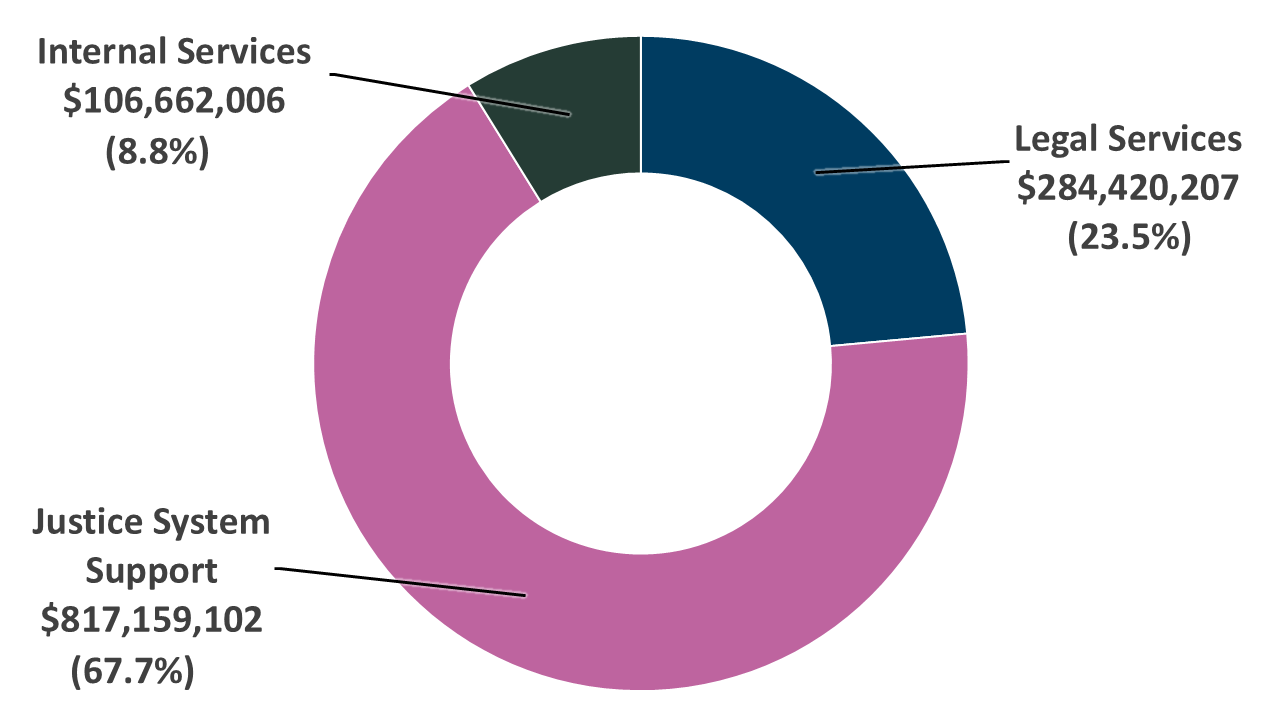
Text version of figure 1
Figure 1 shows that $284,420,207 (or 23.5%) of net actual spending is allocated to the Legal Services core responsibility, $817,159,102 (or 67.7%) of net actual spending is allocated to the Justice System Support core responsibility, and $106,662,006 (or 8.8%) of net actual spending is allocated to support internal services. This represents a total actual spending for 2025–26 of $1,208,241,315.
Analysis of actual spending by core responsibility
The 2025–26 actual spending by core responsibility is in line with expectations as it is consistent with the forecasted spending as published in the 2026–27 Departmental Plan.
As the primary provider of legal services to federal government departments and agencies, the Department has a Vote-Netted Revenue (VNR) authority to collect and spend revenue (respendable revenue) received from the provision of such services. For departmental reporting, this respendable revenue reduces total departmental authorities and operating expenditures.
The Legal Services core responsibility actual spending of $284.4 million is net of legal services revenues of $469.6 million (see Table 11).
The Justice System Support core responsibility actual spending of $817.2 million (see Table 11) includes both operating spending of $63.8 million and grants and contributions spending $753.4 million.
Internal services actual spending of $106.7 million is net of legal services revenues of $66.1 million (see Table 11).
Budgetary performance summary
The table below shows the budget available for 2025–26 and the money that the Department spent in each of the past three years on its core responsibilities and on internal services.
| Core responsibilities and internal services | 2025–26 Main Estimates | 2025–26 total authorities available for use | Actual spending over three years (authorities used) |
|---|---|---|---|
| Legal Services | $280,270,671 | $311,916,728 |
|
| Justice System Support | $793,916,044 | $851,803,394 |
|
| Subtotal | $1,074,186,715 | $1,163,720,122 |
|
| Internal services | $95,922,583 | $110,370,489 |
|
| Total | $1,170,109,298 | $1,274,090,611 |
|
Analysis of the 2025–26 authorities and the past three years of spending
In 2025–26, the Main Estimates totalled $1.17 billion and the total authorities available for use amounted to $1.27 billion, which represents an increase of $104.0 million (8.9%). The total authorities available for use include:
- $102.2 million of funding received through Supplementary Estimates processes, including:
- $56.5 million in grants and contributions program funding received for immigration and refugee legal aid and implementation of Canada's Black Justice Strategy
- $45.7 million in operating funding received mainly for supporting federal legal capacity and for the implementation of the new human resources management system
- $1.8 million received in relation to the operating budget carry forward of prior year authorities, statutory adjustments and other adjustments to authorities
Actual spending in 2025–26 ($1.21 billion) is $65.8 million (5.2%) lower than the total authorities available for use ($1.27 billion). This difference composed of:
- $36.7 million in unspent operating funding mainly related to lower operating and maintenance spending on day-to-day operations
- $29.1 million in unspent grants and contributions funding mainly under the following programs:
- Immigration and Refugee Legal Aid
- Victims Fund
- Impact of Race and Culture Assessments
- Youth Justice Fund
Overall, the Department shows a fluctuating trend in spending over the past three years. Spending decreased by 10.6% from 2024–25 ($1.35 billion) to 2025–26 ($1.21 billion) and increased by 21.7% from 2023–24 ($1.11 billion) to 2024–25 ($1.35 billion). The $142.7 million decrease from 2024–25 to 2025–26 is largely explained by one-time retroactive payments and an associated increase in the employee benefit plan (statutory) in 2024–25 resulting from the ratification of various collective agreements and the Department's implementation of the Comprehensive Expenditure Review and related workforce adjustment measures.
The Finances section of the Infographic for the Department on GC Infobase provides more financial information from previous years.
Planned spending for next three years
The table below shows the Department's planned spending for each of the next three years on its core responsibilities and on internal services.
| Core responsibilities and internal services | 2026–27 planned spending | 2027–28 planned spending | 2028–29 planned spending |
|---|---|---|---|
| Legal Services | $273,540,492 | $263,337,114 | $258,185,364 |
| Justice System Support | $809,329,738 | $757,120,137 | $693,437,928 |
| Subtotal | $1,082,870,230 | $1,020,457,251 | $951,623,292 |
| Internal services | $90,865,301 | $92,370,320 | $85,586,415 |
| Total | $1,173,735,531 | $1,112,827,571 | $1,037,209,707 |
Analysis of the next three years of planned spending
The Department's planned spending shows a decrease from $1.17 billion in 2026–27 to $1.04 billion in 2028–29. This $136.5 million decrease is mainly due to changes in funding for grants and contributions.
The decreases in grants and contributions planned spending are explained by funding reprofiles, reductions to funding profiles and the sunsetting of temporary funding, mainly in the following programs:
- Immigration and Refugee Legal Aid
- Justice Partnership and Innovation Program
- Indigenous Justice Program
- Legal Advice for Complainants of Workplace Sexual Harassment (Legal Aid)
- Access to Justice in Both Official Languages
- Youth Justice Fund
- Impact of Race and Culture Assessments
- Victims Fund
The Finances section of the Infographic for the Department on GC Infobase provides more detailed financial information related to future years.
Budgetary actual gross spending
The table below reconciles gross spending with net spending for 2025–26.
| Core responsibilities and internal services | 2025–26 actual gross spending | 2025–26 actual revenues netted against expenditures | 2025–26 actual net spending (authorities used) |
|---|---|---|---|
| Legal Services | $754,021,211 | $469,601,004 | $284,420,207 |
| Justice System Support | $817,159,102 | $0 | $817,159,102 |
| Subtotal | $1,571,180,313 | $469,601,004 | $1,101,579,309 |
| Internal services | $172,760,351 | $66,098,345 | $106,662,006 |
| Total | $1,743,940,664 | $535,699,349 | $1,208,241,315 |
Analysis of budgetary actual gross spending summary
This table reflects the Department's actual gross spending for 2025–26, which includes the VNR collected of $535.7 million. The revenue collected is distributed between the Legal Services core responsibility and internal services.
The Finances section of the Infographic for the Department on GC Infobase provides information on the alignment of the Department's spending with Government of Canada's spending and activities.
The table below shows the legal services respendable revenue that the Department collected in each of the past three years as well as the vote-net revenue authority (planned VNR).
| Vote-netted Revenue | 2025–26 Main Estimates | Planned VNRFootnote 40 | Actual revenues over three years |
|---|---|---|---|
| Legal Services | $527,000,000 |
|
|
Analysis of departmental Vote-Netted Revenue
In 2025–26, $535.7 million of VNR was generated, representing an increase of $53.0 million compared to 2024–25 ($482.7 million). This is primarily due to an increase in billing rates and demand for legal services from client departments and agencies in such areas as combatting tax evasion, supporting responses to immigration and refugee issues, defending Canadians' interests at home and abroad, facilitating the flow of legitimate travellers and trade, and protecting and conserving Canada's natural heritage.
The Finances section of the Infographic for the Department on GC Infobase offers more detailed financial information related to future years.
Funding
This section provides an overview of the Department's voted and statutory funding for its core responsibilities and for internal services.
The figure below summarizes the Department's approved voted and statutory net actual spending and planned spending from 2023–24 to 2028–29.
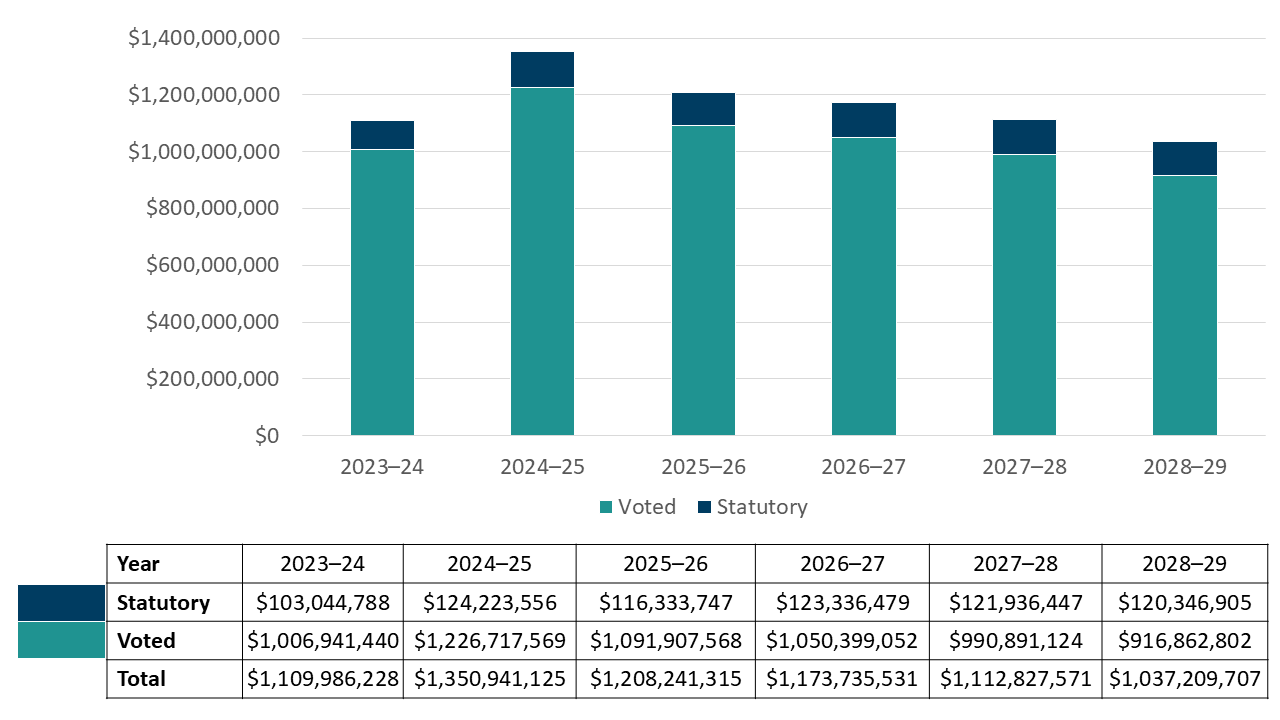
Text version of figure 2
This stacked column graph represents departmental spending trends for six fiscal years for the Department. The graph presents a timeline (in fiscal years) on the horizontal axis and the amount (in millions of dollars) on the vertical axis. The timeline on the horizontal axis shows six columns: one for each fiscal year from 2023–24 on the left through to 2028–29. The columns for fiscal years 2023–24 to 2025–26 show actual spending, while the columns for fiscal years 2026–27 to 2028–29 show planned spending.
The amount of dollars on the vertical axis ranges from 0 on the bottom to 1,400,000,000 on the top. Each column displays an accumulated total of departmental spending for two categories of funding: statutory and voted. These two categories of funding are also displayed numerically below each column to indicate the precise amount of spending (in millions of dollars) for each of the six fiscal years presented.
The first column of the timeline, representing fiscal year 2023–24, displays $103,044,788 in statutory spending and $1,006,941,440 in voted spending, for a total actual spending of $1,109,986,228.
The second column of the timeline, representing fiscal year 2024–25, displays $124,223,556 in statutory spending and $1,226,717,569 in voted spending, for a total actual spending of $1,350,941,125.
The third column of the timeline, representing fiscal year 2025–26, displays $116,333,747 in statutory spending and $1,091,907,568 in voted spending, for a total actual spending of $1,208,241,315.
The fourth column of the timeline, representing fiscal year 2026–27, displays $123,336,479 in statutory spending and $1,050,399,052 in voted spending, for a total planned spending of $1,173,735,531.
The fifth column of the timeline, representing fiscal year 2027–28, displays $121,936,447 in statutory spending and $990,891,124 in voted spending, for a total planned spending of $1,112,827,571.
The sixth and final column of the timeline, representing fiscal year 2028–29, displays $120,346,905 in statutory spending and $916,862,802 in voted spending, for a total planned spending of $1,037,209,707.
Analysis of statutory and voted net actual and planned spending over a six-year period
As illustrated in the graph above, the Department's actual spending shows a fluctuating trend. Actual spending in 2025–26 ($1.21 billion) represents a $142.7 million (10.6%) decrease compared to 2024–25 ($1.35 billion), mainly due to the following:
- decreases in salary spending and an associated decrease in the employee benefit plan (statutory) resulting from one-time retroactive payments in 2024–25, and a decrease in the size of the workforce in 2025–26 due to the Department's implementation of expenditure control measures and reductions
- decreases in operating and maintenance spending, mainly on office equipment, rentals, professional and special services, and travel activities
Consult the Public Accounts of Canada for further information on the Department's voted and statutory expenditures.
Financial statement highlights
This section presents the Department's unaudited financial statements for the year ended March 31, 2026.
Table 13 summarizes the expenses and revenues for 2025–26, which net to the cost of operations before government funding and transfers.
| Financial information | 2025–26 actual results | 2025–26 planned results | Difference (actual results minus planned) |
|---|---|---|---|
| Total expenses | $1,846,101,061 | $1,804,509,646 | $41,591,415 |
| Total revenues | $535,788,364 | $527,000,000 | $8,788,364 |
| Net cost of operations before government funding and transfers | $1,310,312,697 | $1,277,509,646 | $32,803,051 |
Analysis of expenses and revenues for 2025–26
Total expenses by core responsibilities of $1,846.1 million in 2025–26 included $984.8 million (53.3%) of salaries and employee benefits and $737.3 million (39.9%) of transfer payments. Total expenses for 2025–26 exceeded planned results by $41.6 million mainly due to:
- increased demand for legal services from client departments and agencies, resulting in higher overall operating costs
- increased grants and contributions spending related to new funding accessed through Supplementary Estimates B
- paylist expenditures that were not included in planned spending
These increases were partially offset by a reduction in personnel expenditures and related Employee Benefit Plan (EBP) amounts due to lower actual full-time equivalents.
Total revenues amounted to $535.8 million in 2025–26 and were mostly derived from the provision of advisory, litigation and legislative services provided by the Department to other government departments and agencies. Total revenues for 2025–26 exceeded the planned results by $8.8 million (1.7%). This is mainly attributable to the difference between the rates and methodologies used to calculate the planned EBP and the actual EBP.
The 2025–26 planned results information is provided in the Department's Future-Oriented Statement of Operations and Notes 2025–26.
Table 14 summarizes actual expenses and revenues and shows the net cost of operations before government funding and transfers.
| Financial information | 2025–26 actual results | 2024–25 actual results | Difference (2025–26 minus 2024–25) |
|---|---|---|---|
| Total expenses | $1,846,101,061 | $1,955,098,796 | ($108,997,735) |
| Total revenues | $535,788,364 | $482,751,758 | $53,036,606 |
| Net cost of operations before government funding and transfers | $1,310,312,697 | $1,472,347,038 | ($162,034,341) |
Analysis of differences in expenses and revenues between 2024–25 and 2025–26
Total expenses decreased by $109.0 million (5.6%) from 2024–25. This variance is mainly attributable to the following:
- a decrease in salary and employee benefits expenses ($128.1 million or 11.5%), related to the accounting of one-time retroactive payments related to collective bargaining made in 2024–25, and a decrease in full-time equivalent related to expenditure control measures and reductions
- an increase in expenses for grants and contributions spending ($27.8 million or 3.9%), related to increased contribution spending to various initiatives, mainly Immigration and Refugee Legal Aid and Criminal Legal Aid
- a decrease in expenses ($8.7 million) mostly attributable to the following categories: professional and special services; utilities, materials and supplies; and travel and relocation
The figure below outlines the Department's expenses by core responsibility.
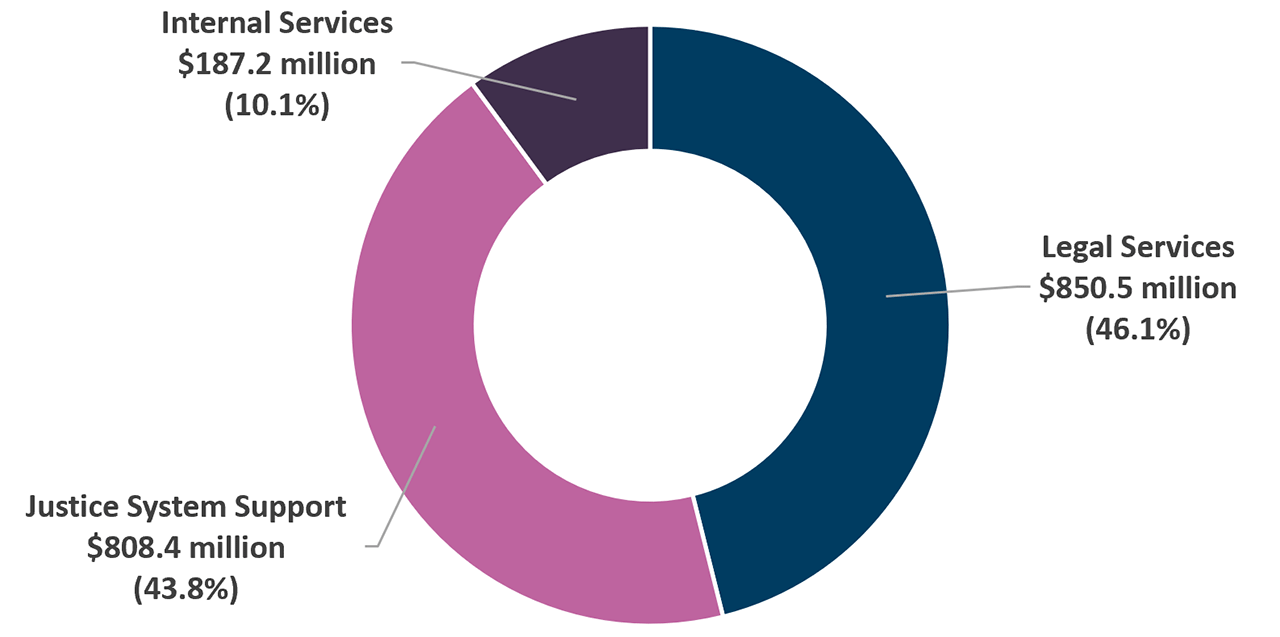
Text version of figure 3
The Department's expenses by core responsibility are broken down as follows:
- $850.5 million for Legal Services (46.1%)
- $808.4 million for Justice System Support (43.8%)
- $187.2 million for internal services (10.1%)
Total revenues increased by $53.0 million (11.0%) from 2024–25. This growth is attributable to the combined effect of higher billing rates and increased demand for legal services. Revenues rose in approximately 65% of client departments, while remaining stable or declining in the remaining departments.
Revenues by type
The figure below presents the Department's gross revenues by type and excludes revenues earned on behalf of the GovernmentFootnote 41 in the amount of $124.7 million.
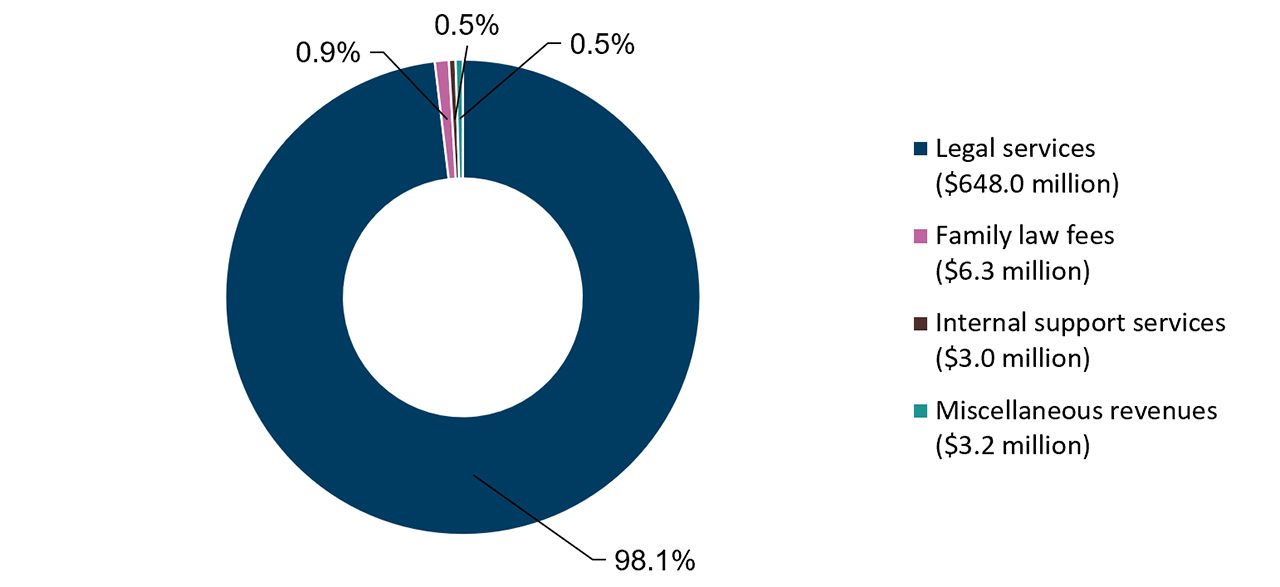
Text version of figure 4
The Department's revenues by type are broken down as follows:
- $648.0 million for legal services (98.1%)
- $6.3 million for family law fees (less than 1%)
- $3.0 million for internal support services (less than 1%)
- $3.2 million for miscellaneous revenues (less than 1%)
Table 15 provides a brief snapshot of the amounts the Department owes or must spend (liabilities) and its available resources (assets), which helps to indicate its ability to carry out programs and services.
| Financial information | Actual fiscal year (2025–26) | Previous fiscal year (2024–25) | Difference (2025–26 minus 2024–25) |
|---|---|---|---|
| Total net liabilities | $522,620,078 | $638,220,024 | ($115,599,946) |
| Total net financial assets | $463,297,627 | $584,493,712 | ($121,196,085) |
| Departmental net debt | $59,322,451 | $53,726,312 | $5,596,139 |
| Total non-financial assets | $19,885,664 | $19,819,802 | $65,862 |
| Departmental net financial position | ($39,436,787) | ($33,906,510) | ($5,530,277) |
Analysis of Department’s liabilities and assets since last fiscal year
From 2024–25 to 2025–26, the Departmental Net Financial Position decreased by $5.5 million due to a number of factors, which are reflected in the information presented below.
Liabilities by type
The net liabilities were $522.6 million at the end of 2025–26, which represents a decrease of $115.6 million (18.1%) from 2024–25. The variance is primarily attributable to a decrease in salary payable at year-end resulting from the one-time retroactive payments related to collective bargaining that were made in 2024–25, a workforce reduction associated with expenditure control measures and reductions, and a decrease in accounts payable related to transfer payments.
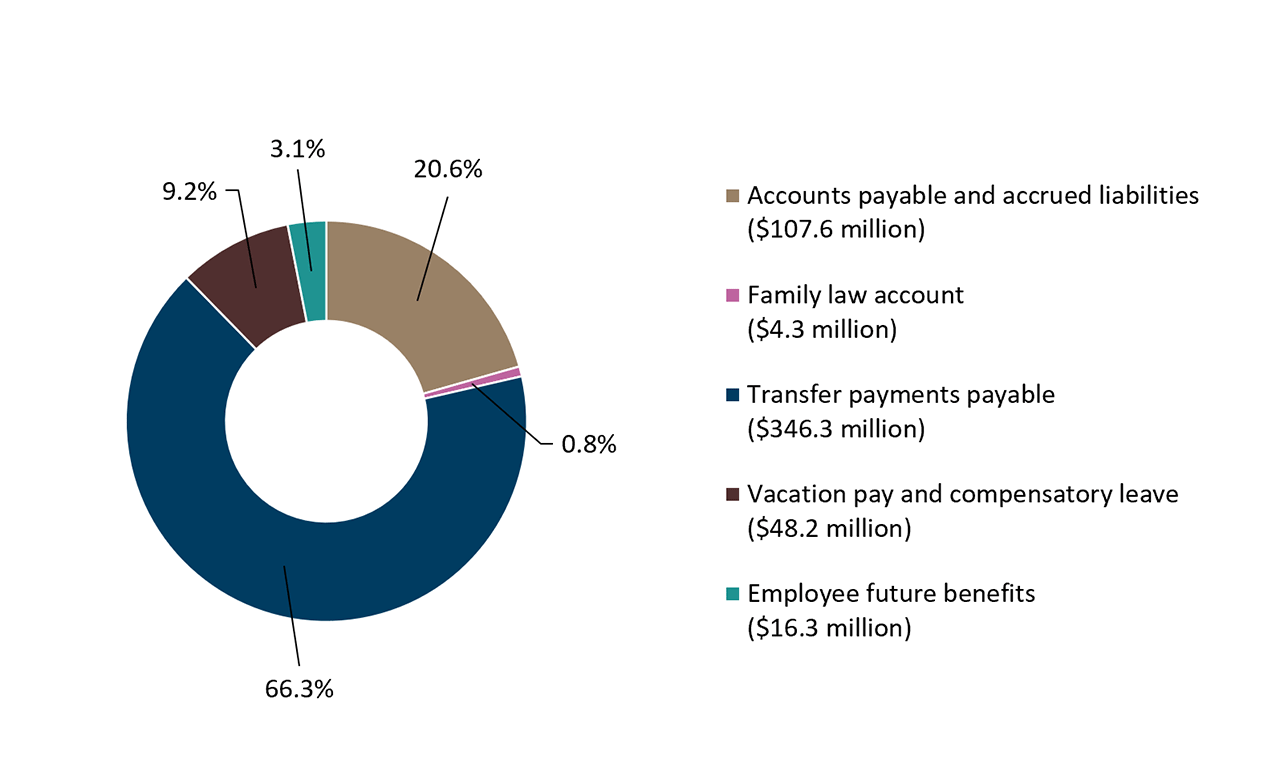
Text version of figure 5
The Department's liabilities by type are broken down as follows:
- $107.6 million for accounts payable and accrued liabilities (20.6%)
- $4.3 million for family law account (0.8%)
- $346.3 million for transfer payments payable (66.3%)
- $48.2 million for vacation pay and compensatory leave (9.2%)
- $16.3 million for employee future benefits (3.1%)
Financial and non-financial assets
The total net financial assets decreased by $121.2 million (20.7%) in 2025–26 as compared to 2024–25. This variance is mainly explained by a decrease in the amount due from the Consolidated Revenue Fund, as a result of the increase in accrued salaries and wages, other government departments transactions and transfer payments payable at year-end.
Total non-financial assets increased by $66 thousand (0.3%) in 2025–26 as compared to 2024–25. This variance is primarily due to increases in spending on office and other equipment.
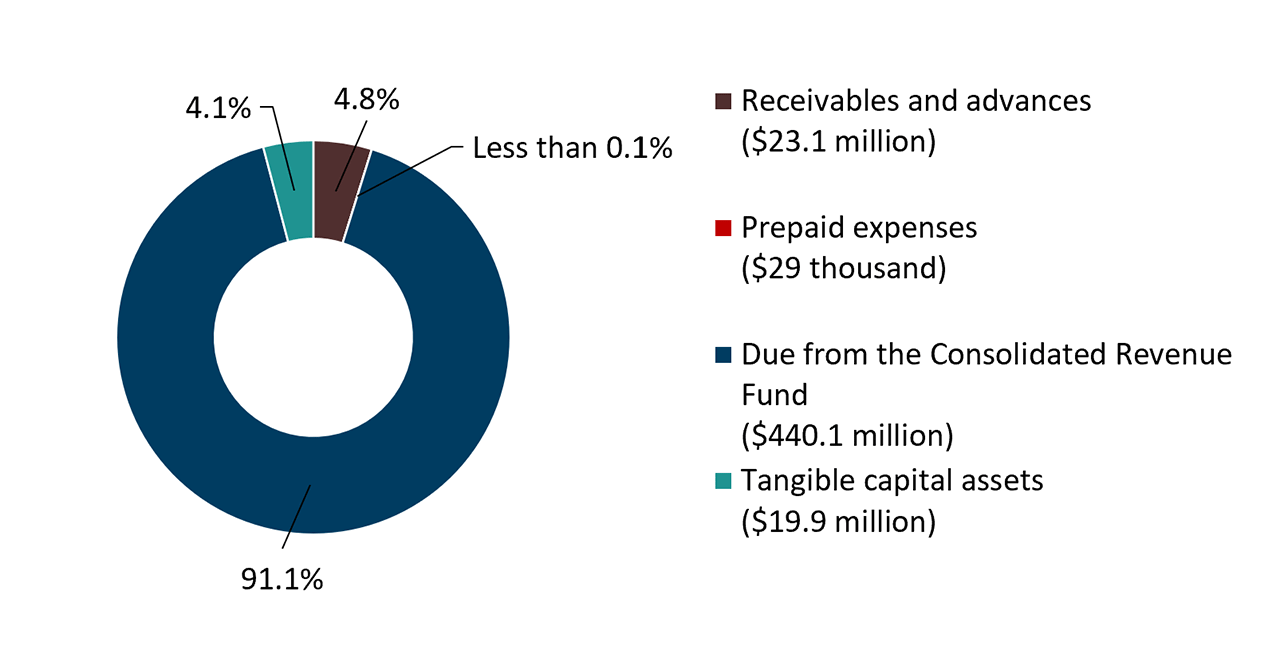
Text version of figure 6
The Department's assets by type are broken down as follows:
- $23.1 million for receivables and advances (4.8%)
- $29,000 for prepaid expenses (less than 0.1%)
- $440.1 million due from the Consolidated Revenue Fund (91.1%)
- $19.9 million for tangible capital assets (4.1%)
Human resources
This section presents an overview of the Department's actual and planned human resources from 2023–24 to 2028–29.
The table below shows a summary of human resources, in full-time equivalents, for the Department's core responsibilities and for its internal services for the previous three fiscal years.
| Core responsibilities and internal services | 2023–24 actual full-time equivalents | 2024–25 actual full-time equivalents | 2025–26 actual full-time equivalents |
|---|---|---|---|
| Legal Services | 3,897 | 4,043 | 3,908 |
| Justice System Support | 390 | 374 | 339 |
| Subtotal | 4,287 | 4,417 | 4,247 |
| Internal services | 1,156 | 1,237 | 1,104 |
| Total | 5,443 | 5,654 | 5,351 |
Analysis of human resources for the last three years
The table above shows a fluctuating trend in human resources. The actual number of full-time equivalents decreased by 303 from 2024–25 (5,654) to 2025–26 (5,351). The most significant decrease was a reduction of 135 full-time equivalents in the Legal Services core responsibility, followed by a reduction of 133 full-time equivalents for internal services due to the Department's implementation of expenditure control measures and planned reductions.
The table below shows information on human resources, in full-time equivalents, for each of the Department's core responsibilities and for its internal services for the next three years.
| Core responsibilities and internal services | 2026–27 planned full-time equivalents | 2027–28 planned full-time equivalents | 2028–29 planned full-time equivalents |
|---|---|---|---|
| Legal Services | 3,878 | 3,836 | 3,807 |
| Justice System Support | 323 | 317 | 317 |
| Subtotal | 4,201 | 4,153 | 4,124 |
| Internal services | 1,065 | 1,057 | 1,055 |
| Total | 5,266 | 5,210 | 5,179 |
Analysis of human resources for the next three years
The Department's planned full-time equivalents for the next three years are forecasted as of October 31, 2025. Due to the timing of forecasts and the information available, the planned full-time equivalents do not include the impact of the following:
- forecasted demand for legal services
- any new initiatives announced in the 2026 Spring Economic Update and upcoming federal Budgets
Supplementary information tables
The following supplementary information tables are available on the Department’s website:
Federal tax expenditures
The tax system can be used to achieve public policy objectives through the application of special measures such as low tax rates, exemptions, deductions, deferrals and credits. The Department of Finance Canada publishes cost estimates and projections for these measures each year in the Report on Federal Tax Expenditures. This report also provides detailed background information on tax expenditures, including descriptions, objectives, historical information and references to related federal spending programs, as well as evaluations and GBA Plus of tax expenditures.
Corporate information
Departmental profile
Appropriate Minister:
The Honourable Sean Fraser, P.C., K.C., M.P.
Institutional head:
Marie-Josée Hogue, Ad. E.
Ministerial portfolio:
Justice
Enabling instrument(s):
Year of incorporation / commencement:
1868
Departmental contact information
Mailing address:
284 Wellington Street
Ottawa, Ontario
Canada K1A 0H8
Telephone:
613-957-4222
TTY:
1-800-465-7735
Email:
Website(s):
Definitions
List of terms
- appropriation (crédit)
- Any authority of Parliament to pay money out of the Consolidated Revenue Fund.
- budgetary expenditures (dépenses budgétaires)
- Operating and capital expenditures; transfer payments to other levels of government, departments or individuals; and payments to Crown corporations.
- core responsibility (responsabilité essentielle)
- An enduring function or role of a department. The departmental results listed for a core responsibility reflect the outcomes that the department seeks to influence or achieve.
- Departmental Plan (plan ministériel)
- A report that outlines the anticipated activities and expected performance of an appropriated department over a three-year period. Departmental Plans are usually tabled in Parliament in spring.
- departmental priority (priorité)
- A plan, project or activity that a department focuses and reports on during a specific planning period. Priorities represent the most important things to be done or those to be addressed first to help achieve the desired departmental results.
- departmental result (résultat ministériel)
- A high-level outcome related to the core responsibilities of a department.
- departmental result indicator (indicateur de résultat ministériel)
- A quantitative or qualitative measure that assesses progress toward a departmental result.
- departmental results framework (cadre ministériel des résultats)
- A framework that connects the department’s core responsibilities to its departmental results and departmental result indicators.
- Departmental Results Report (rapport sur les résultats ministériels)
- A report outlining a department’s accomplishments against the plans, priorities and expected results set out in the corresponding Departmental Plan.
- full-time equivalent (équivalent temps plein)
- Measures the person years in a departmental budget. An employee’s scheduled hours per week divided by the employer’s hours for a full-time workweek calculates a full-time equivalent. For example, an employee who works 20 hours in a 40-hour standard workweek represents a 0.5 full-time equivalent.
- Gender-based Analysis Plus (GBA Plus) (analyse comparative entre les sexes plus [ACS Plus])
- An analytical tool that helps to understand the ways diverse individuals experience policies, programs and other initiatives. Applying GBA Plus to policies, programs and other initiatives helps to identify the different needs of the people affected, the ways to be more responsive and inclusive, and the methods to anticipate and mitigate potential barriers to accessing or benefitting from the initiative. GBA Plus goes beyond biological (sex) and socio-cultural (gender) differences to consider other factors, such as age, disability, education, ethnicity, economic status, geography (including rurality), language, race, religion, and sexual orientation.
- government priorities (priorités pangouvernementales)
- For the purpose of the 2025–26 Departmental Results Report, government priorities are the high-level themes outlining the government’s agenda as announced in the 2025 Speech from the Throne.
- horizontal initiative (initiative horizontale)
- A program, project or other initiative where two or more federal departments receive funding to work collaboratively on a shared outcome usually linked to a government priority, and where the ministers involved agree to designate it as horizontal. Specific reporting requirements apply, including that the lead department must report on combined expenditures and results.
- Indigenous business (entreprise autochtones)
- Requirements for verifying Indigenous businesses for the purposes of the departmental result report are available through the Indigenous Services Canada Mandatory minimum 5% Indigenous procurement target website.
- non‑budgetary expenditures (dépenses non budgétaires)
- Net outlays and receipts related to loans, investments and advances, which change the composition of the financial assets of the Government of Canada.
- performance (rendement)
- What a department did with its resources to achieve its results, how well those results compare to what the department intended to achieve, and how well lessons learned have been identified.
- performance indicator (indicateur de rendement)
- A qualitative or quantitative measure that assesses progress toward a departmental-level or program-level result, or the expected outputs or outcomes of a program, policy or initiative.
- plan (plan)
- The articulation of strategic choices, which provides information on how a department intends to achieve its priorities and associated results. Generally, a plan will explain the logic behind the strategies chosen and tend to focus on actions that lead to the expected result.
- planned spending (dépenses prévues)
- For Departmental Plans and Departmental Results Reports, planned spending refers to the amounts presented in Main Estimates. Departments must determine their planned spending and be able to defend the financial numbers presented in their Departmental Plans and Departmental Results Reports.
- program (programme)
- An individual, group, or combination of services and activities managed together within a department and focused on a specific set of outputs, outcomes or service levels.
- program inventory (répertoire des programmes)
- A listing that identifies all the department’s programs and the resources that contribute to delivering on the department’s core responsibilities and achieving its results.
- result (résultat)
- An outcome or output related to the activities of a department, policy, program or initiative.
- statutory expenditures (dépenses législatives)
- Spending approved through legislation passed in Parliament, other than appropriation acts. The legislation sets out the purpose and the terms and conditions of the expenditures.
- target (cible)
- A quantitative or qualitative, measurable goal that a department, program or initiative plans to achieve within a specified time period.
- voted expenditures (dépenses votées)
- Spending approved annually through an appropriation act passed in Parliament. The vote also outlines the conditions that govern the spending.
- Date modified: