
2 Method
To better understand the legal needs experienced by some Muslims in Canada, a qualitative study was conducted with Muslim adults who have experienced one or more serious legal problems in London or Toronto, Ontario. Participants were recruited via flyers distributed to community and faith-based organizations (e.g., libraries and mosques), non-profits, legal clinics, and halal grocery stores in London and Toronto. Organizations were asked to post the flyers in their facilities and/or share the recruitment material through newsletters, social media, and word of mouth. Flyers were also posted throughout Western University’s campus, and a mass recruitment email was sent to Western students by Western University’s Office of the Registrar.
Recruitment material directed interested individuals to complete an online pre-screening survey (see Appendix A), which was used to assess eligibility and ensure that the participant sample was demographically diverse. To be eligible for the study, individuals were required to be Muslim, 18 years of age or older, and to have experienced a serious problem or dispute in London or Toronto, Ontario within the past three years. The problem or dispute was required to be one that could potentially be addressed through the legal system, though individuals did not need to have accessed the legal system or resolved the problem to be eligible to participate. Examples of serious problems and disputes were presented in the pre-screening survey.
Eligible individuals were invited to take part in a 1.5-hour online interview conducted over Zoom. The interviews were semi-structured and employed an interview guide consisting of central questions and follow-up probes (see Appendix B). This guide was adapted from Sutter and Esses’ (2021) study, “A Qualitative Look at Serious Legal Problems Facing Immigrants in London and Toronto, Ontario,” which was conducted for the Department of Justice Canada as a part of their Series of Qualitative Studies on Serious Legal Problems (https://www.justice.gc.ca/eng/rp-pr/jr/survey-enquete.html). The interview guide included questions related to the type(s) of problem(s) a participant had faced; the strategies they had employed to try to solve the problem(s); and the social, economic, and/or health consequences (if any) that had resulted from the problem(s). The interviews were audio- and video-recorded, as well as transcribed. At the end of the interview, participants were asked a series of demographic questions (see Appendix C) and were provided with a $40 electronic gift card to President’s Choice as a thank-you for their time.
The interviews took place between August and December 2024 and were conducted by two graduate student research assistants from the Faculty of Social Science at Western University. To ensure that the interviews were performed in a rigorous and consistent manner, a training manual was developed and provided to the research assistants. This manual, which was discussed during a team training session, highlighted how to conduct interviews in a culturally sensitive manner, following the interview guides closely while holding space for participants to share their personal—and sometimes sensitive—information at their own pace. The research assistants also received training, guidance, and feedback on their interviewing skills; maintaining confidentiality; note-taking during and after interviews; and using the required technology, such as Zoom and file-sharing software.
Participants were interviewed in the language of their choice. The pre-screening survey and the recruitment flyers were available in English, Arabic, Farsi, and Urdu. All study materials and activities were reviewed and approved by the Western University Non-Medical Research Ethics Board (Project #125010).
2.1 Participant characteristics
A total of 13 Muslim adults were interviewed for this study. Nine of the participants had experienced a serious problem in London, Ontario, while four spoke about problems that they had faced in Toronto. Participant ages ranged from 18 to 47, with an average age of 28 years old, and the majority of participants (8) identified as women (see Figure 1).
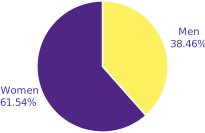
Figure 1. Gender of participants – Text version
The figure shows a pie chart of the distribution of gender of the participants.
- 61.54% women
- 38.46% men
Twelve of the participants were interviewed in English and one was interviewed in Arabic with the help of a professional interpreter, though the languages participants reported most commonly speaking at home spanned five categories (see Figure 2).Footnote 3 All participants rated themselves as more proficient in English than in French (see Figure 3).
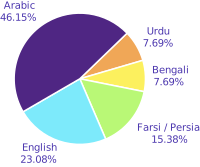
Figure 2. Languages most commonly spoken by participants at home – Text version
The figure shows a pie chart of the distribution of languages most commonly spoken by participants at home, as reported by participants.
- 46.15% Arabic
- 23.08% English
- 15.38% Farsi/Persian
- 7.69% Bengali
- 7.96% Urdu
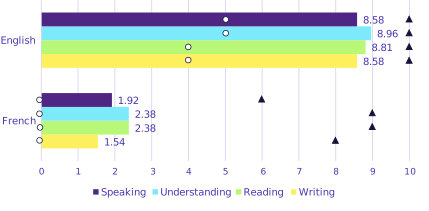
Figure 3. Average self-reported proficiency in English and French – Text version
The figure shows a horizontal bar chart with two categories, one for English and the other for French, both with a range of 0 (“none”) to 10 (“excellent”). Each language has four bars that represent the modalities of language, speaking, understanding, reading, and writing.
The first category shows the self-reported proficiency in English. The scores were:
English speaking:
Highest score: 10
Lowest Score: 5
Mean: 8.58
English Understanding:
Highest score: 10
Lowest Score: 5
Mean: 8.96
English Reading:
Highest score: 10
Lowest Score: 4
Mean: 8.81
English Writing:
Highest score: 10
Lowest Score: 4
Mean: 8.58
The second category shows the self-reported proficiency in French. The scores were:
French speaking:
Highest score: 6
Lowest Score: 0
Mean: 1.92
French Understanding:
Highest score: 9
Lowest Score: 0
Mean: 2.38
French Reading:
Highest score: 9
Lowest Score: 0
Mean: 2.38
French Writing:
Highest score: 8
Lowest Score: 0
Mean: 1.54
Participants’ self-reported racial/ethnic background spanned three categories, with the majority of participants (7) identifying as Arab (see Figure 4).
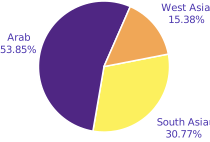
Figure 4. Participants’ self-reported racial/ethnic backgrounds – Text version
The figure shows a pie chart of the distribution of participants’ self-reported racial/ethnic backgrounds.
- 53.85% Arab
- 30.77% South Asian
- 15.38% West Asian
Five participants were born in Canada, while eight had immigrated to Canada within the last two to 11 years. Non-Canadian countries of birth are depicted in Figure 5.
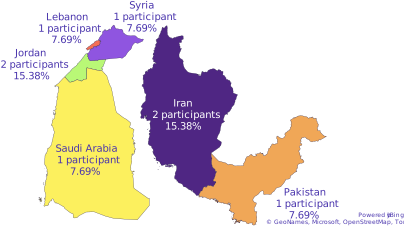
Figure 5. Countries of birth for participants who were not born in Canada – Text version
The figure shows a map of several Middle Eastern countries to show the distribution of countries of birth for participants who were not born in Canada.
- 15.38% Jordan (2 participants)
- 15.38% Iran (2 participants)
- 7.69% Lebanon (1 participant)
- 7.69% Syria (1 participant)
- 7.69% Saudi Arabia (1 participant)
- 7.69% Pakistan (1 participant)
At the time of their interview, 75% of the eight immigrant participants were permanent residents (4) or Canadian citizens (2; see Figure 6).
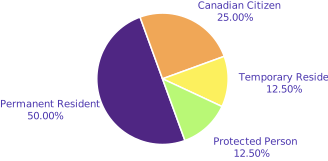
Figure 6. Immigrant participants’ status at the time of the interview – Text version
The figure shows a pie chart of the distribution of Immigrant participants’ status at the time of the interview as reported by participants.
- 50% Permanent Resident
- 25% Canadian Citizen
- 12.5% Temporary resident
- 12.5% Protected Person
The majority of the participants (8) reported having completed some form of postsecondary education (see Figure 7), and many (6) were students at the time of the interview (see Figure 8).
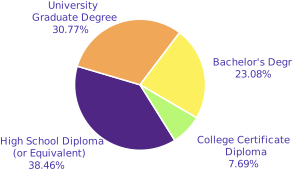
Figure 7. Participants’ highest level of education – Text version
The figure shows a pie chart of the distribution of participants’ highest level of education as reported by participants.
- 38.46% High school diploma (or equivalent)
- 30.77% University Graduate Degree
- 23.08% Bachelor’s Degree
- 7.69% College certificate or diploma
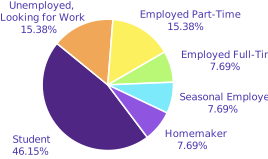
Figure 8. Participants’ occupational situation at the time of the interview – Text version
The figure shows a pie chart of the distribution of participants’ occupational situation at the time of the interview.
- 46.15% Student
- 15.38% Unemployed, looking for work
- 15.38% Employed part-time
- 7.69% Employed full-time
- 7.69% Seasonal employee
- 7.69% Homemaker
One participant did not wish to share their annual household income, and one indicated that they did not have any income to report. Of the other participants, four indicated an annual household income of less than $45,000, two specified an annual income between $45,001 and $80,000, one had an annual income between $80,001 and $130,000, and four replied that their household income was greater than $130,000/year (see Figure 9).
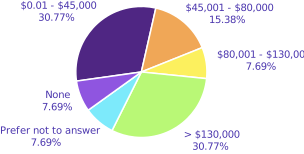
Figure 9. Participants’ estimated annual pre-tax household income – Text version
The figure shows a pie chart of the distribution of participants’ estimated annual pre-tax household income.
- 7.69% Prefer not to answer
- 7.69% None
- 30.77% from $0.01 to $45,000
- 15.38% from $45,001 to $80,000
- 7.69% from $80,001 to $130,000
- 30.77% Greater than $130,000
2.2 Analyses
Data collected during the interviews were analyzed using thematic analysis, meaning that participant responses were coded and sorted to identify common patterns and themes. The analyses were conducted using an intersectionality approach, applying the GBA+ process (Women and Gender Equality Canada, 2022). By employing GBA+, the authors sought to attain a nuanced understanding of how participants’ experiences have been shaped by the various intersecting dimensions of their identities.
Direct quotes from participants have been included throughout the results section with participants’ permission. Quotes have been edited slightly for clarity and brevity. The inclusion of quotes helps to illustrate the major themes identified and further centres the voices and experiences of participants.
Analyses focused on:
- The types of problems faced by participants and the factors that have contributed to these problems;
- The strategies participants employed to resolve their problems, including any challenges and outcomes associated with these strategies;
- If participants sought to solve their problems through recourse to the formal legal system and, if not, why not; and
- The economic, social, and health impacts associated with various problems.
Analyses also considered whether participants’ experiences were related to personal characteristics, such as gender, age, English proficiency, etc. These considerations are in-line with the GBA+ approach, which recognizes that the combination of personal characteristics (as well as external factors) produces outcomes that are unique to each individual or group. The results, therefore, present themes that multiple or all participants had in common, while sometimes presenting findings that were particular to one or a few participants.
2.3 Research challenges
Despite the use of multiple recruitment strategies, the research team faced challenges in recruiting participants for this study. Many potential participants—particularly Muslim women—were hesitant to share their personal concerns about legal issues. Furthermore, some organizations were not open to discussing the potential legal implications surrounding personal and family disputes and were reluctant to share the study information with their membership. As a result, the final sample size is smaller than anticipated. Given the small size of the sample, results have been aggregated across London and Toronto to protect the confidentiality of participants. It should also be noted that this study employed convenience and snowball sampling techniques, meaning that the sample was not selected to be representative of the broader population.
- Date modified: