
Family violence: Results from the 2025 National Family Law Survey of Legal Advisers and Family Justice Professionals
October 2026
Introduction
The Department of Justice Canada (i.e., Justice Canada) has conducted biennial surveys on the experiences and practices of Canadian family legal practitioners since 1998.Footnote 1 These surveys collect information about the characteristics of family law cases and various family law issues. The 2025 National Family Law Survey focused specifically on the experiences of practitioners with some of the Divorce Act amendments that came into force on March 1, 2021, such as the best interests of the child, family violence, relocation, and public legal education and information materials.
This report presents the results from the family violence questions in the 2025 National Family Law Survey. These findings help inform the development of family law policy and programs in Canada.
Methodology
Historically, the National Family Law Surveys were administered at the National Family Law Program Conference. Since 2018, the questionnaire has been distributed as an online survey to increase the number of responses. In 2025, the target audience for the National Family Law Survey was expanded to include the experiences of other family justice professionals, such as mediators, arbitrators and parenting coordinators.
The data collection period for the 2025 National Family Law Survey was open from January 13 to March 11, 2025. Three versions of the survey were circulated: one for legal advisers;Footnote 2 one for family justice professionals; and one for judges. The surveys were similar; however, certain questions were tailored to specific professions and not applicable to other groups. Also, there were instances when questions were altered to reflect the different nature of the professions.
The survey was distributed to legal advisers through the Federation of Law Societies of Canada and the Canadian Bar Association’s Family Law Section. Family justice professionals were invited to participate through Family Mediation Canada and nine provincial mediation and alternative dispute resolution organizations. Some practitioners and organizations were contacted based on the recommendations from members of the Coordinating Committee of Senior Officials – Family Justice, a Federal-Provincial-Territorial committee. Efforts were also made to distribute the survey to judges who hear family law cases through judicial organizations. In total, 178 legal advisers, 97 family justice professionals and 6 judges answered the survey. Since the response rate from judges was low, the experiences of judges will not be presented in this report. Where comparisons are made, only differences that are statistically significant at the 95% confidence level are presented in this report.
The family violence questions were divided into two sections. The first set of questions were asked of every legal adviser and family justice professional respondent. To reduce the length of the survey, only those who agreed to spend an additional five minutes on the survey received the second set of family violence related questions. In total, 126 legal advisers (71% of all legal adviser respondents) and 75 family justice professionals (77% of all family justice professional respondents) agreed to respond to these additional family violence questions.
Limitations
The survey relied on a snowball sampling approachFootnote 3 to be distributed to legal advisers and family justice professionals across Canada. The demographic information collected from respondents as well as the low response rate show that the sample is not representative of those working in the field. For example, a high proportion of responses came from the Prairies (56% of legal adviser respondents and 52% of family justice professional respondents), as well as from professionals who always or almost always take on family law matters (74% of legal advisers and 75% of family justice professionals) and have been working in the area for at least 10 years (75% and 62%). As such, the results in this report should not be generalized to the experiences of all legal advisers and family justice professionals.
At times, comparisons are presented between data from the 2019 Survey of Lawyers and Quebec Notaries on Family Law and Family Violence in Canada and the 2025 National Family Law Survey. Statistical testing has not been applied to determine the significance of any differences that might arise. It is important to remember that the surveys have a different sample size of legal advisers (i.e., 748 to the 2019 survey and 178 to the 2025 survey), which may skew the results.
Findings
Most legal advisers and family justice professionals reported asking their family law clients about family violence during the intake process and at other times during the case.
As shown in Figure 1, most legal advisers (63%) and family justice professionals (89%) reported always or almost always asking their family law clients about family violence when it has not already been raised, either by the client or by the circumstances of the case (e.g., referred by a shelter). The 26-percentage point difference between legal advisers and family justice professionals could be due to the differences between the professions’ requirements. For example, mediators, who represented 47% of the family justice professional respondents, are required to screen for family violence, as the presence or history of family violence can create power imbalances between the parties that mediators may not be able to address in protective ways, whereas legal advisers are not mandated by the Divorce Act to screen clients for family violence.Footnote 4 Only one percent of legal advisers indicated that they never ask about family violence during the intake process, with no family justice professionals having selected that response.
While it is not possible to look at trends over time for family justice professionals, as the 2025 survey marks the first time their experiences were included in the national family law surveys, comparable data are available for legal advisers’ responses. In 2019, 44% of legal advisers stated that they always ask clients about family violence when it has not already been raised.Footnote 5 The higher proportion of legal advisers who report always or almost always asking their clients about family violence in 2025 could be, in part, due to the increased awareness of family violence in family law matters after the coming into force of the 2021 Divorce Act amendments, which added a family violence definition into the legislation and now require the court to consider the impact of family violence on parenting and contact arrangements.
Figure 1. Proportion of legal advisers and family justice professionals by their frequency asking about family violence when it had not been raised by the client or the circumstances of the case, 2019 and 2025
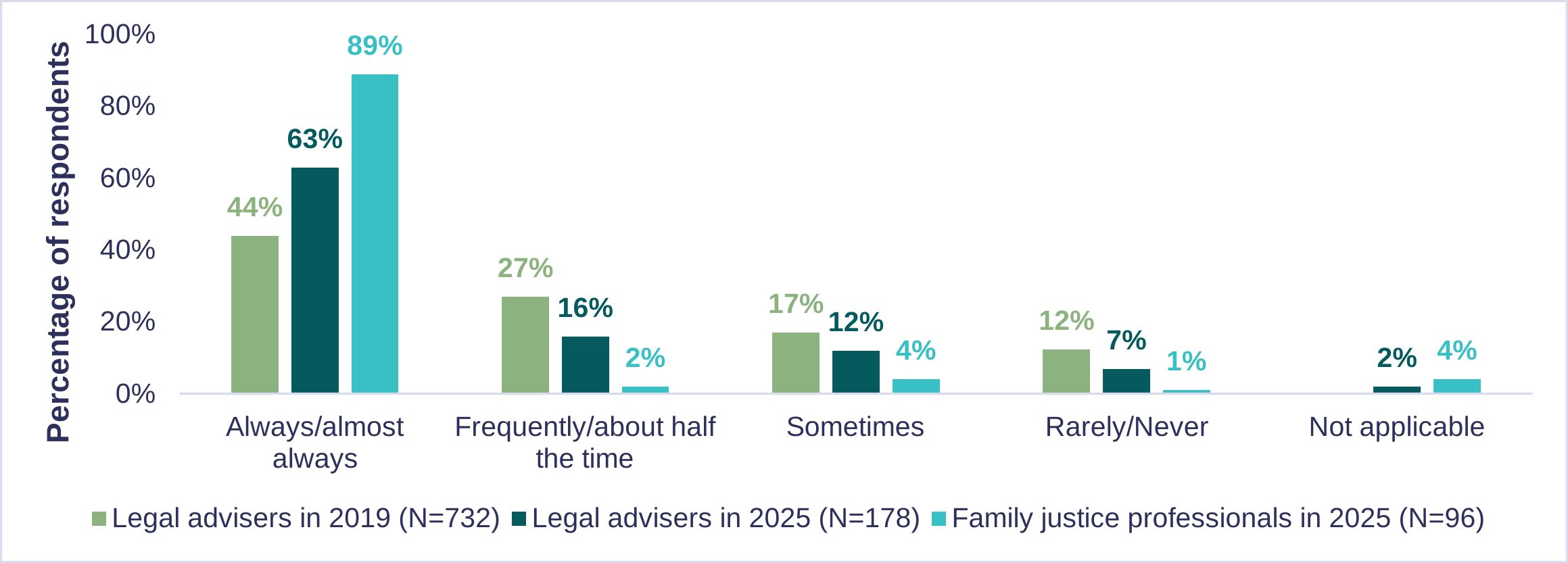
Figure 1. Proportion of legal advisers and family justice professionals by their frequency asking about family violence when it had not been raised by the client or the circumstances of the case, 2019 and 2025 – Text version
This image is a grouped vertical bar chart entitled “Proportion of legal advisers and family justice professionals by their frequency asking about family violence when it had not been raised by the client or the circumstances of the case, 2019 and 2025.” It compares responses from three groups: Legal advisers in 2019 (N=732), Legal advisers in 2025 (N=178), and Family justice professionals in 2025 (N=96). The vertical axis shows the percentage of respondents from 0% to 100%, and the horizontal axis shows the frequency with which respondents asked about family violence when it had not already been raised by the client or indicated by the circumstances of the case.
Always/almost always:
- 44% of legal advisers in 2019
- 63% of legal advisers in 2025
- 89% of family justice professionals in 2025
Frequently/about half the time:
- 27% of legal advisers in 2019
- 16% of legal advisers in 2025
- 2% of family justice professionals in 2025
Sometimes:
- 17% of legal advisers in 2019
- 12% of legal advisers in 2025
- 4% of family justice professionals in 2025
Rarely/Never:
- 12% of legal advisers in 2019
- 7% of legal advisers in 2025
- 1% of family justice professionals in 2025
Not applicable:
- 0% of legal advisers in 2019
- 2% of legal advisers in 2025
- 4% of family justice professionals in 2025
Approximately four in five legal advisers (83%) and family justice professionals (79%) reported asking their clients about family violence at other times in the case to see if it is a concern. A small proportion of legal advisers (13%) and family justice professionals (9%) indicated that they do not ask their clients about family violence at other times in the case. Of the respondents who ask their clients about family violence at different times in their cases, most reported asking every client regardless of any previous disclosure (58% of legal advisers and 78% of family justice professionals). Others indicated that they only ask clients about family violence at other times in the case if there was prior disclosure (15% and 5%, respectively). Respondents were also able to share other situations in which they ask their clients about family violence. The most common other response was that it is situationally dependent on whether the client presents certain signs or makes certain statements.
While most legal advisers reported relying on their professional judgement and experience when asking clients about family violence, similar proportions of family justice professionals used their professional judgement and a tool or questionnaire.
Nine in ten legal advisers (90%) reported using their professional judgement and experience when asking a client about family violence (see Figure 2 below), and they were significantly more likely to report this compared to family justice professionals (71%).Footnote 6 The inverse was also true, as family justice professionals were significantly more likely to report using a tool or questionnaire (66%) compared to legal advisers (23%). Overall, similar proportions of family justice professionals reported using their professional judgement and experience and a tool or questionnaire, and legal advisers were significantly more likely to use their professional judgement as opposed to a tool or questionnaire. The most common tool used by both legal advisers and family justice professionals was a custom or internal tool that they developed or that was developed by their organization. Among legal advisers, these findings are consistent with the results from the 2019 survey, where 86% of legal advisers also reported relying on their professional judgement and experience and few legal advisers (7%) reported using a tool or questionnaire to ask clients about family violence.Footnote 7
A small proportion of legal advisers (8%) and family justice professionals (13%) reported using a screening service to ask clients about family violence. Screening services are defined as the outsourcing of the family violence screening on behalf of the legal adviser or family justice professional, such as a specific colleague within their organization or the use of a third-party organization.
Respondents were able to select multiple approaches. Legal advisers (64%) were significantly more likely than family justice professionals (35%) to report using only one approach, while family justice professionals were significantly more likely to have selected three approaches (27%) compared to legal advisers (8%).Footnote 8 This may explain why a considerably higher proportion of legal advisers reported relying on their professional judgment and experience instead of a tool or an adapted tool, while similar proportions of family justice professionals reported using their professional judgement and a tool or questionnaire.
Figure 2. Proportion of legal advisers and family justice professionals by their approach(es) to asking about family violence, 2025
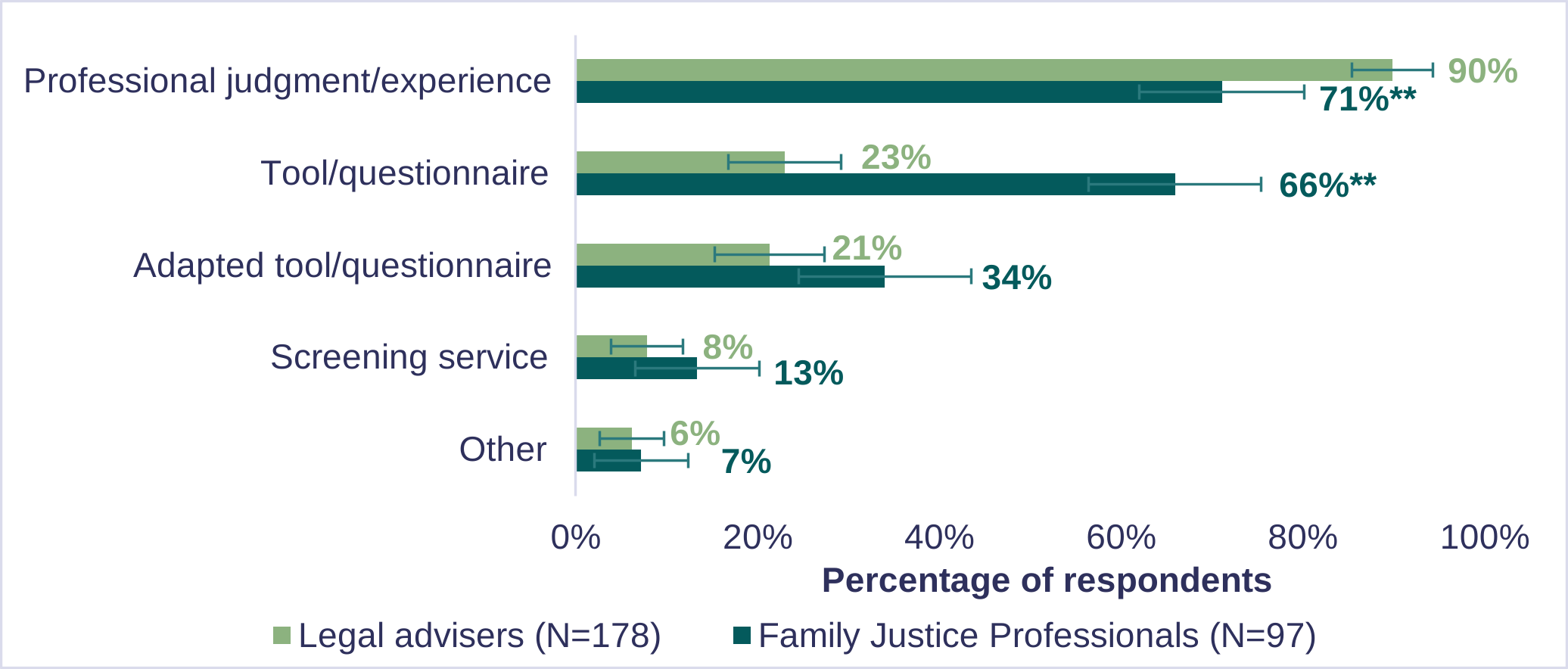
Figure 2. Proportion of legal advisers and family justice professionals by their approach(es) to asking about family violence, 2025 – Text version
This image is a horizontal bar chart entitled “Proportion of legal advisers and family justice professionals by their approach(es) to asking about family violence, 2025.” It shows the percentages of two respondent groups; Legal advisers (N=178) and Family justice professionals (N=97). The horizontal axis shows the percentage of respondents from 0% to 100% and the vertical axis shows approaches used when asking about family violence. Each bar includes error bars indicating confidence intervals on the reported percentages.
Professional judgment/experience:
- 90% of legal advisers
- 71%Figure 2 footnote ** of family justice professionals
Tool/questionnaire:
- 23% of legal advisers
- 66%Figure 2 footnote ** of family justice professionals
Adapted tool/questionnaire:
- 21% of legal advisers
- 34% of family justice professionals
Screening service:
- 8% of legal advisers
- 13% of family justice professionals
Other approach:
- 6% of legal advisers
- 7% of family justice professionals
Over one in three respondents indicated that concurrent legal proceedings occur more than half of the time when a case involves family violence.
Family violence is an issue that is not only addressed through the family justice system, but also through other systems, such as the criminal justice, child protection and civil justice systems. Over one-third of legal advisers (35%) and family justice professionals (38%) shared that concurrent legal proceedings or orders occur more than half the time in their cases involving family violence. In contrast, most legal advisers (62%) and family justice professionals (56%) reported that concurrent legal proceedings or orders occur sometimes or rarely in their cases. While concurrent legal proceedings may not occur frequently, few respondents indicated that they never see concurrent legal proceedings or orders (1% of legal advisers and 2% of family justice professionals).
Although most respondents reported that concurrent legal proceedings occur less than half the time in their cases involving family violence, this does not mean that the cases did not meet the threshold of being involved with other systems. For instance, research shows that family violence victims can be reluctant to report to the police and/or child protection for several reasons, for example, a mistrust of the justice system, fear of reprisal directed at them or their children, economic and/or emotional dependency on their perpetrator, and fear of their children being taken away.Footnote 9
Over two in three respondents indicated that supervised parenting time or exchanges and prohibiting one party from contacting the other are the most frequent remedies in cases involving family violence.
Respondents were asked to rank the three most frequent remedies used in cases involving family violence. Legal advisers were asked about the most frequent court-ordered remedies, whereas family justice professionals were asked about the most frequent remedies in family dispute resolution processes. Because of these differences, legal advisers were given a longer list of possible remedies, which included parenting time and decision-making responsibility being denied to the abusive parent.
As reported by legal advisers, the top three most frequent court-ordered remedies in cases involving family violence were supervised parenting time or exchange (72%), prohibiting a party from contacting the other party (69%) and prohibiting the removal of the children (32%). Approximately one in three legal advisers (29%) indicated that denying decision-making responsibility to the abusive parent was one of the three most frequent court-ordered remedies. Legal advisers reported that denying parenting time to the abusive parent was infrequent, with only 10% selecting it as one of the three most frequent court-ordered remedies.
Among family justice professionals, the top three most frequent remedies in family dispute resolution processes for cases involving family violence were prohibiting a party from contacting the other party (79%), supervised parenting time or exchange (75%), and prohibiting a party from contacting the children (47%). Over two in five (45%) family justice professionals reported that prohibiting the removal of the children was one of the three most frequently used remedies in alternative dispute resolution processes. Overall, over two in three respondents selected supervised parenting time or exchange and prohibiting a party from contacting the other party as two of the three most frequently used remedies in family law cases involving family violence.
Over a quarter of legal advisers agreed that the courts are adequately addressing family violence in their cases involving parenting orders.
Legal advisers were specifically asked whether the courts are adequately addressing family violence in parenting orders in their family law cases. Approximately one in four (26%) agreed and one in five (21%) neither agreed nor disagreed with the statement.Footnote 10 In contrast, over two in five (43%) legal advisers disagreed that courts are adequately addressing family violence in parenting orders.
Most respondents were at least slightly familiar with family violence services and about half reported always or almost always recommending these services to their clients.
Over two in five (45%) legal advisers and almost two in three (64%) family justice professionals indicated that they were very or extremely familiar with family violence services available to clients. All family justice professionals reported being at least slightly familiar with these services, with 2% of legal advisers reporting not being familiar with these services at all.
Similar proportions of legal advisers and family justice professionals (49% and 49%) reported always or almost always recommending family violence services to their clients when the case involved family violence. Over one in four legal advisers (28%) and family justice professionals (27%) indicated they rarely or sometimes recommend these services, and a small proportion reported never recommending these services (2% of legal advisers and 1% of family justice professionals).
Respondents were also asked to rank the top three most frequently used services in their family law cases involving family violence. Consistent with results from 2019,Footnote 11 the three topmost frequently used services reported by legal advisers were counselling (48% in 2025; 48% in 2019), police (47%; 44%) and child protection (36%; 44%). Family justice professionals reported that the three topmost frequently used services by their clients were police services (40%), safer living arrangements (37%), such as shelters, and safety planning services (37%). Less than one in four respondents reported that parent education and information programs (10% of legal advisers and 24% of family justice professionals) and risk assessment services (5% and 18%) were the most frequently used services by their clients.
One in three legal advisers noticed a change in how family courts address family violence, noting an increase in the courts’ awareness and consideration since the 2021 amendments came into force.
Almost one-third of legal advisers (31%) reported that they had noticed a change in the way courts address family violence since the Divorce Act amendments came into force in 2021. Of the legal advisers who noticed a change, 78% indicated that they were seeing more awareness and consideration from the courts about family violence. The remaining legal advisers either did not notice a change in the way courts address family violence in their family law cases between the time the 2021 Divorce Act amendments came into force and the early 2025 survey (44%) or did not know if there was a change (20%).
Over half of respondents agreed that their family violence knowledge increased because of the 2021 amendments and the materials developed by Justice Canada.
More than half of legal advisers (54%) and family justice professionals (57%) agreed that the 2021 Divorce Act amendments related to family violence and the materials developed by Justice Canada contributed to an increase in their knowledge of family violence, including the role it plays in deciding parenting arrangements in the best interests of the children post-separation or divorce. Less than a quarter of respondents disagreed with the statement (24% of legal advisers and 12% of family justice professionals). These results highlight that the amendments and related materials developed by Justice Canada may have contributed to an increase in legal professionals’ knowledge of family violence.
Less than one in two respondents agreed that the 2021 amendments and Justice Canada materials contributed to an increase in their clients’ awareness of the impact of family violence.
Approximately one in three legal advisers reported disagreeing (35%), neither agreeing nor disagreeing (32%), and agreeing (31%) that their clients’ level of awareness of the impact of family violence on them and their children increased because of the Divorce Act amendments and the materials developed by Justice Canada. Among family justice professionals, almost half agreed (46%), while one in five (20%) disagreed that their clients’ awareness of the impact of family violence on them and their children had increased. The remaining family justice professionals (28%) neither agreed nor disagreed that their clients’ awareness had increased.
The low awareness of the impact of family violence among respondents’ clients could be, in part, due to Canadians’ low level of knowledge about the family justice system.Footnote 12 This low knowledge about the family justice system would also extend to the recent Divorce Act amendments and the related materials prepared by Justice Canada. According to previous research, most victims of spousal violence tend to minimize their experiences, for example, feeling that it was minor, that no one was harmed or that it was not important enough.Footnote 13 This minimization could also be, in part, why respondents’ clients may not be aware of the impact of family violence.
Half or more of respondents reported being aware of Justice Canada’s public legal and education information materials on family violence, but fewer were aware of the family violence fact sheet and training course.
After the 2021 Divorce Act amendments received Royal Assent, Justice Canada developed and updated its public legal and education information (PLEI) materials on the topic of family violence, such as the Making Plans guide, the Parenting Plan Tool and Checklist, and the What Happens Next booklet. Justice Canada also published a Fact Sheet on Divorce and Family Violence and a free course on Family Violence and Family Law for Legal Advisers. In 2022, after working with many different family violence and family law experts as well as legal advisers, Justice Canada published the HELP Toolkit: Identifying and Responding to Family Violence for Family Law Legal Advisers (https://www.justice.gc.ca/eng/fl-df/help-aide/index.html).
The National Family Law Survey asked several questions about respondents’ awareness of different Justice Canada products, including the family violence products listed above. Not only were most respondents aware of the family violence related PLEI materials, but legal advisers and family justice professionals were also significantly more likely to report being aware of (50% of legal advisers and 58% of family justice professionals) and having recommended to others (20% and 31%) these PLEI materials compared to the family violence fact sheet, the family violence training course and the HELP Toolkit (see Figure 3).Footnote 14
The product with the second highest awareness levels among respondents was the HELP Toolkit (33% of legal advisers and 35% of family justice professionals). A higher proportion of family justice professionals however reported being unawareFootnote 15 of the HELP Toolkit (36%) compared to legal advisers (29%). Although the difference between the two professions were not significant, this difference could be, in part, because the HELP Toolkit was designed for and targeted to legal advisers.
Most legal advisers (62%) and family justice professionals (59%) reported being unaware of the fact sheet on divorce and family violence. However, when looking at awareness levels, the family violence course had the lowest proportion of respondents who reported having taken (15% of legal advisers and 10% of family justice professionals), having used (9% and 8%) and/or having recommended it (5% and 7%). For more information on the respondents’ awareness levels with PLEI materials, please see Awareness of Justice Canada Products: Results from the 2025 National Family Law Survey of Legal Advisers and Family Justice Professionals.
Figure 3. Proportion of legal advisers’ and family justice professionals’ awareness with Justice Canada’s family violence related products, 2025
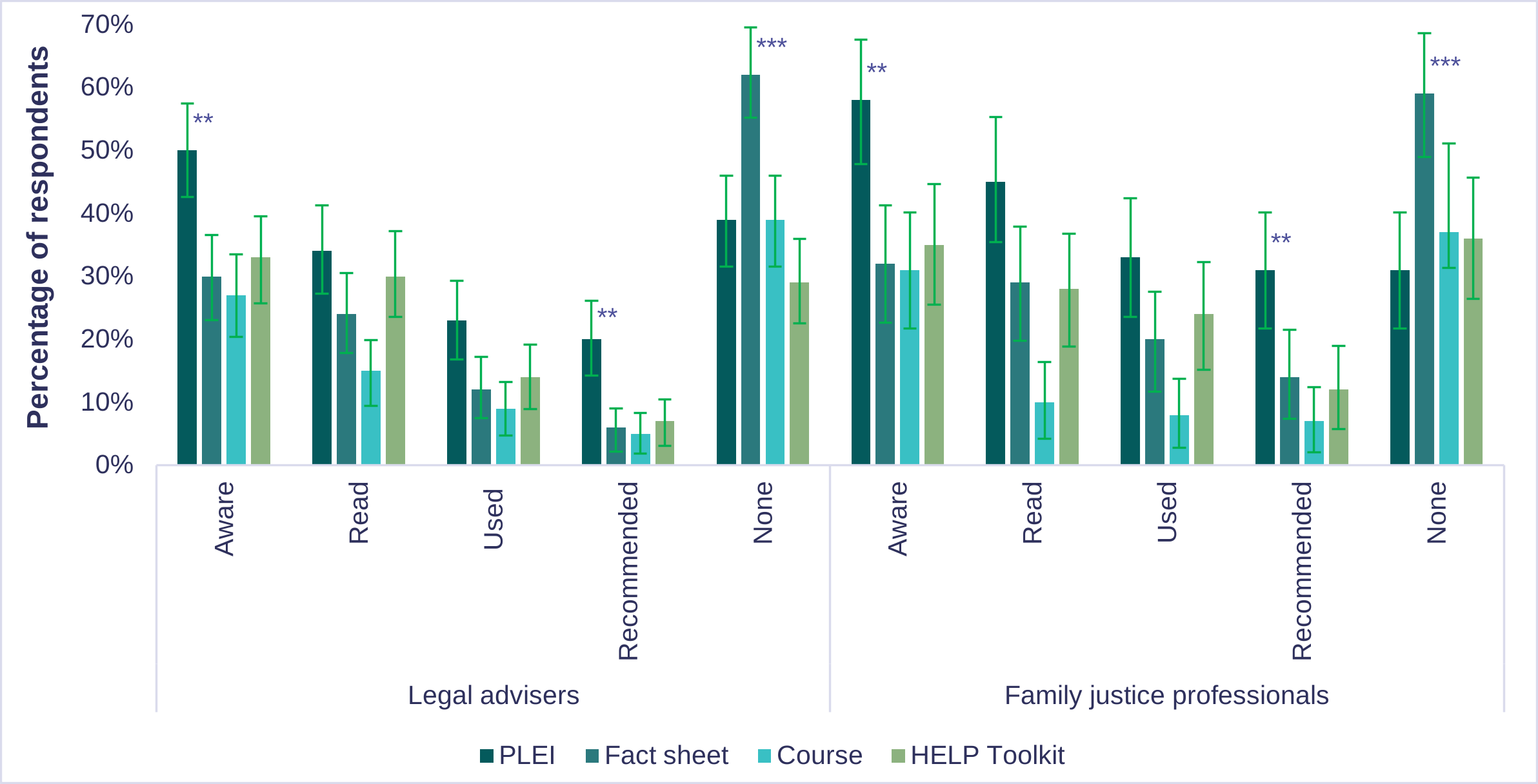
Figure 3. Proportion of legal advisers’ and family justice professionals’ awareness with Justice Canada’s family violence related products, 2025 – Text version
This is a clustered bar chart entitled “Proportion of legal advisers’ and family justice professionals’ awareness with Justice Canada’s family violence related products, 2025.” It shows the percentages of two respondent groups : Legal advisers and Family justice professionals. The horizontal axis shows whether respondents were aware of, read, used, recommended, or had no awareness of four Justice Canada family violence-related products: PLEI, Fact Sheet, Course, and HELP Toolkit. The vertical axis shows the percentage of respondents from 0% to 70%. Each bar includes error bars indicating confidence intervals on the reported percentages.
Legal advisers are aware of
- 50%Figure 3 footnote ** – PLEI products (significantly different from the other family violence products)
- 30% – Fact sheets
- 27% – Courses
- 33% – HELP Toolkit
Legal advisors have read
- 34% – PLEI products
- 24% – Fact sheet
- 15% – Course
- 30% – HELP Toolkit
Legal advisors have used
- 23% – PLEI products
- 12% – Fact sheet
- 9% – Course
- 14% – HELP Toolkit
Legal advisors have recommended
- 20%Figure 3 footnote ** – PLEI products (significantly different from the other family violence products)
- 6% – Fact sheet
- 5% – Course
- 7% – HELP Toolkit
Legal advisors are unaware of
- 39% – PLEI products
- 62%Figure 3 footnote *** – Fact sheet (statistically different from being aware of, having read, having used and having recommended the fact sheet)
- 39% – Course
- 29% – HELP Toolkit
Family justice professionals are aware of
- 58%Figure 3 footnote ** – PLEI products (significantly different from the other family violence products)
- 32% – Fact sheet
- 31% – Course
- 35% – HELP Toolkit
Family justice professionals have read
- 45% – PLEI products
- 29% – Fact sheet
- 10% – Course
- 28% – HELP Toolkit
Family justice professionals have used
- 33% – PLEI products
- 20% – Fact sheet
- 8% – Course
- 24% – HELP Toolkit
Family justice professionals have recommended
- 31%Figure 3 footnote ** – PLEI products (significantly different from the other family violence products)
- 14% – Fact sheet
- 7% – Course
- 12% – HELP Toolkit
Family justice professionals are unaware of
- 31% – PLEI products
- 59%Figure 3 footnote *** – Fact sheet (statistically different from being aware of, having read, having used and having recommended the fact sheet)
- 37% – Course
- 36% – HELP Toolkit
Most legal advisers and family justice professionals indicated that the information in the HELP Toolkit has been useful when working with clients to identify and respond to family violence.
Respondents who reported being aware of the HELP Toolkit were asked whether the HELP Toolkit has been useful to them when working with clients. A higher proportion of legal advisers (71%) and family justice professionals (87%) reported that the HELP Toolkit is useful when working with their clients to identify and respond to family violence, compared to the proportion who reported that the toolkit was not useful (29% and 13%, respectively). These findings are consistent with results obtained when testing the draft HELP Toolkit in legal advisers’ practices across the country in 2021, where participating legal advisers also found the HELP Toolkit to be useful.Footnote 16
Conclusion
This report summarized the findings from the 2025 National Family Law Survey’s family violence related questions. A new development from the 2025 National Family Law Survey was the inclusion of family justice professionals’ experiences. It will be important to continue collecting survey responses from these professionals to monitor any trends over time. While some of the results point towards a positive step, such as the high proportions of legal advisers and family justice professionals who always or almost always ask their clients about family violence during the intake process and throughout the case, it is important to remember that these findings cannot be generalized as only a small proportion of legal advisers (n=178) and family justice professionals (n=97) answered the survey.
The survey results provided timely information about legal professionals’ experiences with the family violence provisions that came into force with the 2021 Divorce Act amendments. According to respondents, the amendments, along with materials developed by Justice Canada, have contributed to an increase in their knowledge of family violence. One in three legal advisers also reported noticing a change in how family courts have addressed family violence, particularly an increased awareness and consideration of family violence by the courts. However, the survey was circulated less than four years after the amendments came into force and it can take time to see the impacts of legislative changes. Ongoing monitoring of the updated legislation will help to inform whether more changes are observed over time.
Following the 2021 Divorce Act amendments, Justice Canada produced several products to increase awareness of family violence and the new legislative changes. Most respondents were aware of the family violence related PLEI materials, while less than half were aware of the family violence course, the family violence and divorce fact sheet and the HELP Toolkit. Including questions about these specific products within the survey helped to gain a better understanding of what products legal professionals are aware of and inform what further distribution efforts may be needed to increase awareness among this audience. The survey also helped to increase professionals’ awareness of these products. Several legal advisers and family justice professionals contacted Justice Canada to ask for a list of family law products following their completion of the survey. These results provide a baseline and, in the future, when similar questions are asked, they will help inform whether future knowledge mobilization efforts are leading to an increase in awareness of Justice Canada products.
For more information, please contact:
Rsd-drs@justice.gc.ca
Family violence: Results from the 2025 National Family Law Survey of Legal Advisers and Family Justice Professionals
J4-208/2026E-PDF
978-1-100-00838-7
- Date modified: